- The Republican "One Big Beautiful Bill" bundles popular provisions (TCJA extension: 58% support) with deeply unpopular ones (cut Medicaid by $700B: 67% oppose; remove 10M+ from coverage: 73% oppose) — a framing battle that will define 2026 advertising.
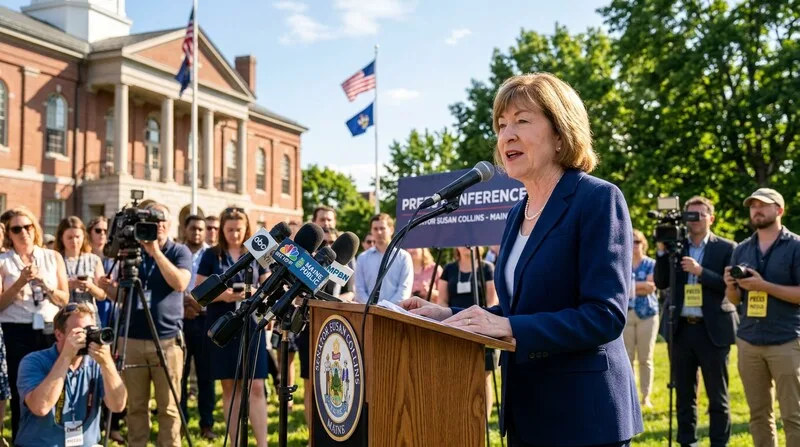
- Republicans can afford to lose only 2 Senate votes with VP Vance as tiebreaker; Collins and Murkowski are the decisive moderates, both representing states with large Medicaid populations.
- CBO projects $3–4 trillion in added deficits over 10 years from the TCJA extension alone — with Medicaid cuts as the primary offset mechanism, making healthcare access the central fiscal and political tension of the bill.
- The Medicaid framing gap is the strategic battlefield: "work requirements" (-5 net) polls far better than "remove 10 million people from coverage" (-59 net) — which is why Democrats will spend 2026 using the latter framing exclusively.
The "One Big Beautiful Bill"
President Trump has pushed congressional Republicans to pass a comprehensive budget reconciliation package that he has called the "One Big Beautiful Bill" — a legislative vehicle that combines tax policy, spending cuts, immigration enforcement, and energy deregulation into a single package that can pass the Senate with 51 votes rather than the 60 required to overcome the filibuster. The reconciliation process is a powerful but limited tool: the Senate Parliamentarian must certify that each provision has a direct budgetary impact, preventing the inclusion of policy changes that are merely tangentially fiscal. Republicans are navigating these constraints while trying to hold together a coalition of conservatives who want deep spending cuts and moderates representing competitive districts who fear the political backlash.
The bill's core provisions as of spring 2026 include: extension of the 2017 Tax Cuts and Jobs Act provisions set to expire in 2025-2026 (primarily the individual rate cuts and the doubled standard deduction); new Medicaid work requirements for non-elderly, non-disabled adults; increased border security and immigration enforcement funding; rollback of IRA clean energy provisions; and SNAP (food stamp) eligibility tightening. The fiscal score from the Congressional Budget Office projects a net increase in the deficit of approximately $3-4 trillion over 10 years, mostly driven by the TCJA extension. Republican deficit hawks have demanded offsetting cuts; the primary offset mechanism is the Medicaid restructuring, which CBO estimates reduces federal Medicaid spending by $700+ billion over 10 years — achieved through work requirements, per-capita caps on state funding, and eligibility changes that CBO projects will result in 10+ million people losing Medicaid coverage.
The Medicaid provisions are the most politically explosive element. Senators Susan Collins (Maine) and Lisa Murkowski (Alaska) — both of whom represent states with significant Medicaid populations and face re-election in 2026 or 2028 in blue-leaning states — have publicly expressed concern about the scale of Medicaid cuts. Their votes are potentially decisive: with 53 Republican senators and a 51-vote threshold, Republicans can only lose 2 members and pass the bill (with VP Vance as tiebreaker). The negotiations over the bill's Medicaid language have been the central drama of the 119th Congress's first session.

Key Provisions & Polling
| Provision | Support | Oppose | Net |
|---|---|---|---|
| Extend TCJA tax cuts | 58% | 35% | +23 |
| Increase border security funding | 54% | 39% | +15 |
| Medicaid work requirements | 44% | 49% | −5 |
| Cut Medicaid spending by $700B | 21% | 67% | −46 |
| Remove 10M+ from Medicaid | 14% | 73% | −59 |
| Rollback IRA clean energy | 31% | 52% | −21 |
| Tighten SNAP eligibility | 36% | 54% | −18 |
Source: Polling averages from AP-NORC, Quinnipiac, Morning Consult, March-April 2026. Note the distinction between "work requirements" (+slight opposition) and "remove 10M from coverage" (-59 net) — Republicans frame as the former, Democrats frame as the latter.
The Senate Vote Math
Firm Yes (R)
~49 Republicans who have publicly supported or signaled support for the reconciliation package. Freedom Caucus conservatives have demanded the bill go further on spending cuts; leadership has resisted to keep moderates on board.
Key Swing Votes
Susan Collins (ME): Lean R seat, raised Medicaid concerns publicly. Lisa Murkowski (AK): Lean R, Alaska has one of the highest Medicaid enrollment rates in the country. Thom Tillis (NC): Competitive 2026 race, hospital industry concerns about Medicaid cuts. Jerry Moran (KS): Rural hospital closures from Medicaid cuts.
All Democrats: No
All 47 Democratic and Independent senators have signaled opposition. Democrats will use the "vote-a-rama" amendment process to force Republicans to take difficult votes on Social Security, Medicare, and specific healthcare provisions — creating campaign ad material regardless of whether the amendments pass.
Why This Bill Defines 2026
Budget reconciliation bills become the central campaign issue in the next election with remarkable regularity. The 2010 midterms were dominated by the Affordable Care Act, which had passed via reconciliation. The 2018 midterms featured Democratic attacks on the Tax Cuts and Jobs Act (particularly the SALT cap) that drove suburban Republican losses. The 2026 midterms are almost certain to be fought primarily over the reconciliation bill that Republicans pass in 2025-2026, with Democrats running against the Medicaid cuts in every competitive district and Republicans defending the tax cuts.
The strategic dilemma for Republicans is severe. If they pass the bill with large Medicaid cuts intact, they hand Democrats a campaign weapon that polls at -59 net nationally. If they soften the bill to remove the Medicaid cuts, they face backlash from conservatives and lose much of the deficit-reduction offset that makes the tax cuts fiscally defensible. The narrower they cut, the more their base is disappointed; the broader they cut, the more their swing-district members are endangered. Senate Majority Leader Thune's primary challenge is managing this coalition without either splitting the conference or producing legislation so politically toxic that it costs Republicans the House majority in November 2026.