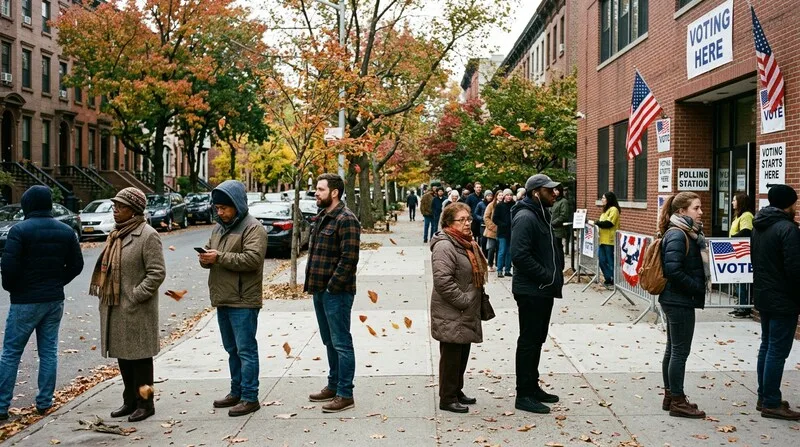
- Historical alignment: Jewish Americans have supported Democratic presidential candidates at 70-80% since FDR — one of the most durable demographic loyalties in American electoral politics.
- The Gaza fracture is qualitatively different from prior Israel debates: duration, visibility, and direct relevance to Jewish identity create genuine inflection point uncertainty that 2004 and 2020 polling noise did not.
- Two-direction movement: older Jewish voters edging toward Republicans on Israel concerns; younger Jewish voters moving further Democratic on Gaza humanitarian grounds — pulling the coalition in opposite directions simultaneously.
- NY-17 and NJ-5 are the specific competitive districts where marginal Jewish voter shifts could directly determine House majority outcomes.
Decades of Democratic Alignment: The Historical Foundation
Jewish Americans have supported Democratic presidential candidates at rates of 70-80% in virtually every presidential election cycle since Franklin Roosevelt. The alignment reflects a confluence of factors: the historical experience of persecution and the association of liberal democracy with protection from authoritarianism; urban and suburban residential concentration in areas that trend Democratic; high educational attainment; and social liberalism on issues including church-state separation, reproductive rights, and civil rights. These structural factors explain why even periods of significant disagreement with specific Democratic policies have not historically produced sustained electoral realignment.
The 2004 and 2020 elections both saw some polling noise about Republican gains among Jewish voters, particularly around Israel policy and economic issues. Neither translated into durable shifts at the voting booth. The question entering 2026 is whether the Gaza conflict — qualitatively different in its visibility, duration, and direct relevance to Jewish identity — represents a genuine inflection point or another cycle-specific disruption that will fade.
Jewish American Voter Behavior: Presidential Cycles 2004–2024
| Year | D Presidential Vote | R Presidential Vote | D Margin | Key Issues |
|---|---|---|---|---|
| 2004 | 74% | 25% | D+49 | Iraq War, domestic policy |
| 2008 | 78% | 21% | D+57 | Economy, healthcare |
| 2012 | 69% | 30% | D+39 | Israel-Iran, economy |
| 2016 | 71% | 24% | D+47 | Security, Supreme Court |
| 2020 | 68% | 30% | D+38 | COVID, Democracy |
| 2024 | ~66% | ~32% | ~D+34 | Gaza, democracy, economy |
| 2026 | Est. 60–68% | Est. 28–35% | Est. D+25 to D+40 | Gaza, antisemitism, Medicaid |
Sources: Exit polls (Edison Research), AP VoteCast, AJC Annual Survey of American Jewish Opinion. 2026 projections based on 2024 trend extrapolation and survey data through Q1 2026.
The Gaza Fracture: Two Directions at Once
The Gaza conflict after October 7 has created simultaneous pressure from two opposite directions within the Jewish American electorate. Progressive Jewish voters — younger, non-Orthodox, concentrated in major metros — have expressed anger at Democratic elected officials perceived as insufficiently critical of civilian casualties in Gaza. This cohort drove the "uncommitted" primary movement, supported progressive primary challengers, and in some cases organized voting strike pledges. Their grievance is with Democrats, not Republicans.
On the other side, traditional and Orthodox Jewish voters — concentrated in South Florida, Brooklyn's Orthodox communities, and parts of New Jersey — have moved toward Republicans partly on the grounds that Trump and Republicans provide more unconditional support for Israel. This group's shift is toward Republicans, not away from both parties. The net result in competitive districts depends heavily on which community is larger and more activated, and on whether progressive disaffection translates to abstention, third-party votes, or renewed Democratic enthusiasm once the alternative is a Republican ballot.
NY-17 and NJ-5: The Districts to Watch
Held by Rep. Mike Lawler (R) since 2022. The Rockland County Orthodox community has trended Republican; the Westchester Reform/Conservative Jewish community remains Democratic. A Biden+4 district in 2020, won by Lawler R+2 in 2022. One of the most watched House races nationally for 2026.
Currently held by Rep. Josh Gottheimer (D), himself Jewish. Strong incumbent advantage but district is R+3 in presidential lean. Bergen County's large Modern Orthodox community has shifted Republican in recent cycles. Redistricting made the seat more competitive for 2026.
Bottom Line: Margin Erosion in a Loyal Coalition
Jewish American voters are not abandoning the Democratic Party en masse — the structural factors that have produced D+40 to D+57 margins for decades are still present. But margin erosion from D+50 to D+34 (as suggested by 2024 estimates) is electorally meaningful in districts where Jewish voters comprise 10-15% of the electorate. A further 5-10 point erosion in 2026, concentrated in NY-17 and NJ-5, could affect House majority outcomes. The wildcard is antisemitism: Trump administration rhetoric and some far-right adjacency has created a counter-pressure pushing some Jewish voters back toward Democrats on civil liberties grounds. The balance between Gaza disaffection and antisemitism concern will define the 2026 Jewish American electoral story.