- "Departed" from conservatism: Pence says the second Trump term has embraced tariffs, business nationalization, price controls, and isolationism — policies he says break from Reagan-era Republican principles.
- Won't fully endorse Paxton: Pence would never vote for Texas Democrat Colin Allred, but repeatedly declined to say he personally supports Ken Paxton.
- Wants the weaponization fund killed: Pence calls the reported $1.8 billion DOJ fund "a bad idea from the start" and says the administration should "drop it."
- Rules out 2028, mostly: Pence says he has "no active ambition to reenter politics," while declining to say whether J.D. Vance embodies the conservative principles he's championing.
Why This Interview Matters
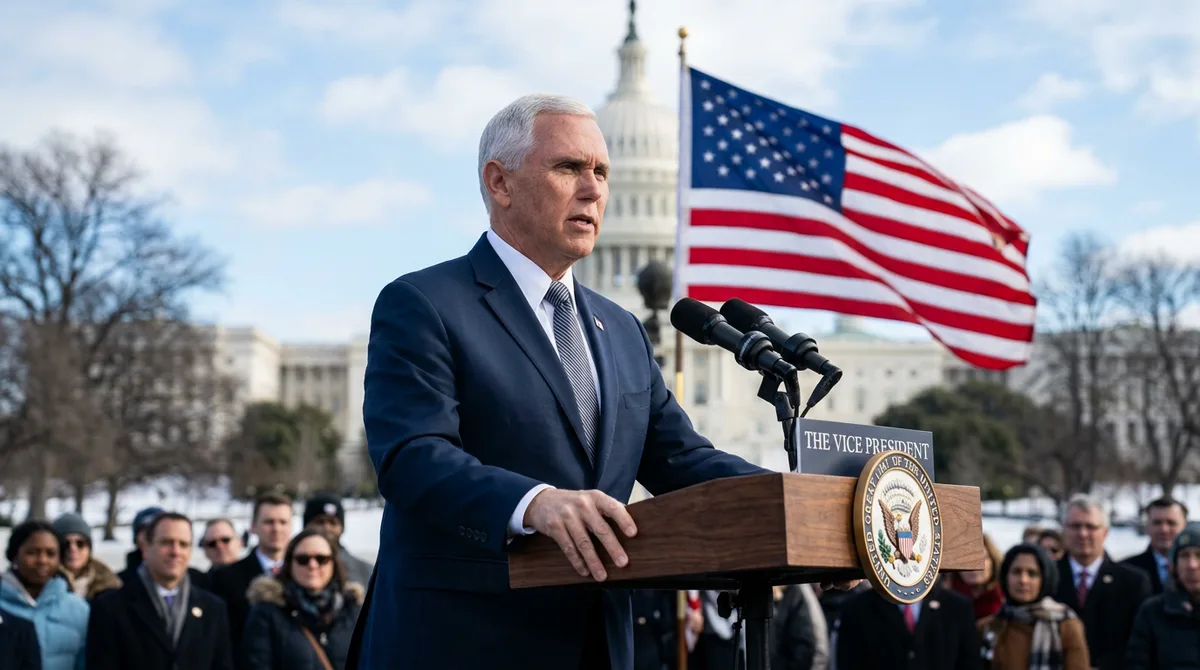
Former Vice President Mike Pence returned to Meet the Press on May 31, 2026, to promote his new book, "What Conservatives Believe: Rediscovering the Conservative Conscience," but the conversation quickly became the most direct public break yet between Pence and the direction of the party he once served at the top of the ticket. Pence is a singular figure in this argument: a former vice president who ran against Trump in the 2024 primary, remains broadly popular with traditional movement conservatives, and now has a book-length argument that the party he helped build for decades is at risk of losing itself to what he calls "the populist right."
The timing mattered. The interview came just as Ken Paxton secured the Republican Senate nomination in Texas over incumbent John Cornyn, and after a string of primary results — involving Sen. Bill Cassidy, Rep. Thomas Massie, and several Indiana state legislators — that Pence frames as evidence of a party increasingly defined by loyalty to Trump rather than to a fixed set of policy commitments. With institutional and democratic norms already a live political issue, Pence's willingness to publicly question his own party's direction gives Democrats and skeptical Republicans alike a high-profile, on-record data point heading toward the midterms.
Pence's underlying argument is that the fight over "who we're for" heading into 2028 should be preceded by a fight over "what we're for" — a deliberately philosophical framing that lets him criticize the administration's substance without directly attacking Trump personally.
"A Departure From the Conservative Agenda"
Asked directly whether the Republican Party is "the party of Donald Trump," as Sen. Lindsey Graham has said, Pence didn't dispute Trump's popularity but drew a distinction between popularity and philosophy: "what's lesser known right now is the way this second Trump administration has departed from the conservative agenda that we governed on... an agenda of American leadership, limited government, free market economics, the right to life." He gave the administration credit on some fronts — "strong securing the border, the extending tax cuts, standing with Israel" — but listed his objections in detail: "broad-based tariffs, nationalization of American businesses, questioning and pulling back from our allies as they endure the brutal assault in Eastern Europe from Russia," and what he described as marginalizing "the right to life," including criticism of the administration's HHS secretary for not restricting mail-order abortion pill access.
Pence was careful to say his book is "not at all" a rejection of the broader MAGA movement, insisting he has "spoken in front of more MAGA rallies than I could possibly remember" and believes most of those voters would themselves "reject ideas like nationalization of businesses and price controls and broad-based tariffs" if given a clear choice.
The Paxton Question: A Careful Non-Endorsement
Confronted with Ken Paxton's 2015 securities fraud indictment, his 2023 impeachment by fellow Republicans over bribery allegations, and his wife's 2025 divorce filing citing adultery, Pence was asked bluntly whether he supports Paxton. He never said yes. Instead, he pivoted twice to the Democratic alternative: "I could never... vote for the Democrat nominee Colin Allred, who is a radical left, supports abortion on demand." Pressed a second time — "Paxton, do you... give him your support?" — Pence again redirected to broader partisan framing: "Republicans have lost our way, but Democrats have lost their mind." The exchange is a case study in how far a prominent Republican will go to avoid directly answering a character question about his own party's nominee, even one who has separately compared his approach to Democratic-nominee character questions about Maine's Graham Platner.
The Anti-Weaponization Fund: "Deeply Offensive to Me"
In a rapid-fire closing segment, Pence was asked about a reported $1.8 billion "anti-weaponization fund" designed to compensate people who say they were unfairly investigated or prosecuted by the government, currently tied up in litigation. His answer was unequivocal: "I think that the weaponization fund is a bad idea from the start and I would encourage the administration just to drop it." He argued the Justice Department already has tools to settle individual cases fairly, citing a "well-deserved seven-figure settlement" reached that week with a pro-life family allegedly mistreated during the Biden administration. But he drew a hard line at any possibility the fund could pay people involved in the January 6 Capitol riot: "it's deeply offensive to me that you could have a fund that could even possibly compensate people who assaulted police officers or vandalized the capital on January 6."
Beyond Trump: Vance, 2028, and "Choice, Not an Echo"
Asked whether Vice President J.D. Vance could be the standard-bearer for the traditional conservatism Pence is championing, Pence declined to answer directly, twice: "that'll be up for voters to decide," and, when pressed further, trailed off without a clear response. His stated priority for 2028, he said, is that Republicans "first focus on what we're for before we focus on who we're for." Asked whether he was ruling out a 2028 run himself, a year after telling the same host he didn't "see that in my future," Pence went further this time: "I have no active ambition to reenter politics," quoting a Luke Combs lyric — "I think I rode that rocket about as far as it can fly" — to describe his own political ambitions while framing his book as his remaining vehicle for influence within the party.
Outlook: A Warning Shot for the Post-Trump GOP
Pence's interview reads less as a 2028 opening bid than as an attempt to stake out philosophical ground before that fight begins. By declining to fully endorse Paxton, criticizing tariffs and the weaponization fund, and refusing to anoint Vance, Pence positions his book — and himself — as a reference point for Republicans uneasy with the party's populist direction, without directly challenging Trump's standing inside the party today. That is a notably different posture than his 2024 primary run against Trump, and reflects a recognition that head-on opposition to Trump inside the GOP has so far failed.
The more immediate test is electoral: whether Republicans can hold the Senate with nominees like Paxton on the ballot, and whether the intraparty "fault lines" Pence describes show up as real drag in competitive midterm races this November. If Republican approval numbers soften further, Pence's argument that "Republicans would do well to take some time to reflect on what we believe again" may gain more traction inside the party than it currently commands — but if the GOP holds the Senate as Pence predicts, his critique risks being remembered as a footnote rather than a turning point.