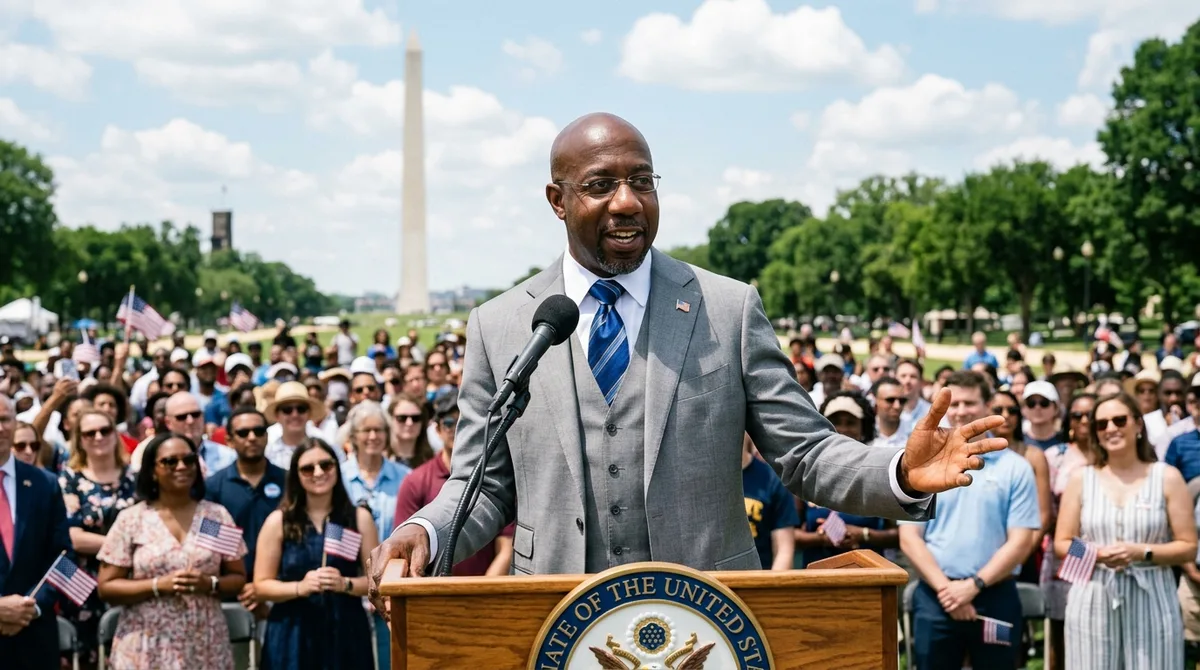
In the post-show "Overtime" segment of Real Time, Bill Maher turned to Sen. Raphael Warnock (D-GA) and comedian-writer Larry Wilmore for an unfiltered, audience-driven Q&A. The panel arrived days after Vice President JD Vance's own appearance on the main show, and Maher opened by relaying a Vance line the audience wanted addressed: that Watergate, judged by today's news cycle, would be "a 12-hour story." From there the conversation moved through a real, on-the-ground organizing win in rural Georgia, a debate about how authoritarian-adjacent regimes rewrite history, and a candid discussion of faith's role in American politics from a senator who is also a working pastor.
The segment is worth examining closely because it captures Democratic strategy in miniature: not a national messaging plan, but a specific, replicable case study of local organizing beating back a federal policy, layered with a broader argument about how quickly political norms erode when accountability weakens. Warnock's home state of Georgia remains one of the most competitive states in the country, and how Democrats there talk about enforcement, religion, and history carries real weight heading into the 2026 midterms.
- Organizing works: Warnock said local pushback killed a proposed 10,000-bed detention center in Social Circle, Georgia, and stalled a state redistricting map after capitol protests.
- Revisionism debate: Wilmore compared Trump-era historical reframing to Soviet-style "Pravda" truth-making; Warnock called it an attempt to make Americans "numb" to history.
- Faith and politics: Warnock, a Baptist pastor and senator, argued religion should inform values, not policy mandates, criticizing lawmakers who "perform" faith while cutting Medicaid.
- Complicated history: Warnock paired January 6 with January 5, the date Georgia sent its first Black and first Jewish senators to Washington in one election.
Pushback Works: The Detention Center That Wasn't
Asked about the administration's abrupt closure of the "Alligator Alcatraz" facility in Florida and whether it signaled a broader retreat on aggressive immigration enforcement, Warnock offered a Georgia case study instead of a national theory. The federal government, he said, had planned to build a detention center with roughly 10,000 beds in Social Circle, a town of about 5,000 residents that "mostly vote for Donald Trump." Local residents, he said, "began to stand up" once they realized the federal government intended to more than triple the size of their town, and "elevated their concerns" until the plan was withdrawn in both Oakwood and Social Circle.
Warnock connected that outcome to a second recent example: when Georgia Republicans moved to redraw congressional maps, "hundreds of people showed up at the state capital, and the legislators got nervous," leading them to table the effort, at least for now, in what he described as a pattern also visible in Minnesota. His conclusion was blunt: "standing up makes a difference." It is a modest, local claim rather than a sweeping one, but it is the specific evidence Warnock chose to offer when asked whether Trump's team is pulling back.

"Pravda" and the Watergate Reframe
The panel's most pointed exchange concerned JD Vance's remark, made on the same show days earlier, that Watergate would be "a 12-hour story" by today's standards. Warnock agreed with the underlying premise but rejected the framing: "our standards are so low right now" not because Watergate was minor, but because, in his words, the current administration "commits, like, five Watergates before breakfast." He called the broader rehabilitation of Nixon's reputation "amazing revisionism," comparing it to people who now question settled history from World War II.
Wilmore pushed the analysis further, describing the phenomenon as "Soviet-style revisionism." He drew a direct comparison between the Soviet Union's Pravda ("means 'truth,'" he noted, "it was anything but the truth") and modern information ecosystems, joking it was "kind of like Truth Social: it's not social, it's not true." Warnock added that the goal of this kind of retelling is to make the public "numb to things" by "getting rid of a lot of history," which he flatly labeled "Soviet-style revisionism going on in this country."
Religion as Performance vs. Substance
A viewer question about a Texas State Board of Education requirement that students study Bible stories prompted Warnock, who is also senior pastor of Ebenezer Baptist Church in Atlanta, to distinguish between religion as personal conviction and religion as political theater. "I don't want to live in anybody's theocracy," he said, "Christian, Jewish, Muslim," describing the American arrangement as a covenant among people of many faiths and no faith — "e pluribus unum." His sharper point was aimed at hypocrisy: he criticized lawmakers who "gather with other legislators, say a long prayer, join hands, and then go and cut a trillion dollars out of Medicaid," arguing that young people are not put off by religion itself but by the gap "between their creeds and their deeds."
Wilmore framed the same dynamic historically, arguing the push to reintroduce religion into schools stems from faith's declining default presence in culture since the "moral majority" era, replacing what he called the older norm of Sunday school. Warnock confirmed he still serves as a sitting senator and an active pastor simultaneously, joking that combining the presidency with a pulpit would be "impractical," though Maher countered, to audience laughter, that being a felon and president is apparently not disqualifying either.
January 6 and "We're Also January 5"
Asked to explain a line from his book, The Crooked Places Made Straight — "January 6th is exactly who we are and who we have always been" — Warnock rejected the impulse to say the Capitol riot was somehow un-American. "There's a way in which that is who we are," he said, arguing that treating it as an aberration is "dishonest," even as he immediately paired it with a counterweight: "we're also January 5th," the date in the 2021 Georgia runoffs when the state elected its first Black senator (Warnock himself) and first Jewish senator (Jon Ossoff) "in one fell swoop." His framing: "all families have a complicated story," and reckoning honestly with the "ugly side" is what allows progress. The panel closed by contrasting Nixon's 1974 resignation, which Maher noted happened because Nixon "lost the support of even the Republican Party," with the present, where Warnock and Maher agreed that kind of intra-party accountability "does not happen anymore."
What It Means Going Forward
Warnock's Georgia case studies double as a midterm playbook: local, specific resistance to unpopular federal actions — even in towns that voted for Trump — can force retreats without needing to win a national argument first. That is a more modest, ground-level Democratic strategy than sweeping generic-ballot messaging, but it is the version Warnock chose to highlight, and it maps onto contested Senate terrain he knows well as Georgia's own senator heading toward another competitive cycle.
The revisionism argument, meanwhile, is likely to keep recurring through the 2026 cycle as both parties fight over how recent history, from January 6 to Watergate, gets characterized in real time rather than settled after the fact. And Warnock's insistence on separating personal faith from theocratic policy is a marker for how Democrats, including a sitting pastor-senator, plan to contest religious-right messaging without ceding the language of faith altogether.