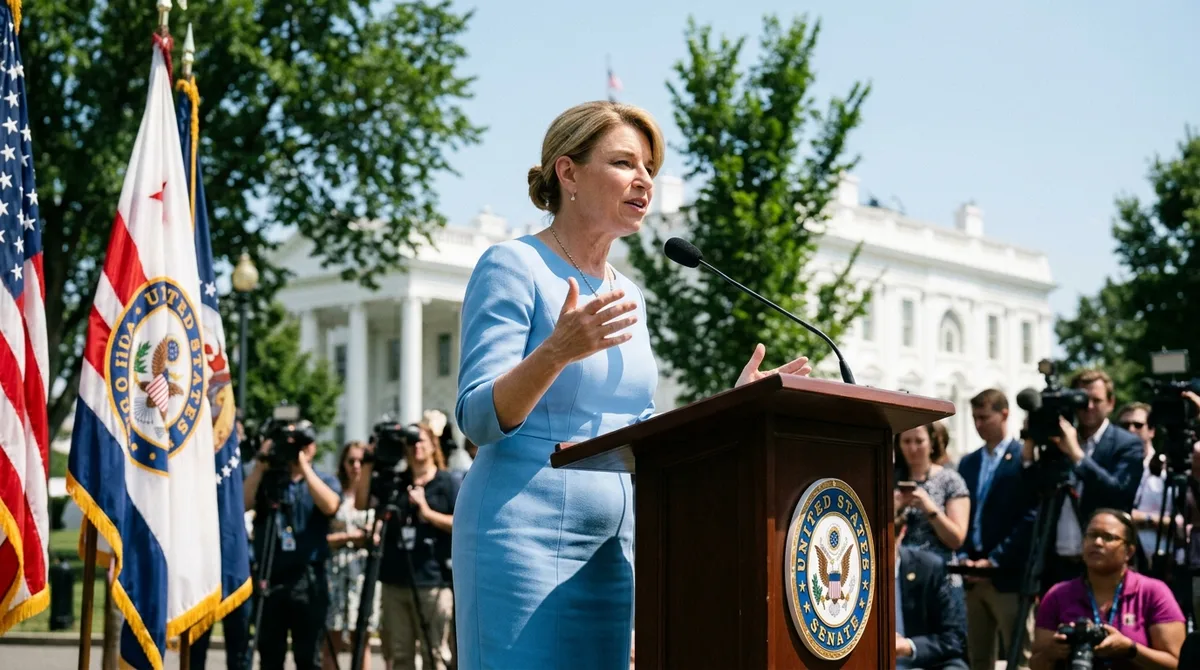

Political Profile
Amy Klobuchar occupies a distinctive niche in the Senate: a Midwestern pragmatist from one of the most progressive states, who has built a 17-year legislative career around accessible, concrete achievements rather than ideological positioning. Her trademark policy focus on antitrust enforcement — particularly against big tech — predates by years the bipartisan consensus that has since emerged around concerns about Amazon, Google, and Apple's market power. Her 2020 presidential campaign, while ultimately unsuccessful, demonstrated genuine crossover appeal in early primary states.
Minnesota's political trajectory has been one of the most closely watched in the country — the state has voted Democratic in every presidential election since 1972, but Harris's 3-point win in 2024 was the closest since 1984, driven by rural defections that mirror Wisconsin and Michigan's dramatic swings. Klobuchar's 10-point Senate win in the same cycle, dramatically outperforming the presidential margin, demonstrates that she has successfully cultivated the kind of individualized political identity that survives national trends through personal reputation and constituent service.
- Amy Klobuchar (D-MN) is a three-term senator from Minnesota, first elected in 2006, who ran for president in 2020 before dropping out and endorsing Biden.
- Minnesota is D+5 at the presidential level — Klobuchar has consistently won by large margins and is not considered a serious re-election risk in 2026.
- She leads the Senate Rules and Administration Committee, overseeing federal election administration, ethics, and congressional operations.
- Klobuchar is known for antitrust legislation targeting tech giants — her American Innovation and Choice Online Act has been one of the most debated tech regulation bills in the Senate.
Career Timeline
| Year | Event |
|---|---|
| 1960 | Born Plymouth, Minnesota; father was a sportswriter, grandfather an iron ore miner |
| 1982 | BA Yale University (political science); JD University of Chicago Law School 1985 |
| 1998 | Elected Hennepin County Attorney; serves two terms as Minnesota's chief prosecutor |
| 2006 | Elected to U.S. Senate in first run for political office; defeats Mark Kennedy (R) by 20 points |
| 2007 | Joins Senate Commerce and Judiciary Committees; begins consumer and antitrust focus |
| 2012 | Re-elected by 35 points; growing national profile as pragmatic dealmaker |
| 2018 | Re-elected again by 24 points; chairs Senate Judiciary Committee subcommittee |
| 2019 | Announces 2020 presidential campaign; famous Iowa caucus blizzard announcement |
| 2020 | Drops out Feb 29 after New Hampshire primary; endorses Biden before Super Tuesday |
| 2024 | Re-elected to fourth term; becomes top Democrat on Senate Judiciary Committee |
Policy Positions
| Issue | Position | Key Action |
|---|---|---|
| Antitrust | Leading advocate | American Innovation and Choice Online Act; Open App Markets Act; FTC/DOJ reform push |
| Technology | Regulation champion | Tech platform accountability; data privacy; AI regulation bills |
| Healthcare | ACA + drug prices | Supported Medicare drug price negotiation; Inflation Reduction Act provisions |
| Immigration | Pragmatic moderate | Backed bipartisan 2024 border deal that Trump killed; not ideologically rigid |
| Climate | Pro-clean energy | Voted for IRA climate investments; supports clean energy transition |
| Judiciary | Constitution focus | Top Dem on Senate Judiciary Committee; focuses on Supreme Court ethics, antitrust |
Prosecutor to Senator
Klobuchar's political career began not in elected office but in the prosecutor's office — she served two terms as Hennepin County Attorney (the Minneapolis area's chief prosecutor) before running for Senate in 2006. That background shapes her approach: evidence-based, process-oriented, and comfortable with legal complexity. Her 2006 Senate win by 20 points against a well-funded Republican in a competitive cycle demonstrated strong grassroots appeal in Minnesota.
Antitrust: Taking On Big Tech
Klobuchar has spent years building the Senate's most sustained legislative effort to reform antitrust law for the digital economy. Her American Innovation and Choice Online Act would have prohibited large tech platforms from preferencing their own products over competitors. Though the bill never passed into law, it catalyzed a broader bipartisan conversation and pushed the FTC and DOJ to take more aggressive enforcement positions. She also authored a book on monopoly power, Antitrust: Taking on Monopoly Power from the Gilded Age to the Digital Age (2021).
Not on 2026 Ballot — Judiciary Watchdog Role
Klobuchar was re-elected in 2024 and will not face voters until 2030. Minnesota approval: 54%. As the top Democrat on the Senate Judiciary Committee, she has a prominent platform to scrutinize Trump judicial nominees and administration legal controversies. Her 2020 presidential campaign established national name recognition; she remains a potential factor in future Democratic primary politics. Her moderate brand has prevented any significant primary challenge despite progressive activists' occasional frustration with her positions.
Electoral History
| Year | Race | Result | Margin |
|---|---|---|---|
| 2024 | MN Senate re-election (Class 2) | Klobuchar ~60% — Republican opponent ~36% | D +24 |
| 2018 | MN Senate re-election (Class 2) | Klobuchar 60.3% — Jim Newberger (R) 36.2% | D +24.1 |
| 2012 | MN Senate re-election (Class 2) | Klobuchar 65.2% — Kurt Bills (R) 30.6% | D +34.6 |
| 2006 | MN Senate (open — Mark Dayton retiring) | Klobuchar 58.0% — Mark Kennedy (R) 38.0% | D +20 |


