Biography
Barack Hussein Obama was born on August 4, 1961, in Honolulu, Hawaii, to a Kenyan father and a mother from Kansas. Raised partly in Indonesia and later by his maternal grandparents in Hawaii, Obama attended Occidental College before transferring to Columbia University and going on to Harvard Law School, where he became the first Black editor of the Harvard Law Review. He served as an Illinois state senator beginning in 1997, then won a US Senate majority in 2004 on the strength of an electrifying keynote address at the Democratic National Convention that introduced him to the country. He declared his presidential candidacy in February 2007 and won a grueling primary defeating Hillary Clinton, then won the general election against John McCain 365–173 in the Electoral College. On January 20, 2009, he was inaugurated as the 44th President and the first African American to hold the office. He won re-election in 2012, defeating Mitt Romney 332–206.
Obama's presidency produced legislative and executive achievements across a wide front. The Affordable Care Act (2010) was the most significant expansion of American healthcare since Medicare, insuring more than 20 million previously uninsured people. His administration rescued the US auto industry through the GM and Chrysler bailouts, saving an estimated one million jobs. In May 2011, US Navy SEALs killed Osama bin Laden in Abbottabad, Pakistan — the defining counterterrorism action of his presidency. The economic recovery from the 2008 financial crisis, underpinned by TARP and the American Recovery and Reinvestment Act, produced 75 consecutive months of job growth and added 11.6 million jobs over his two terms. Other major accomplishments include Dodd-Frank financial reform, the repeal of Don't Ask, Don't Tell, the Iran nuclear deal (JCPOA 2015), the Paris Climate Agreement, DACA protecting 800,000 Dreamers, the normalization of relations with Cuba, and two Supreme Court appointments (Sotomayor and Kagan). The Obergefell v. Hodges decision in 2015 — enabled by Obama's appointments — established same-sex marriage as a constitutional right.
Obama left office in January 2017 with a 59% approval rating (Gallup) — among the highest for a departing president in the modern era. His post-presidency has been among the most consequential since Theodore Roosevelt. He actively campaigns and fundraises for Democratic candidates, shaped the Biden 2020 campaign, produces content via Higher Ground Productions, and has written two presidential memoirs. He has been a consistent public critic of Trump-era nationalism and populism. His electoral coalition — young voters, Black voters, college-educated whites, urban professionals — remains the template Democrats attempt to recreate in every cycle. The contrast between Obama's sustained high approval and Trump's enduring polarization defines the central fault line of contemporary American partisanship.
- Barack Obama was the 44th President of the United States (2009-2017) — the first Black president in US history, winning the White House in 2008 with 365 electoral votes in one of the most historic elections in American history.
- His presidency included passage of the Affordable Care Act (ACA) — the most significant healthcare legislation since Medicare and Medicaid — and the economic recovery from the 2008 financial crisis through the American Recovery and Reinvestment Act.
- Obama was awarded the Nobel Peace Prize in 2009, his first year in office — the award cited his "extraordinary efforts to strengthen international diplomacy and cooperation between peoples," though the early timing was widely criticized as premature.
- He won re-election in 2012 by 126 Electoral College votes over Mitt Romney, then governed through divided government in his second term — using executive action on immigration (DACA), climate (Clean Power Plan), and Cuba relations to advance his legacy.
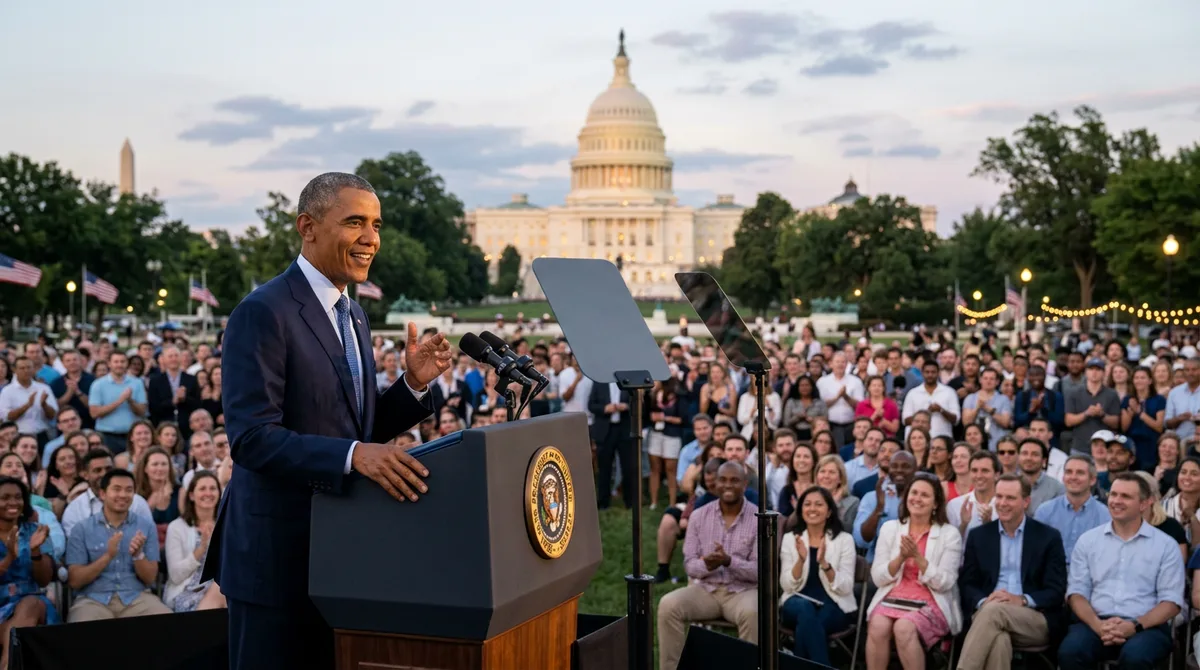
Key Policy Areas
Healthcare & the ACA
The Affordable Care Act (2010) insured 20 million previously uninsured Americans, eliminated pre-existing condition denials, and extended coverage for young adults to age 26. Enacted against unified Republican opposition, it remains Obama's most contested and consequential domestic legacy.
Foreign Policy
The killing of Osama bin Laden (May 2011), the Iran nuclear deal (JCPOA 2015), the Paris Climate Agreement, normalization of relations with Cuba, and building the international coalition against ISIS defined Obama's foreign policy. Critics pointed to the red line in Syria as a significant failure.
Economic Recovery
Obama inherited the worst financial crisis since the Great Depression. The auto industry bailout saved an estimated one million jobs. The $787 billion stimulus (ARRA) stabilized the economy. His two terms added 11.6 million jobs and cut unemployment from 10% to 4.7%. Dodd-Frank reformed financial regulation.
Obama’s Presidential Record by the Numbers
| Category | Achievement | Key Metric | Year |
|---|---|---|---|
| Healthcare | Affordable Care Act signed | 20M+ newly insured Americans | 2010 |
| Economy | Jobs recovery (post-crisis) | 11.6M jobs added over two terms | 2010–2017 |
| Counterterrorism | Osama bin Laden killed | SEAL Team 6 raid in Abbottabad, Pakistan | May 2011 |
| Financial reform | Dodd-Frank Wall Street Reform | Created CFPB; ended too-big-to-fail doctrine | 2010 |
| Climate | Paris Climate Agreement | 196 countries signed; US later withdrew under Trump | 2015 |
| Immigration | DACA executive action | 800K Dreamers protected from deportation | 2012 |
| SCOTUS | Sotomayor & Kagan appointments | First Latina justice; Obergefell same-sex marriage ruling followed | 2009, 2010 |
| Approval | Departing favorability (Gallup) | 59% — among highest for departing presidents post-WWII | Jan 2017 |
Historical Legacy
Obama's “Yes We Can” became one of the most resonant political rallying cries in modern American history, capturing a moment of genuine national optimism. His election as the first African American president was a landmark in a country where Black citizens were legally denied the right to vote less than fifty years earlier. The Nobel Peace Prize awarded in 2009 — early in his first term and explicitly for the promise of his presidency rather than achievements — remains one of the most debated awards in the prize's history.
His most durable legacy may be structural: he defined the Democratic Party's multiracial, cross-class coalition that subsequent nominees have tried to recreate. He appointed two Supreme Court justices who joined the liberal wing; the Obergefell same-sex marriage ruling and the ACA's survival through multiple legal challenges are partly his judicial legacy. His post-presidency fundraising and endorsements remain among the most powerful in the Democratic Party — making him, alongside Hillary Clinton, one of the two most influential figures in Democratic politics who has not held office in the current cycle.
Frequently Asked Questions
What were Obama's biggest accomplishments?
Obama's most significant accomplishments include the Affordable Care Act, which insured 20 million Americans; the killing of Osama bin Laden; the economic recovery adding 11.6 million jobs; the Iran nuclear deal; the Paris Climate Agreement; DACA protecting 800,000 Dreamers; the normalization of US-Cuba relations; and two Supreme Court appointments (Sotomayor and Kagan) that helped secure the Obergefell same-sex marriage ruling.
How did Obama win the 2008 election?
Obama won the 2008 Democratic primary by defeating Hillary Clinton in a long, contested race decided by pledged delegates rather than superdelegates. In the general election he defeated John McCain 365–173 in the Electoral College, powered by historic turnout among Black voters, record youth turnout, and strong performance with college-educated suburban voters. The 2008 financial crisis, erupting in October, shifted the race decisively toward Obama.
What is Obama doing now after his presidency?
Obama is one of the most active post-presidents since Theodore Roosevelt. He campaigns and fundraises for Democratic candidates, produces content via Higher Ground Productions (Netflix), has written two presidential memoirs, and remains a key behind-the-scenes voice in Democratic strategy. He has been a consistent public critic of Trump-era politics — his 2021 Capitol riot statement and 2017 “nationalism” speech were widely read as direct responses to Trump.