- Jimmy Carter (1924-2024) served as the 39th President of the United States (1977-1981) — losing re-election to Ronald Reagan in 1980 in a landslide after four years defined by the Iran hostage crisis, energy shocks, and economic stagflation.
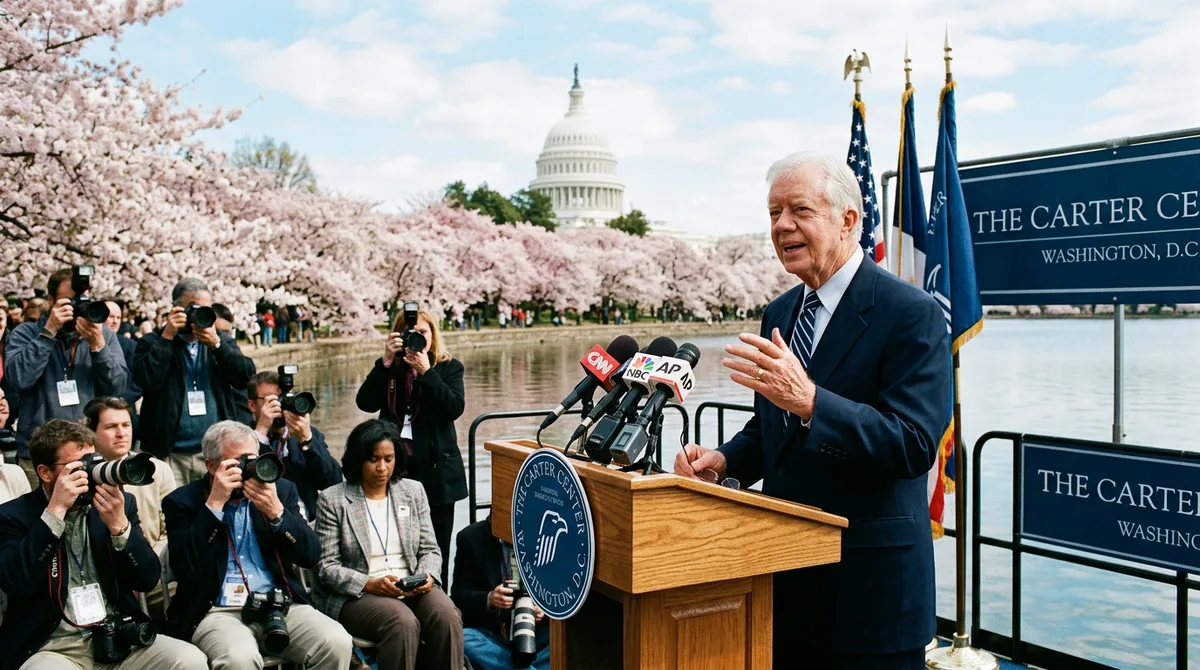
- His post-presidential career is considered the most consequential in modern history — founding the Carter Center to monitor elections and combat disease globally, building Habitat for Humanity houses into his 90s, and winning the Nobel Peace Prize in 2002.
- Carter brokered the Camp David Accords (1978) — a peace agreement between Egypt and Israel that remains the most durable diplomatic achievement of his presidency, establishing the framework for Egyptian-Israeli peace that has held for over 45 years.
- He died in December 2024 at age 100 — the longest-lived US president in history — outliving all other presidents of his era and continuing to work with the Carter Center until shortly before his death.
Biography
James Earl Carter Jr. was born on October 1, 1924, in Plains, Georgia — the first US president born in a hospital. He grew up on a peanut farm, graduated from the US Naval Academy in 1946, and served as a submarine officer under Admiral Hyman Rickover in the early nuclear submarine program. After his father’s death in 1953, he resigned his commission and returned to Plains to run the family peanut business. He was elected to the Georgia State Senate in 1962, became Governor of Georgia in 1971, and ran for president as a relatively unknown former governor in 1976 — capitalizing on post-Watergate, post-Vietnam American hunger for a Washington outsider. He defeated Gerald Ford 297–240 in the Electoral College, winning largely on his image as an honest, plain-spoken southerner untouched by the corruption that had defined the Nixon era.
Carter’s greatest achievement came in September 1978, when he personally brokered the Camp David Accords between Egyptian President Anwar Sadat and Israeli Prime Minister Menachem Begin after 13 days of intensive, often near-collapsed negotiations at the presidential retreat in Maryland. The accords produced the Egypt–Israel Peace Treaty of 1979 — the first between Israel and an Arab nation — and remain the most significant achievement of his presidency. Carter also established the Department of Energy and Department of Education, negotiated the Panama Canal Treaties returning the canal to Panama, normalized relations with China, and deregulated the trucking and airline industries. His emphasis on human rights as a cornerstone of foreign policy represented a genuine shift in American diplomatic doctrine.
The final two years of Carter’s presidency were dominated by cascading crises. Inflation reached 13.5% in 1979. Gas lines stretched around city blocks as the oil crisis bit hard. His July 1979 speech — which became known as the “malaise speech,” though he never used the word — warned of a “crisis of confidence” in American identity and struck many voters as more accusatory than reassuring. On November 4, 1979, Iranian revolutionary students seized the US Embassy in Tehran and took 52 Americans hostage. They were held for 444 days. A rescue attempt, Operation Eagle Claw, failed catastrophically in April 1980 when helicopters broke down in the Iranian desert, killing 8 servicemen and severely damaging Carter’s image of competence. He also faced a strong primary challenge from Ted Kennedy, which split the Democratic Party. Ronald Reagan defeated him in a landslide — 489 vs. 49 electoral votes. The 52 hostages were released on January 20, 1981 — the minute Reagan was sworn in. Carter died on December 29, 2024, at age 100, the longest-lived president in American history.
Key Policy Areas
Camp David Accords & Middle East
The September 1978 Camp David Accords, brokered by Carter over 13 days of personal diplomacy, produced the Egypt–Israel Peace Treaty (March 1979) — the first between Israel and an Arab nation. Sadat and Begin shared the 1978 Nobel Peace Prize. The accords are widely regarded as the most consequential diplomatic achievement of the post-Vietnam era and a direct result of Carter’s personal commitment and unusual preparation for the talks.
Iran Hostage Crisis
The 444-day hostage crisis (November 1979 – January 1981) consumed the last 14 months of Carter’s presidency and defined its public legacy. Carter exhausted diplomatic options through Algerian intermediaries while refusing military escalation that might endanger the hostages. Operation Eagle Claw (April 1980) — the rescue attempt — failed in the Iranian desert with 8 American deaths. The hostages were released the minute Reagan was inaugurated, a timing widely interpreted as a deliberate Iranian insult to Carter.
Energy, Economy & Domestic Policy
Carter created the Department of Energy in 1977 in direct response to the oil crises of the 1970s, pushing conservation, solar panels (installed on the White House roof, removed by Reagan), and a national energy policy. Inflation reached 13.5% in 1979 under his watch; he appointed Paul Volcker as Fed Chair, whose eventual monetary tightening broke inflation but at the cost of recession. He also created the Department of Education, deregulated airlines and trucking, and passed the Airline Deregulation Act of 1978.
Post-Presidency: The Greatest Ex-President
Carter’s post-presidential legacy is virtually without parallel in American history. Where most former presidents retreat into relative public obscurity or elder-statesman advisory roles, Carter spent the 44 years after leaving office engaged in a level of direct humanitarian work that transformed how the office’s aftermath is understood. The Carter Center, founded in 1982, has monitored more than 100 elections in more than 40 countries, deploying impartial observers to certify democratic contests from Nicaragua to Zambia. Its health programs led a global campaign to near-eradicate Guinea worm disease — a parasitic infection that afflicted 3.5 million people in 1986; by 2021, fewer than 14 cases were recorded worldwide. The Center has also worked to eliminate river blindness, trachoma, and lymphatic filariasis across Africa and Asia.
Carter’s personal work with Habitat for Humanity — picking up a hammer and building houses with volunteers until he was physically unable to, well into his eighties — became one of the most recognized images of public service in modern American life. He received the Nobel Peace Prize in October 2002. The Nobel Committee explicitly noted his post-presidential work: “In a situation currently marked by threats of the use of power, Carter has stood by the principles that conflicts must as far as possible be resolved through mediation and international co-operation based on international law, respect for human rights, and economic development.” He was widely described, across partisan lines, as the greatest ex-president in American history — a man whose legacy was built not in the White House but in the decades after he left it. He died at his home in Plains, Georgia, on December 29, 2024, at age 100.
| Category | Key Fact | Context |
|---|---|---|
| Camp David Accords | 13 days of secret talks, Sep 1978 | Led to Egypt-Israel Peace Treaty (1979) — first peace agreement between Israel and an Arab nation |
| Iran Hostage Crisis | 444 days, 52 Americans held (1979-81) | Defined and ultimately ended his presidency; hostages released minutes after Reagan's inauguration |
| Operation Eagle Claw | Failed rescue mission, 8 US servicemembers killed | April 1980 helicopter collision in Iranian desert; deepened sense of US impotence |
| 1980 Election Loss | 49 electoral votes vs. Reagan's 489 | One of the worst incumbent defeats in US history; third-party candidate John Anderson took ~6.6% |
| Carter Center | 100+ elections monitored in 40+ countries | Set the global standard for independent election observation from 1989 onward |
| Guinea Worm Eradication | 3.5 million cases (1986) → fewer than 14 (2021) | Nearly complete eradication of a parasitic disease — one of public health's greatest victories, led by Carter Center |
| Nobel Peace Prize | 2002, "decades of untiring effort" | Awarded for conflict mediation, disease eradication, and democracy promotion post-presidency |
| Longest-Lived President | Died Dec 29, 2024, age 100 | Outlived all previous US presidents; spent 43 years post-presidency — longer than he lived before entering politics |
Historical Legacy
Carter’s presidential rating among historians has shifted substantially over time. For the first decade after his presidency, he was typically ranked low — the hostage crisis, the inflation, the “malaise speech,” and the landslide loss to Reagan all weighed heavily. As the Camp David Accords aged and their durability became apparent, and as his post-presidential work accumulated moral authority, his ratings improved. He is now typically ranked in the middle tier of American presidents, with foreign policy achievements recognized as among the most significant of the post-WWII era.
His presidency is often read as a cautionary tale about the gap between personal integrity and political effectiveness. Carter was widely acknowledged as exceptionally intelligent, knowledgeable, and morally serious — and widely criticized for being unable to communicate a coherent political vision, manage Congress, or project the forceful leadership that American voters expect from the presidency in a crisis. His approval hit 28% in 1979 — among the lowest ever recorded. His electoral loss in 1980, 489–49 in the Electoral College, was one of the most decisive defeats of an incumbent in modern history. The contrast between the presidential and post-presidential records makes Carter one of the most complicated figures in the American political tradition: a man who did some of the most consequential and lasting good in American public life, but not while he was president.
Frequently Asked Questions
What were the Camp David Accords and why do they matter?
The Camp David Accords were two framework agreements signed in September 1978, brokered by Carter over 13 days of intensive personal diplomacy between Egyptian President Sadat and Israeli Prime Minister Begin. They led directly to the Egypt–Israel Peace Treaty of March 1979 — the first between Israel and any Arab nation. Egypt became the first Arab country to formally recognize Israel. Sadat and Begin shared the 1978 Nobel Peace Prize. The peace has held for nearly 50 years and remains the foundation of Middle East stability.
What was the Iran hostage crisis and how did it end?
Iranian students seized the US Embassy in Tehran on November 4, 1979, and held 52 Americans for 444 days. Carter pursued diplomacy through Algerian intermediaries rather than military escalation. A military rescue attempt (Operation Eagle Claw, April 1980) failed in the desert, killing 8 Americans. Carter negotiated a deal — including releasing frozen Iranian assets — but the hostages were released the exact minute Reagan was inaugurated, January 20, 1981. The timing was widely seen as a deliberate Iranian humiliation of Carter.
Why is Jimmy Carter considered the greatest ex-president in American history?
Carter’s 44-year post-presidency was extraordinary by any measure. The Carter Center monitored over 100 international elections and led the near-eradication of Guinea worm disease (from 3.5 million cases to fewer than 14). His Habitat for Humanity work — physically building homes into his late 80s — became iconic. He received the Nobel Peace Prize in 2002. He died on December 29, 2024, at age 100 — the longest-lived president in US history. The breadth and depth of his post-presidential humanitarian work is without parallel in the history of the office.