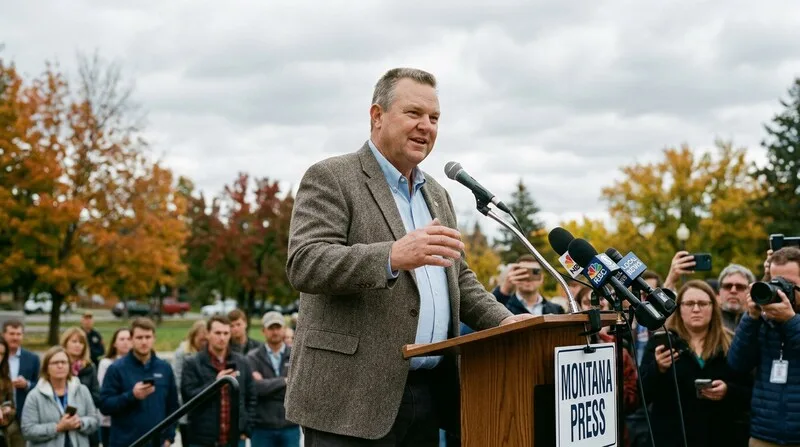

The Last Rural Democrat
Jon Tester was, for most of his Senate career, the most improbable politician in Washington: a third-generation Montana wheat farmer with a flat-top haircut, three missing fingers on his left hand, and a Senate record that consistently ranked him among the more moderate Democrats in the chamber. He held a Senate majority in a state that had voted Republican for president in every election since 1992 — and he did it by being exactly what he appeared to be. There was no gap between Jon Tester’s political identity and his actual life. He farmed his land near Big Sandy. He knew what diesel cost. He understood what a drought meant to a family that had been working the same acres for three generations. That authenticity was not a strategy; it was simply the truth, and Montana voters could tell the difference for long enough to give him three terms.
Tester came to the Senate in 2007 after defeating one-term Republican Conrad Burns by just 3,562 votes — one of the closest Senate races of the cycle — in a year when Democrats swept back into the majority largely on the strength of opposition to the Iraq War and Bush administration scandals. He had served in the Montana State Senate, where he was president before his congressional run. His entry into federal politics coincided with a moment when rural Democrats could still find paths to Senate seats in red-leaning states, a window that has essentially closed in the decade since.
His signature legislative accomplishment was the PACT Act of 2022 — the most significant expansion of veterans health care and benefits in decades, extending VA coverage to millions of veterans exposed to toxic burn pits during service in Iraq and Afghanistan. The bill passed after a dramatic Senate procedural standoff in which Republicans initially blocked it, prompting outrage from veterans groups and comedian Jon Stewart, who had advocated for the legislation for years. Tester shepherded the final passage as chair of the Senate Veterans Affairs Committee, and it stands as his clearest legislative legacy. His 2024 defeat by Tim Sheehy, by a 14-point margin, reflected Montana’s completion of its Republican realignment rather than any particular failure of Tester’s politics.
- Jon Tester (D-MT) lost his 2024 re-election bid to Republican Tim Sheehy by 6 points, ending an 18-year Senate career that made him the longest-serving Democrat ever to win statewide office in Montana.
- He won three Senate terms in Montana (R+12) by running as an organic farmer, emphasizing veterans' affairs and local agriculture — a personal brand that outperformed the Democratic baseline until Trump's margins grew too large.
- Tester was the chair of the Senate Veterans' Affairs Committee and authored the PACT Act with Jerry Moran — legislation expanding VA healthcare for veterans exposed to burn pits, a signature bipartisan achievement.
- His 2024 loss was the only Democratic Senate defeat of the cycle — reflecting Trump's dominant 21-point win in Montana that finally proved too large for even Tester's personal appeal to overcome.
Key Policy Areas
PACT Act Champion
Tester chaired the Senate Veterans Affairs Committee for much of his tenure and was the lead Senate author of the PACT Act, which expanded VA health care to approximately 3.5 million veterans exposed to burn pits and other toxic substances. He framed veterans care not as a partisan issue but as a basic obligation, consistently winning bipartisan support for veterans legislation even as broader political divisions hardened.
Conservation & Access
Tester secured the Blackfoot Clearwater Stewardship Act as part of the Great American Outdoors Act (2020), protecting over 100,000 acres of Montana wilderness. His approach to public lands was shaped by Montana’s hunting and fishing culture: he believed in protecting land for access rather than preservation in isolation, a framing that gave him credibility with rural Montanans skeptical of environmental politics.
Rural Democrat Profile
Tester received an “A” rating from the NRA early in his Senate career, opposing certain gun polling measures that were mainstream positions for most Democrats. He also fought consistently for Montana agriculture: farm bill support, livestock producers’ interests, crop insurance programs, and rural broadband access. These positions were genuine constituency service, not calculated moderation, and they explained his ability to survive in Montana longer than any structural analysis of the state suggested was possible.
Electoral History
| Year | Race | Result | Margin |
|---|---|---|---|
| 2024 | Montana Senate | Sheehy (R) 56.7% — Tester (D) 40.9% | R +15.8 |
| 2018 | Montana Senate (re-election) | Tester 50.3% — Matt Rosendale (R) 46.8% | D +3.5 |
| 2012 | Montana Senate (re-election) | Tester 48.9% — Denny Rehberg (R) 44.9% | D +4.0 |
| 2006 | Montana Senate | Tester 49.2% — Conrad Burns (R, inc.) 47.9% | D +1.3 |
| 2004 | Montana State Senate | Re-elected; served as State Senate President | D win |
Why Montana Turned
Tester’s three Senate victories were each narrow, each requiring him to outrun the Democratic presidential ticket by double digits, and each a minor miracle of coalition maintenance in a state trending steadily Republican. In 2018, with Trump specifically targeting his seat and rallying twice in Montana, Tester survived by 3.5 points while Trump\'s approval in the state was north of 55%. That race was his last miracle.
By 2024, the structural forces were simply too strong. Montana is now a state where Republican statewide candidates win by 15 to 20 points routinely. The white working-class voters who split their tickets to keep Tester despite voting Republican for president had realigned more fully toward the GOP. His defeat was the final chapter of a realignment that began in 2016 and was complete by 2024 — the end of the rural Democrat archetype as a viable political model in much of the West and Midwest.



Watch: Senator Tester Farewell Speech December 2024
External resources: Jon Tester on Wikipedia — Jon Tester on Ballotpedia
