
The Electoral Count Reform Act: What the January 6 Fix Actually Did — and What It Left Open
In December 2022, Congress updated the 1887 Electoral Count Act to close the loopholes that Trump's legal team tried to exploit on Janr(--text-light);font-size:1rem;max-width:640px;margin:0 0 8px;"> In December 2022, Congress updated the 1887 Electoral Count Act to close the loopholes that Trump's legal team tried to exploit on January 6, 2021. The VP's role is now explicitly ceremonial. Objections require 20% of each chamber. State governors — not legislatures — certify electors. But the ECRA is a statute, not a constitutional amendment, and legal scholars debate whether it fully closes every scenario.
- The original 1887 Electoral Count Act had ambiguous language that Trump's legal team exploited on January 6 — arguing VP Pence could reject or return electoral votes.
- The 2022 Electoral Count Reform Act explicitly made the VP's role "solely ministerial" and raised the objection threshold from 1 member each chamber to 20%.
- The ECRA also clarified that governors — not state legislatures — have primary authority to certify electoral votes, closing another potential vulnerability.
- Because the ECRA is a statute (not a constitutional amendment), Congress could theoretically repeal or amend it — and legal scholars debate whether it closes every scenario.
What the ECRA Changed: Before and After
| Issue | Original ECA 1887 | ECRA 2022 |
|---|---|---|
| VP role | Ambiguous — argument made VP could reject or return electoral votes | Explicitly "solely ministerial" — no authority to reject, delay, or return |
| Objection threshold | One Senator + one Representative could trigger sustained objection proceedings | 20% of each chamber required to sustain an objection |
| Who certifies electors | Ambiguous; could argue state legislature can override governor certification | Governor is primary certifying authority; "failed election" exception narrowed |
| Competing slates | Unclear process if multiple slates submitted from one state | Only one certified slate from each state; federal courts have jurisdiction to resolve disputes |
| "Failed election" exception | Broad — could be used to argue state legislature can intervene if election "failed" | Narrowed — applies only to extraordinary catastrophic events (not disputed results) |
Why It Matters for 2026
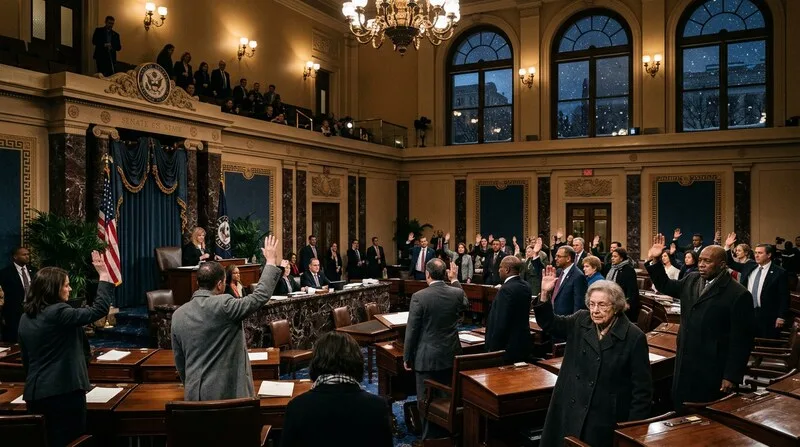
The ECRA was first applied when Vice President Harris presided over the January 6, 2025 certification of Trump's 2024 electoral victory. The new law was tested in real time: the ministerial role provision meant Harris had no legal basis to take any action other than announce the results, and the 20% objection threshold made a sustained objection procedurally harder. The certification proceeded without major incident — the first peaceful certification since 2017.
The ECRA's gubernatorial certification provisions become crucial in close state-level contests. In Georgia, Arizona, and Nevada — states with Republican-controlled legislatures but potentially Democratic or mixed executive branches — the ECRA's provision that the governor is the primary certifying authority matters greatly. Legal challenges seeking to have state courts or legislatures override gubernatorial certifications would now face the ECRA's explicit statutory framework in addition to constitutional arguments.
The ECRA is a statute — it can be amended or repealed by a simple majority in Congress. It does not address fake elector schemes that operate entirely at the state level before federal certification. It does not address what happens if a governor refuses to certify or certifies fraudulently. And the 20% threshold, while higher, is still achievable for a party that controls 20% of either chamber. Legal reformers continue to push for a constitutional amendment to fully eliminate election certification vulnerabilities.
Frequently Asked Questions
What was the original Electoral Count Act of 1887 and why was it confusing?
The 1887 ECA was passed after the Hayes-Tilden election disaster of 1876. Its language was notoriously ambiguous — particularly on the VP's role (did they have discretion to reject votes?) and how objections worked. Trump's legal team in 2020-21 exploited this ambiguity, arguing Pence could reject or return electoral votes. Pence refused. The events of January 6, 2021 made reforming the ambiguous 1887 law a bipartisan priority; the ECRA passed in December 2022 with significant bipartisan support.
What did the Electoral Count Reform Act of 2022 change?
The ECRA: (1) explicitly made the VP's role "solely ministerial" — no authority to reject or delay; (2) raised the objection threshold from one member of each chamber to 20% of each chamber; (3) clarified that governors — not state legislatures — are the primary certifying authority for electors; (4) established that each state can only submit one certified slate; (5) narrowed the "failed election" exception that could allow state legislatures to substitute their own electors; (6) gave federal courts jurisdiction to resolve certification disputes quickly.
Does the ECRA fully eliminate the risk of another January 6 scenario?
Not fully. The ECRA closes the specific VP authority argument and makes coordinated objections harder. But it is a statute, not a constitutional amendment — it can be repealed. It does not address fake elector schemes that play out at the state level. It does not address a rogue governor who refuses to certify, or a coordinated multi-state scheme to certify fraudulent results. Some legal scholars argue only a constitutional amendment (e.g., clarifying the VP's role and electoral counting procedures at the constitutional level) would fully close the vulnerabilities exposed by January 6.




Polling Alerts
Get notified the moment new polling data drops — right in your browser, no spam.
