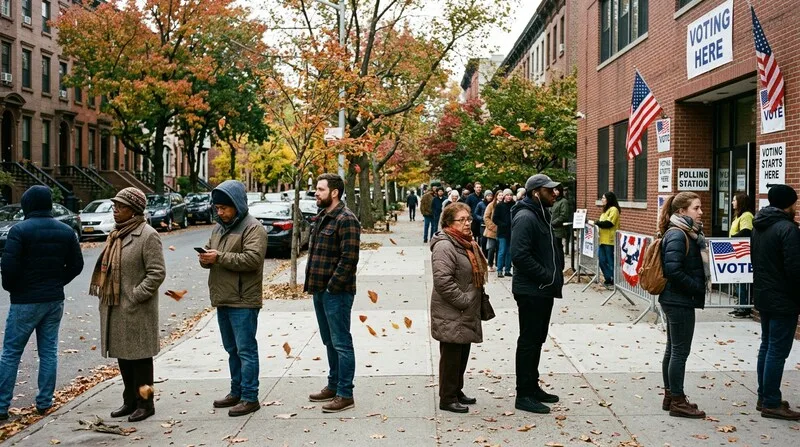
- 46% of 2022 votes were cast before Election Day nationally; universal mail states (CO, OR, WA) routinely exceed 85% early vote share, while low-access states can be below 20%
- Pennsylvania has no in-person early voting — only absentee mail ballots — making mail ballot request and return rates the primary pre-election-day indicator campaigns watch in this critical swing state
- Michigan's 2022 constitutional amendment established 9 days of in-person early voting; Arizona's Permanent Early Voting List (PEVL) auto-sends ballots to registered users, producing 74% early vote share — the highest among non-mail states
- A large Democratic early vote bank does not predict a Democratic win — it predicts a competitive race where Republican Election Day performance is the decisive variable; this is why early vote leads are routinely overhyped by partisans on both sides
State-by-State Early Voting Rules: Battlegrounds
| State | In-Person Early | No-Excuse Absentee | 2022 Early Vote % | D vs. R Early Pattern |
|---|---|---|---|---|
| Pennsylvania | No | Yes (since 2019) | 38% | D-leaning absentee |
| Michigan | Yes (9 days) | Yes | 52% | D-leaning in total |
| Wisconsin | Yes (limited) | Yes (litigated) | 41% | D-leaning absentee |
| Arizona | Yes (27 days) | Yes (PEVL auto) | 74% | Mixed, R PEVL growing |
| Georgia | Yes (17 days) | Yes (ID required) | 58% | Mixed, D urban early |
| Nevada | Yes (14 days) | Yes | 61% | D-leaning overall |
| North Carolina | Yes (17 days) | Yes | 55% | D-leaning absentee |
| Ohio | Yes (28 days) | Yes | 49% | Mixed, R growing |
| Texas | Yes (12 days) | No (excuse required) | 42% | Mixed, D urban early |
| Florida | Yes (8+ days) | Yes | 53% | R-leaning overall |

What Early Vote Data Does (and Does Not) Tell You
What It Tells You
Party registration of early voters. Geographic concentration of early voting. Turnout relative to prior cycles. Whether specific demographic targets (seniors, young voters) are responding to mobilization. Ballot return rates for registered voters who requested absentee ballots.
What It Does Not Tell You
How those early voters actually voted. Whether the early vote represents net new turnout or cannibalized Election Day voters. How Election Day turnout will compare. Whether unaffiliated/independent early voters lean one way or the other in a given cycle.
2022 Lesson
In multiple 2022 races, large Democratic early vote leads (registration-based) did not translate to Democratic wins because Republicans compensated on Election Day. Florida saw a massive Republican Election Day turnout after a relatively close early vote phase. Early vote is a leading indicator, not a result.
Democratic Early Vote Strategy in 2026
Democratic campaigns and allied turnout organizations have historically prioritized early vote banking as a core strategy, based on the theory that a voter who has already cast a ballot cannot be suppressed, deterred by bad weather, or lost to last-minute persuasion attacks. The DCCC and state Democratic parties have invested heavily in early vote programs for 2026, with particular emphasis on high-density Democratic precincts in the suburbs of swing districts where midterm drop-off from presidential year turnout is highest.
Republicans have significantly improved their early vote programs since the 2020 cycle, when Trump’s anti-mail-voting message left Republican campaigns at a structural disadvantage in states where early vote was dominant. The RNC’s “Bank Your Vote” initiative, operational since 2021, has been specifically designed to close the early vote gap. In Arizona’s 2022 Senate race, Republican early vote totals were nearly equal to Democratic totals — a significant improvement over 2020. Whether this improvement holds in a strongly Democratic national environment in 2026 is one of the key tactical unknowns heading into the cycle.


