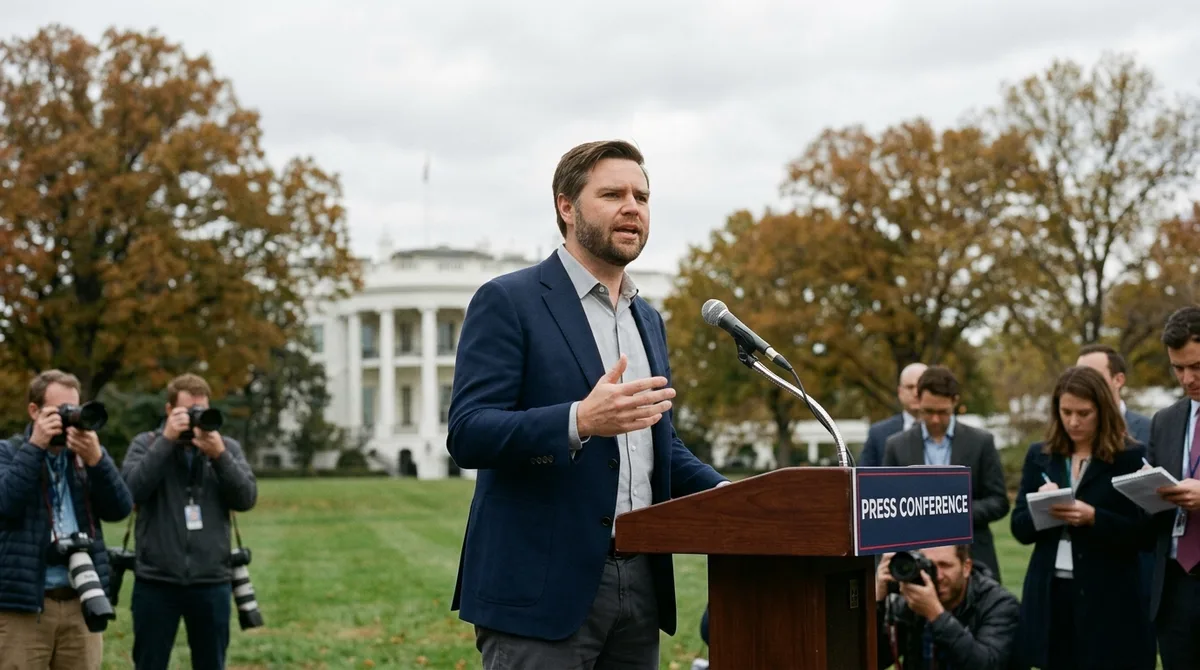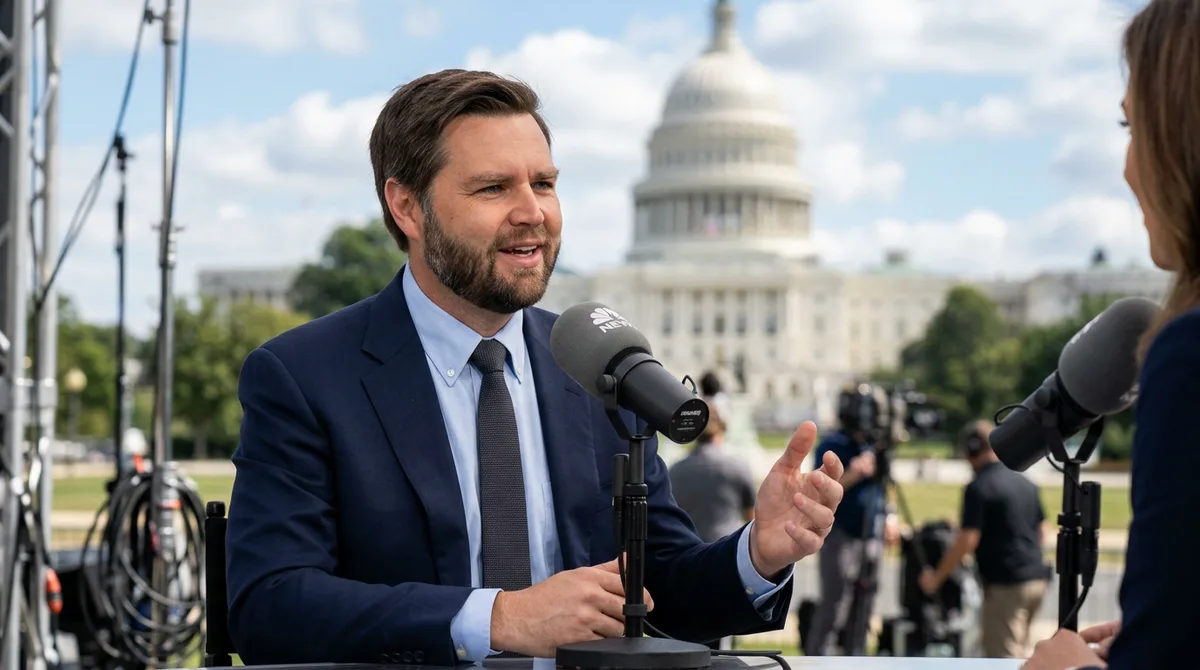
Vice President JD Vance sat down with Bill Maher on Real Time this week, a booking Maher himself flagged as unusual: elected Republicans, he joked, "take their beating like a man" when they come on the show, while the people he actually votes for are typically the ones who refuse. Vance is now the second sitting or former vice president to appear on the program in a matter of weeks, following an earlier visit from Mike Pence, and the conversation ranged well beyond the show's comedic framing into substantive terrain — the fragile Iran ceasefire, the administration's immigration enforcement record, the unresolved arguments over the 2020 election, and Vance's new memoir on his conversion to Catholicism.
The interview matters for reasons beyond novelty. Vance is the most closely watched potential 2028 Republican standard-bearer, and how he handles unscripted, adversarial television is itself a data point for that race. It also landed at a moment when the administration's Iran diplomacy and its domestic immigration enforcement are both under active scrutiny, giving Vance's answers on both fronts real policy weight rather than just soundbite value. This piece focuses on the substance of what was said, not the show's comedic framing.
- Iran: Vance called Iran's enrichment capability "functionally destroyed" while acknowledging a buried stockpile of previously enriched material has not yet been recovered, tying progress to falling oil prices under ongoing negotiations.
- Immigration: Vance defended ICE operations against Maher's "too rough, too mean" critique, arguing law enforcement cannot deport people without arrests that sometimes look bad out of context.
- 2020 election: Vance stopped short of endorsing non-concession as a principle, instead relocating his "rigged" argument to alleged tech-company censorship of pro-right content in 2020, which he said did not recur in 2024.
- 2028: Maher said his own vote is "in play" for 2028, floating Vance or Marco Rubio as options if the Democratic Party moves further toward its socialist wing.
The Iran Ceasefire: "America Wins Either Way"
Pressed on why the current round of Iran diplomacy would succeed where decades of talks failed, Vance pointed to a concrete market signal: oil, he said, is "back down to $73 a barrel" after spiking to $126 during the crisis, which he offered as evidence "there's something real going on here." He described the underlying memorandum of understanding as guaranteeing that the Strait of Hormuz stays open and oil keeps flowing, paired with a ceasefire he conceded would "always going to be a little messy when you're dealing with the Iranians."
When Maher pushed on whether Iran's nuclear program was actually destroyed, Vance drew a distinction between enrichment capacity and the enriched material itself. "The thing that you have to destroy is their ability to enrich uranium, which has been destroyed," he said, because it requires "functioning centrifuges that can actually spin." He acknowledged the highly enriched stockpile — accumulated, he said, "over 20 years of previous administrations" — has not been recovered and is "buried deep underground," but argued that without functioning centrifuges it cannot be turned into a weapon. His framing of the broader U.S. strategy toward Tehran: after 47 years as, in his telling, the largest state sponsor of terrorism, Iran has been offered a choice to change its behavior toward the West, "and if they're not willing to change, we still fundamentally have all the cards."

Immigration: "You Went Too Far, and You Should Own It"
The sharpest exchange came on immigration enforcement. Maher told Vance directly that closing the border was popular, but that ICE's conduct under the administration had been "too rough, too mean, too unnecessary," and suggested Vance's team would benefit politically from simply owning that excess the way it had owned the "childless cat ladies" remark rather than doubling down.
Vance's response leaned on the mechanics of enforcement rather than a concession: "you cannot do any deportations without law enforcement, and you can't do a law enforcement operation like that without having some situations that don't look good when they're recorded." He offered the analogy of an arrest for murder that looks "pretty icky" on an out-of-context clip, then argued that objecting to any video that looks bad functionally means objecting to enforcement itself. He cited a figure of 12 million people entering the interior of the country between 2021 and 2025, framing the current administration as elected "with a mandate to get some of those people out." Maher's rejoinder was that "nothing ever lands in the middle" — Biden, in his view, let in too many people, but the response has swung fully to the other extreme, including personnel changes at the Pentagon that Maher characterized sharply. Vance disputed that framing on the Pentagon specifically, saying promotions under Defense Secretary Pete Hegseth had gone to "people from all walks of life," while agreeing more broadly that media coverage sometimes "obfuscates" what is actually happening.
Recasting the 2020 Argument
Maher tried to extract a firmer commitment from Vance on election legitimacy heading into future contests, asking whether Vance or Marco Rubio — the two most plausible 2028 successors — would commit to conceding future elections regardless of outcome, rather than treating every loss as fraud. Vance said "I don't think that we should not concede elections," but reframed his underlying grievance about 2020 in narrower terms, setting aside disputes over vote counts in Georgia or Pennsylvania. His argument instead centered on technology companies: he said firms with "financial interests that exist outside the United States" suppressed negative coverage of the left and promoted negative coverage of the right in the run-up to the 2020 election, which he called a distortion of the "free and open exchange of ideas" guaranteed by the First Amendment. Notably, he added that "it didn't happen in 2024," a qualifier that narrows his claim considerably from a blanket fraud allegation to a specific complaint about platform moderation in one election cycle.
Communion, Conversion, and the 2028 Undertone
The interview's final stretch turned to Vance's memoir, Communion: Finding My Way Back to Faith, which traces his path from a Baptist upbringing through atheism to Catholicism. Vance described being drawn less to doctrine at first than to what he called "the beauty and the stability" of Catholic practice in a world of "ugly buildings" and constant flux, and said his faith redirected an ambition he now views critically: "I think it's wrong to be ambitious for ambition's sake." He also fielded, and deflected, a question about why he chose Catholicism over Hinduism, his wife Usha's faith, promising a longer conversation on Maher's podcast.
Underneath the banter sat a real 2028 marker. Maher told Vance his vote is "in play," explicitly naming Vance and Secretary of State Marco Rubio as the two Republicans who would need to "bring us back to the middle" on election concessions, and warning that a further leftward drift by Democrats toward what he called "this Democratic Socialist" politics would push him toward the GOP field.
What It Means Going Forward
Two threads from this interview will keep surfacing between now and the midterms. First, the Iran deal's durability is now a testable claim: Vance staked the administration's credibility on oil prices and a "final deal" that either happens or leaves Iran, in his words, "still much weaker as a country" either way. If the enriched stockpile Vance conceded is unrecovered ever resurfaces as a flashpoint, expect the "functionally destroyed" framing to become a political liability rather than an asset, tracked in approval polling on foreign policy specifically.
Second, Vance's answer on 2020 is a preview of how the GOP's most likely 2028 frontrunner intends to handle the party's central unresolved controversy: not by relitigating vote counts, but by narrowing the grievance to content moderation and declining to repeat it as a 2024 claim. Whether that satisfies swing voters who want a cleaner break from election denialism, or simply defers the fight to the next cycle, will shape how Vance is measured against rivals as the invisible 2028 primary begins in earnest.