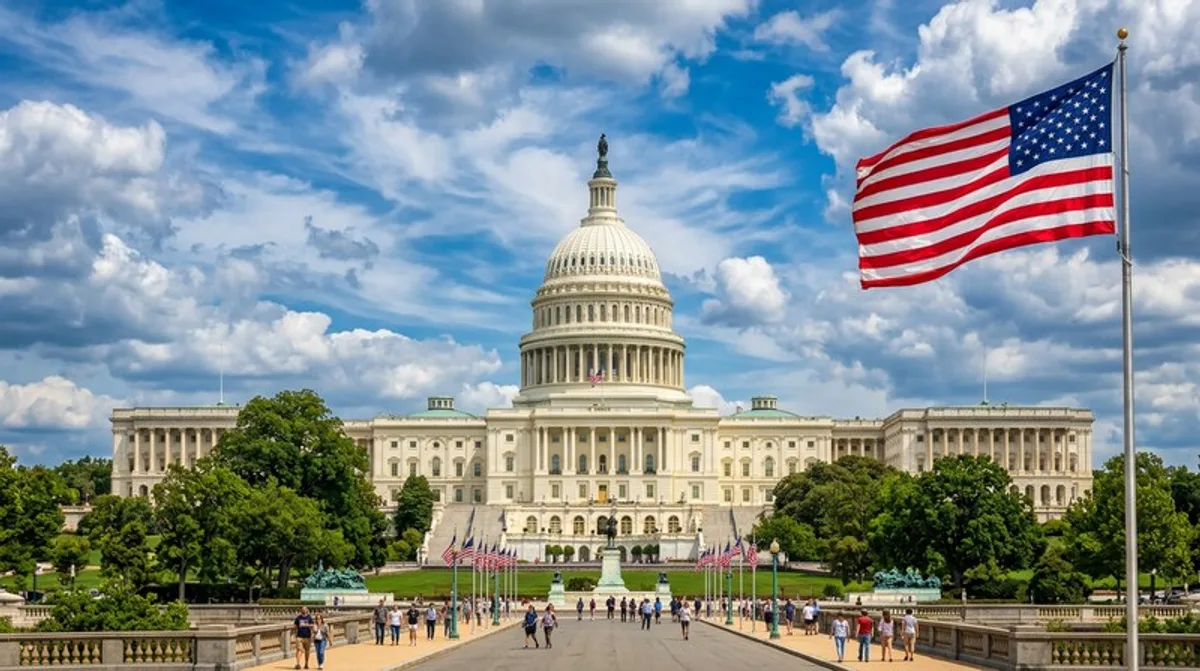
- NATO defended, not abandoned: Tillis called NATO "the most important alliance in the history of mankind" while acknowledging a two-decade, $2 trillion shortfall in allied defense spending fuels White House frustration.
- Fed blockade continues: Tillis says he will not support any Federal Reserve board or chair nominee until a DOJ probe tied to Chair Powell is resolved.
- Tariff criticism: He singled out the 50% tariff on Brazil as "irrational" and called for a "surgical," not "blunt force," approach to Canada and Mexico.
- 2026 outlook: Tillis predicts Republicans "hold on to the Senate" but has "questions about the House," citing redistricting overreach.
Why This Interview Matters
Sen. Thom Tillis (R-N.C.) sat down with Margaret Brennan on Face the Nation not from a Senate hallway but from the Munich Security Conference, the annual gathering where transatlantic defense policy gets stress-tested in public. The timing was pointed: a report released at the conference this year argued that leaders are "taking an axe to existing rules and institutions" and that the era in which Europe could treat the United States as an "unquestioned security guarantor" is over. Tillis was asked directly whether that framing is fair.
The senator's answer, and much of the interview that followed, illustrates a dynamic that has defined his time in the Senate: open, on-camera disagreement with elements of the administration's approach on NATO, tariffs and personnel, paired with continued institutional loyalty to the broader Republican project. That balancing act carries added weight because Tillis has said he will not seek re-election in 2026, leaving North Carolina's Senate seat as one of the cycle's most closely watched open-seat contests. A senator with nothing left to lose politically, speaking from a security conference that is explicitly questioning American reliability, is a notable combination heading into a midterm year.
The conversation moved across four distinct fronts: the health of the NATO alliance and the Arctic, tariff policy toward Canada, Mexico and Brazil, an ongoing blockade of Federal Reserve confirmations tied to a Justice Department investigation of Chair Jerome Powell, and Tillis's own read on the 2026 midterm map. Below is what he actually said on each.
"Not a Second-Tier Alliance": Defending NATO While Explaining the Frustration
Asked point blank if the U.S. is "no longer a reliable partner to Europe," Tillis did not concede the premise. He argued that "in some ways, I hope that we're going to enter an era where our reliance on Europe is improved," then pivoted to what he sees as the root cause of White House frustration: a $2 trillion shortfall in mutual defense investment by NATO allies "over two decades." He asked reporters and viewers to weigh that history against the moment: "What has that done to our readiness? What has that done to our innovation? What's that done to our military industrial base and manufacturing capacity?"
Still, Tillis distanced himself from the sharper language coming out of the Pentagon. Asked about the Defense Department sending its number-three official to a NATO meeting to say U.S. support would continue but "in a more limited and focused fashion," Tillis said flatly: "I would not have used those words." He added that "our alliance is what makes us the world's superpower and what keeps this world safer," and warned against viewing Munich's mood as a eulogy for NATO: "People coming to Munich thinking that this is the end of NATO are being a bit alarmist."
On Russia, Tillis was unambiguous, calling Vladimir Putin "a liar and a murderer" who "should be expelled from Ukraine," while saying he would accept a peace agreement "if Vladimir Zelenskyy wants one." Pressed on the German chancellor's remark that "the world order as we know it is over," Tillis pushed back: "Only if the chancellor allows it," arguing NATO members who underspent for decades should "admit that was a mistake" and "redouble their efforts" rather than declare the alliance finished.
Greenland, the Arctic and a 1951 Treaty
The interview also touched on NATO's newly announced Arctic Sentry mission, coming weeks after the president raised, then dropped, talk of pressuring Denmark over Greenland. Tillis said the priority now is modernizing "the 1951 agreement where Greenland and Denmark agreed to more or less give us unfettered access in Greenland to project power in the Arctic," including upgrading the U.S. space base there and reviewing a separate base Denmark reportedly offered "for a dollar." He framed the goal as working with Canada's icebreaker fleet and Scandinavian allies to "defer deter China and Russia" in the region — the kind of allied coordination he said should replace "hyperbolic" rhetoric about annexation.
Tariffs: "A Surgical Approach, Not a Blunt Force Object"
Tillis was more openly critical on trade policy. Asked about the House vote — where a bloc of Republicans joined Democrats to reject the president's tariffs on Canada — he said he wants the USMCA modernization "on the table" and called for resolving disputes "in a room" rather than through blanket tariffs. He was pointed about one case in particular: "I still to this day can't figure out why we have a 50% tariff on Brazil when we have a trade surplus with Brazil. Those sorts of things are irrational to me." He said other tariffs are more defensible given "past behaviors of countries that we have a deficit with," but argued the administration needs "a surgical approach, not a blanket approach."
Asked whether his party should distance itself from the president on tariffs as November approaches, Tillis rejected the framing of loyalty tests altogether: "I don't think it's a matter of distancing ourselves. That's what's wrong with Washington." He said the "what" of holding trade-deficit countries accountable is often justified; his objection is to "the how."
Blocking the Fed: Tillis Ties Confirmations to the Powell Probe
Tillis reiterated a stance he has held publicly: he will not support confirming any nominee to the Federal Reserve board or chairmanship — including to fill what he called "the Cougler seat" — until a Justice Department investigation connected to Chair Jerome Powell is resolved. Asked whether that includes potential chair candidate Kevin Warsh, Tillis drew a distinction between a confirmation hearing, which the committee chair can schedule unilaterally, and a confirmation markup, which is his call: "I'm saying that until the matter is solved, I'm a no."
He was dismissive of the underlying case, saying it stemmed from "about two minutes of commentary" and noting that "seven members, Republican members" on the relevant committee "said they didn't see any criminal intent or activity." When told Treasury Secretary Scott Bessent had suggested there was a "deal" to at least hold hearings for Warsh, Tillis corrected the record: "That's not a deal. That's a decision that the chair makes unilaterally."
The Midterm Math: Senate Holds, House Is a Question Mark
Asked the direct polling question — if the election were held today, would Republicans keep the House and Senate — Tillis gave an answer that will matter to anyone tracking the Senate map: "I think that we hold on to the Senate. I have questions about the House," citing what he called "a little bit of overreach with respect to redistricting" plus the historical pattern of a difficult midterm following a presidential win. He also used the moment to take a direct shot at White House staff, naming deputy chief of staff Stephen Miller specifically as someone whose approach he has criticized, and said of his final stretch in office: "If I have to speak bluntly, that's what I'm going to do in my remaining time in the Senate."
What Comes Next
Tillis's Munich interview is a preview of two fights that will not resolve quickly. The first is over the Federal Reserve: Powell's term as chair runs until May 2026, and Tillis's blockade means whoever the administration nominates — Kevin Warsh or otherwise — faces a Senate Banking Committee where at least one Republican vote is conditioned on an outcome he does not control. If the Justice Department investigation into Powell drags on, so does the standoff, with real consequences for how markets read the succession race at the central bank.
The second is the broader question Tillis was really being asked to answer in Munich: whether Republican officeholders will keep drawing a public line between supporting the president's broad agenda and objecting to specific tactics on tariffs, NATO messaging, and personnel. Tillis, freed by his decision not to seek re-election, has positioned himself as one of the few Republicans willing to do that on camera repeatedly. Whether that posture becomes more common among Senate Republicans — or remains a retiring senator's parting message — is likely to shape both the tone of the 2026 campaign and the fight over North Carolina's open Senate seat, one of the cycle's genuine toss-ups on the map.
Tillis's own forecast, that the Senate majority holds but the House is in doubt, tracks closely with what the generic-ballot and battleground polling averages have shown throughout the cycle. Whether that assessment ages well will become clearer as more state-level Senate polling arrives through the spring.


