
Biography
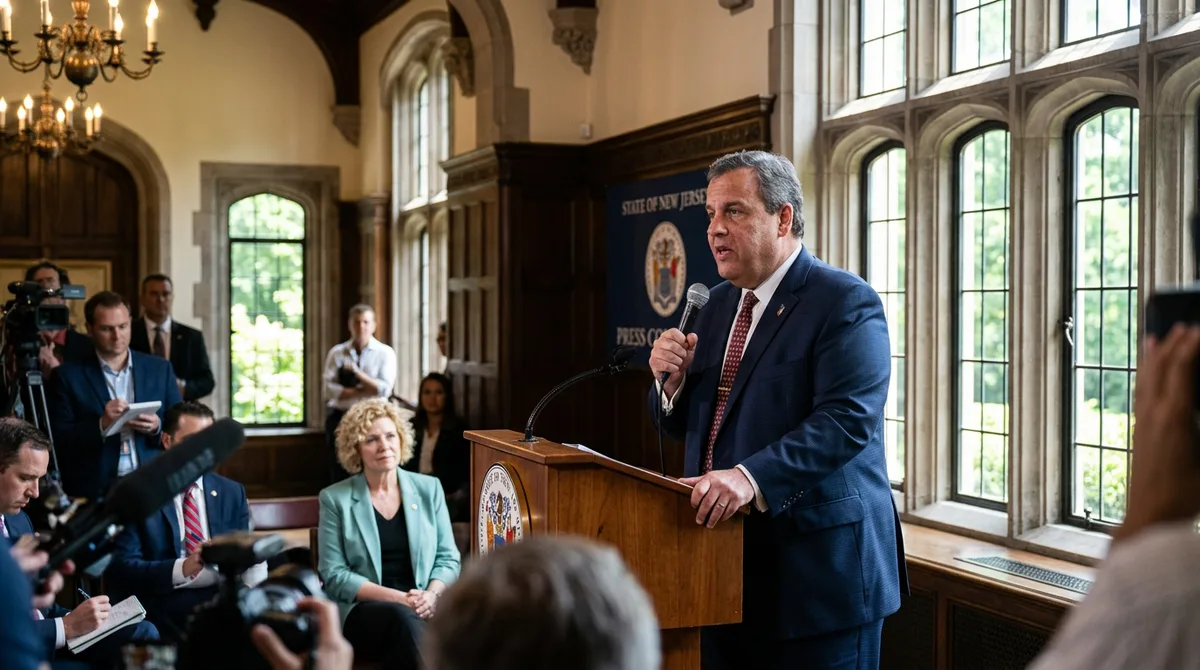
Christopher James Christie was born on September 6, 1962, in Newark, New Jersey, and grew up in Livingston. He graduated from the University of Delaware and earned his law degree from Seton Hall University School of Law in 1987. Christie built his career as a lobbyist and political fundraiser before President George W. Bush appointed him U.S. Attorney for the District of New Jersey in 2002, a role he held until 2008. As U.S. Attorney in the post-9/11 era, Christie built a significant reputation by prosecuting corruption cases against both Democratic and Republican officials, convicting over 130 public officials without a single loss. His aggressive prosecution of political corruption in a state legendary for it made him one of the most prominent figures in New Jersey politics before he had ever sought elected office.
Christie was elected Governor of New Jersey in 2009 in a convincing upset over incumbent Democrat Jon Corzine, becoming a major national figure in the Republican Party. His re-election in 2013 by 22 percentage points — the largest Republican margin in New Jersey in decades — made him the front-runner for the 2016 Republican presidential nomination and the chair of the Republican Governors Association. The "Bridgegate" scandal — in which members of his administration orchestrated lane closures on the George Washington Bridge as apparent political retaliation — severely damaged his national standing in 2014. Two aides were convicted of federal crimes, though convictions were later reversed by the Supreme Court in 2020. Christie ran for president in 2016, dropping out after a poor New Hampshire result. He endorsed Trump, later helped Trump prepare for presidential debates, and served as the head of Trump's 2016 transition team before being unceremoniously removed by Jared Kushner.
Christie's most consequential national act came in the 2024 Republican presidential primary, when he entered the race as the only major candidate willing to directly and consistently attack Trump as unfit for the presidency. While every other Republican contender either deferred to Trump or offered only oblique criticism, Christie took the debate stage as the designated Trump antagonist, calling him a "lonely, self-consumed, self-serving mirror hog" and arguing that Trump's multiple criminal indictments and January 6th conduct disqualified him. Christie polled in single digits nationally throughout the race, held on through the early debate phase, and dropped out on January 10, 2024, just before the New Hampshire primary, when internal polling showed no viable path. He became a regular presence on CNN explaining MAGA psychology to non-MAGA audiences and maintained his platform as the Republican Party's most prominent internal critic of Trump's fitness to govern.
- Chris Christie (R-NJ) ran for president in 2024 — dropping out in January before the New Hampshire primary — after building his campaign around the most direct anti-Trump message of any major Republican candidate, calling him unfit for office.
- He served as Governor of New Jersey (2010-2018) for two terms — winning re-election in 2013 by 22 points in a blue state with a record typically available only to incumbents with strong crossover appeal.
- Christie was the first major Republican official to endorse Trump in 2016 after dropping out of that presidential race — an endorsement that helped legitimize Trump's candidacy in the Republican establishment, before their falling out after January 6th.
- The George Washington Bridge "Bridgegate" scandal (2013) — in which his aides ordered bridge lane closures to punish a Democratic mayor who didn't endorse him — defined the second half of his governorship and effectively ended his political career's momentum.
Key Policy Positions
Anti-MAGA Republicanism
Christie is the most prominent Republican officeholder to run an explicitly anti-Trump campaign in 2024. He argued that Trump's character, criminal exposure, and conduct on and around January 6, 2021 disqualified him from returning to the presidency. Christie positioned himself as the voice of traditional center-right conservatism — pro-rule of law, institutionalist, and internationalist — against the MAGA movement's populist nationalism. His willingness to attack Trump directly, by name, on debate stages, was singular among major Republican candidates in both 2016 and 2024.
Law Enforcement & Prosecutorial Standards
Christie's political identity was forged as a federal prosecutor. He applied prosecutorial standards to political arguments more consistently than most politicians, insisting that indictments and convictions represent serious evidence of wrongdoing that voters must weigh. His U.S. Attorney record of convicting over 130 corrupt officials across party lines gave him credibility in arguing for rule-of-law principles within a Republican Party that increasingly dismissed criminal prosecutions of Trump as politically motivated persecution.
Bipartisan Governance
As New Jersey's Republican governor in a heavily Democratic state, Christie's most celebrated executive moment came in the aftermath of Hurricane Sandy in October 2012, when he worked visibly and warmly with President Barack Obama to secure federal disaster relief. The images of Christie embracing Obama just days before the 2012 presidential election drew fury from Republicans who saw it as damaging to Mitt Romney's campaign. Christie defended the cooperation as what governing required, citing the needs of New Jersey residents above partisan calculation.
Christie’s Career Arc: From Corruption Prosecutor to Trump’s Most Vocal Republican Critic
| Year | Role / Event | Outcome | Significance |
|---|---|---|---|
| 2002–2008 | US Attorney, District of New Jersey | 130+ convictions, 0 losses | Built law-enforcement reputation prosecuting both D and R corruption; NJ legend before ever running for office |
| 2009 | Won NJ governor over incumbent Corzine | R+1 | Republican win in deep-blue NJ; made him national party figure immediately |
| Oct 2012 | Embraced Obama post-Hurricane Sandy | Appeared together on NJ coastline | Bipartisan governing moment; alienated Romney camp 5 days before election; Christie defended it as governing necessity |
| 2013 | Re-elected NJ governor | R+22 (historic margin) | Largest NJ R gubernatorial margin in decades; made him presumptive 2016 frontrunner |
| 2014 | Bridgegate scandal broke | Two aides indicted; convictions later overturned | Crippled 2016 presidential run before it could gain traction; Christie denied knowledge throughout |
| 2016 | Ran for president; dropped out post-New Hampshire | 10th place Iowa; 6th NH | Endorsed Trump; led transition team; was removed by Kushner; became Trump debate prep coach |
| 2023–2024 | Ran for 2024 president; only major anti-Trump candidate | Dropped out Jan 10, 2024 (pre-NH) | Consistent Trump criticism on debate stage; documented record of warning; polled in single digits throughout |
2026 / 2028 Relevance
Christie holds no elected office and has no immediate electoral path in 2026. His relevance is entirely as a commentator, media presence, and potential candidate for 2028. If Trump's second term produces significant policy failures, constitutional crises, or criminal proceedings that result in conviction, Christie is uniquely positioned among Republicans to say — with documented consistency — that he warned the party from the beginning.
The scenario most favorable to Christie is a 2028 Republican base in which Trump cannot run again (due to the two-term constitutional limit), Trumpism is discredited by failed governance, and the party is searching for an alternative that combines electability with executive competence. In that environment, Christie's debate skills, prosecutorial sharpness, and track record of winning a blue state by historic margins would become relevant assets.
The scenario least favorable to Christie is a 2028 primary in which MAGA remains dominant and the party rallies around a Trump-endorsed successor. In that case, Christie's 2024 anti-Trump campaign would make him permanently unacceptable to the base. His national profile depends almost entirely on the direction of the Republican Party after Trump's second term concludes.
Frequently Asked Questions
Why did Chris Christie criticize Trump?
Christie argued that Trump's four criminal indictments, his conduct surrounding January 6th, and his character made him unfit for the presidency. He was the only major 2024 Republican base candidate to attack Trump directly and by name on debate stages, calling him a "lonely, self-consumed, self-serving mirror hog." Christie framed his candidacy as an act of Republican Party honesty about what Trump's return would mean for the country.
What is Bridgegate?
Bridgegate was the 2013 scandal in which Christie administration aides ordered the closure of lanes on the George Washington Bridge in apparent political retaliation against Fort Lee's Democratic mayor. The closures caused massive traffic gridlock. Two Christie aides were convicted of federal crimes in 2016, though convictions were overturned by the Supreme Court in 2020. Christie denied knowledge of the scheme, but the scandal crippled his 2016 presidential campaign.
Did Christie run for president in 2024?
Yes. Christie entered the 2024 Republican base in June 2023 as the field's designated Trump antagonist. He participated in multiple primary debates, consistently attacking Trump as unfit. He dropped out on January 10, 2024, before the New Hampshire primary, after internal polling showed no viable path to the nomination. He did not endorse another candidate upon exiting.