Biography
Richard Bruce Cheney was born on January 30, 1941, in Lincoln, Nebraska, and grew up in Casper, Wyoming. He attended Yale briefly before dropping out and eventually earned his bachelor's and master's degrees from the University of Wyoming. He began his career as a congressional intern and political staffer, rising to become White House Chief of Staff under President Gerald Ford at just 34 years old — the youngest in history at the time. He represented Wyoming in Congress from 1979 to 1989, serving six terms and rising to the position of House majority Whip. When George H.W. Bush appointed him Secretary of Defense in 1989, Cheney oversaw a period of profound transformation: the fall of the Berlin Wall, the collapse of the Soviet Union, and the successful prosecution of the 1991 Gulf War against Saddam Hussein's Iraq under General Norman Schwarzkopf.
After the Clinton years, during which Cheney served as CEO of Halliburton, George W. Bush selected him as his running mate in 2000. The selection of a deeply experienced Washington insider was widely seen as compensating for Bush's relative lack of foreign policy credentials. The two won the presidency in the disputed Florida recount, ultimately decided by the Supreme Court in Bush v. Gore. After the September 11 attacks, Cheney became the defining figure of the administration's response: he championed the Authorization for Use of Military Force, the Patriot Act, warrantless NSA surveillance, the detention facility at Guantanamo Bay, and the use of enhanced interrogation techniques — including waterboarding — which critics called torture. He was the primary advocate within the administration for the 2003 invasion of Iraq, built on intelligence assessments about weapons of mass destruction that proved false.
Cheney's approval rating peaked above 70% in the days after 9/11. By the time he left office in January 2009, it had fallen to roughly 13% — the lowest for a departing VP in recorded polling history. His post-vice presidential years were defined by continued outspoken defense of Bush-era national security policies, five heart attacks across his career, a dramatic 2012 heart transplant at age 71, and — in a remarkable late-career reversal — becoming one of the most prominent Republican critics of Donald Trump. He voted for Biden in 2020 and endorsed Kamala Harris in October 2024.
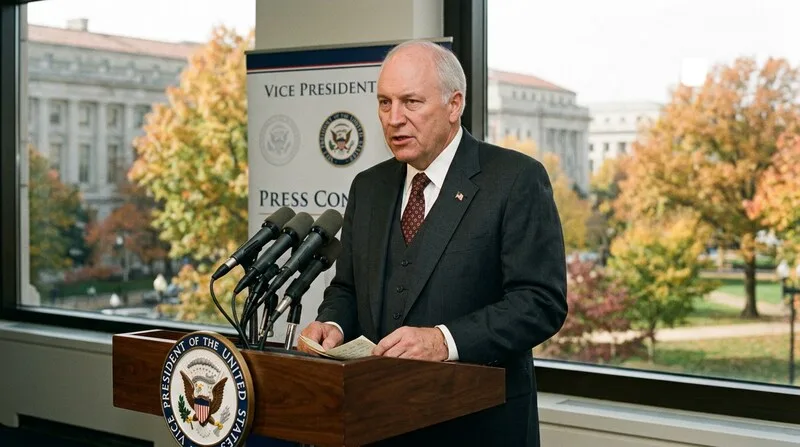
- Dick Cheney served as Vice President of the United States (2001-2009) under George W. Bush — widely considered the most powerful VP in American history, deeply involved in post-9/11 intelligence policy, the Iraq War, and energy policy.
- He was a central architect of the post-9/11 national security state — advocating for enhanced interrogation, warrantless surveillance, and the invasion of Iraq, policies that defined the Bush administration and remain deeply controversial.
- Cheney previously served as Secretary of Defense (1989-1993) under George H.W. Bush, overseeing the Gulf War, and as House Minority Whip representing Wyoming — one of the most complete national security resumes of any modern VP.
- His daughter Liz Cheney's break with Trump placed him in the rare position of having a family member who became the Republican Party's most prominent internal critic — Dick Cheney endorsed Liz's anti-Trump positions and endorsed Kamala Harris for president in 2024.
Key Policy Areas
Iraq War & WMD Claims
Cheney was the administration's most forceful advocate for the 2003 invasion of Iraq, citing assessments of weapons of mass destruction programs and alleged ties to al-Qaeda. No WMDs were found. The war cost more than 4,400 American lives and hundreds of thousands of Iraqi lives, and destabilized the region for decades. Cheney has never retracted his support for the decision.
Counterterrorism & Enhanced Interrogation
Cheney was the primary architect of the post-9/11 national security apparatus: the Patriot Act, warrantless surveillance, Guantanamo detentions, and the CIA's enhanced interrogation program including waterboarding. He maintained publicly that these techniques were legal, effective and not torture — a position directly at odds with the 2014 Senate Intelligence Committee report.
Energy Policy & Halliburton
Cheney's 2001 National Energy Policy Development Group — the "Energy Task Force" — conducted its meetings in secret. Critics alleged that oil and gas industry executives shaped policy behind closed doors. Separately, Cheney's former employer Halliburton received billions in no-bid Iraq reconstruction contracts, producing a conflict of interest controversy that dogged his vice presidency.
Cheney’s Vice Presidency: Key Decisions and Their Aftermath
| Decision | Year | Cheney’s Role | Outcome / Legacy |
|---|---|---|---|
| Afghanistan AUMF | 2001 | Key advocate | War lasted 20 years; longest in US history |
| Patriot Act | 2001 | Champion of mass surveillance authority | Expanded NSA warrantless wiretapping; controversies lasting decades |
| Iraq War authorization | 2002–03 | Primary architect; drove WMD case | No WMDs found; 4,400+ US deaths; regional destabilization |
| Enhanced interrogation | 2003–07 | Defended waterboarding as legal and effective | Senate 2014 report: ineffective and constituted torture |
| Energy Task Force | 2001 | Led secret meetings with energy executives | Ongoing controversy; Supreme Court upheld secrecy in 2004 |
| VP approval rating | 2001→2009 | Peaked 72% (post-9/11) | Left office at 13% — lowest departing VP in modern polling |
| 2024 endorsement | Oct 2024 | Endorsed Kamala Harris; called Trump “threat to Constitution” | Remarkable late-career repudiation of MAGA successor |
Historical Legacy
Dick Cheney redefined the American vice presidency. Where previous VPs had been largely ceremonial figures, Cheney built a parallel national security and policymaking apparatus that operated with unusual independence and secrecy. He attended virtually every significant meeting, controlled information flow to the president, and drove decisions on the most consequential issues of the era. Scholars who study the presidency routinely rank him as the most influential vice president in American history — a designation that is not uniformly complimentary.
His daughter Liz Cheney, a Wyoming congresswoman, became one of the most prominent Republican critics of Donald Trump, serving as vice chair of the House January 6 committee and voting to impeach Trump in 2021. She lost her primary in 2022 by 37 points. Dick Cheney's own public repudiation of Trump — including his endorsement of Kamala Harris in 2024 — illustrated how completely the Republican Party of Bush-era hawks and internationalists had been displaced by MAGA nationalism. The Iraq War's failure, which Cheney emblematizes more than any other figure, is widely cited by analysts as a key cause of the erosion of trust in American institutions that helped produce the Trump phenomenon.
Frequently Asked Questions
What is Dick Cheney best known for?
Cheney is best known as Vice President under George W. Bush (2001–2009), where he was widely regarded as the most powerful VP in American history. He was a principal architect of the 2003 Iraq War, championed enhanced interrogation techniques including waterboarding after 9/11, and headed the secretive Energy Task Force. Earlier, as Secretary of Defense under George H.W. Bush, he oversaw the 1991 Gulf War and the end of the Cold War military drawdown.
Did Dick Cheney receive a heart transplant?
Yes. Cheney suffered five heart attacks between 1978 and 2010. He had a defibrillator implanted, used a left ventricular assist device (LVAD) for 20 months, and received a heart transplant in March 2012 at age 71. He described the experience in his memoir “Heart: An American Medical Odyssey” co-written with his cardiologist. His survival through decades of severe heart disease became one of the more remarkable medical stories in American political history.
What is Dick Cheney's position on Donald Trump?
Cheney became one of the most prominent Republican critics of Trump. He voted for Biden in 2020 and endorsed Kamala Harris in October 2024, calling Trump “a threat to our Constitution.” His daughter Liz Cheney served on the House January 6 committee and lost her Wyoming primary in 2022 by 37 points for her anti-Trump stance. The Cheney family's evolution represents the sharpest Republican break with Trump from the party's hawkish establishment wing.