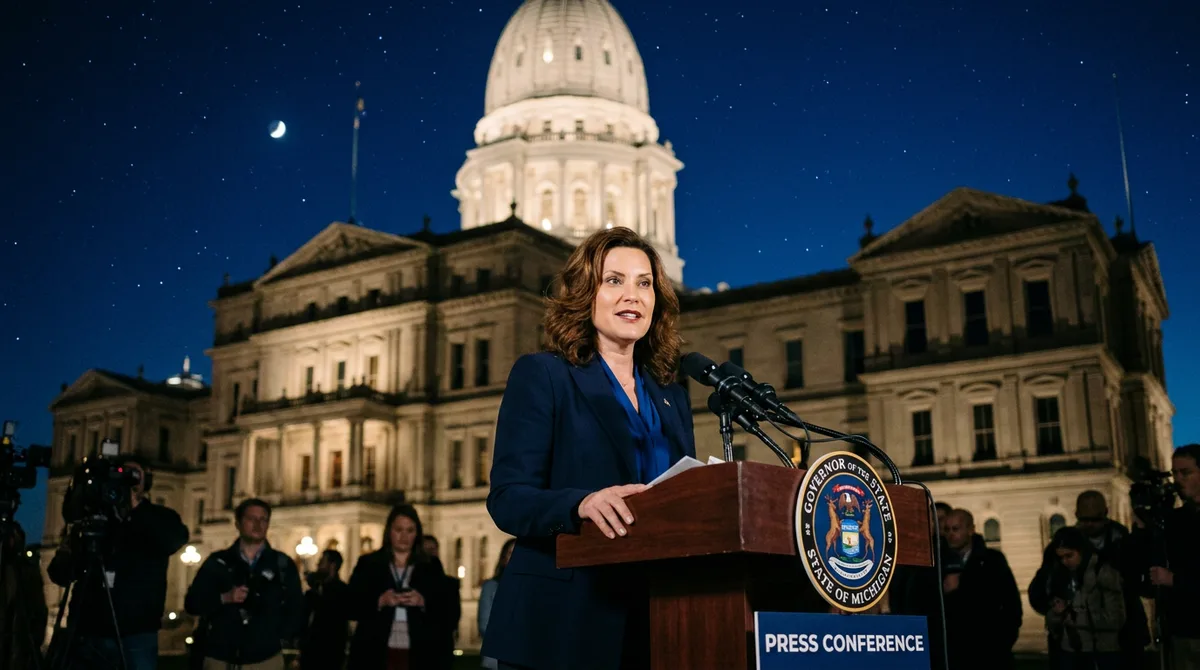
- Gretchen Whitmer (D-MI) won re-election as Michigan governor in 2022 by 10.5 points over Republican Tudor Dixon — a significant win in the ultimate swing state, cementing her as one of the most powerful Democratic executives in the country.
- Michigan is a genuine toss-up — Trump won the state by 1.4 points in 2024 while Whitmer won in 2022 by 10.5 points, one of the largest governor-presidential splits in the cycle and a testament to her personal crossover appeal.
- She survived a 2020 kidnapping plot foiled by the FBI — a domestic terrorism plot by a militia group that had targeted her over COVID restrictions, an event that gave her national visibility as a symbol of political threats to democratic governance.
- Whitmer was discussed as a potential 2024 presidential or vice presidential candidate — her ability to win in a swing state, her national media profile, and her popularity among Midwestern Democrats made her a recurring name in Democratic succession planning.
Biography
Gretchen Esther Whitmer was born on August 23, 1971, in Lansing, Michigan, and grew up in Grand Rapids and East Lansing. Her father, Richard Whitmer, was a senior official in Michigan state government under both Republican and Democratic governors, giving her an early exposure to bipartisan governance. She attended Michigan State University and Michigan State University College of Law, earning her law degree in 1998.
Whitmer began her political career in the Michigan House of Representatives, serving from 2001 to 2006. She then served in the Michigan State Senate from 2006 to 2015, including as Senate majority Leader from 2011 to 2015 — one of the most difficult periods for Michigan Democrats as Republicans dominated the legislature and passed controversial legislation including right-to-work laws. After leaving the Senate she served as Ingham County Prosecutor before launching her 2018 gubernatorial campaign.
Whitmer won the 2018 Michigan gubernatorial race with 53% of the vote, defeating Republican Bill Schuette by over 9 points. Her campaign centered on fixing infrastructure — her slogan “Fix the Damn Roads” resonated with Michigan voters frustrated by crumbling highways and bridges — along with expanding Medicaid and protecting public education funding. She took office in January 2019.
Her first term was defined substantially by the COVID-19 pandemic. Michigan was an early and hard-hit state, and Whitmer imposed strict shutdown orders that made her one of the most nationally prominent pandemic-era governors. She became simultaneously a hero to public health advocates and a target for conservative criticism. In October 2020, the FBI and Michigan State Police disrupted a domestic terrorism plot in which a right-wing militia had planned to kidnap and potentially execute her — an incident that focused national attention on the threat of political violence and significantly raised her national profile.
She won re-election in 2022 with 54% of the vote, a 10.6-point margin that outperformed Democrats nationally in a difficult environment. Her second term saw Michigan Democrats win full legislative control for the first time in decades, allowing her to pass significant legislation including repealing the state’s right-to-work law, expanding LGBTQ+ civil rights protections, codifying abortion polling, and tying Michigan’s economy to federal EV transition funding via major battery manufacturing deals with Ford, GM, and international battery suppliers. She is constitutionally term-limited and cannot seek a third term as governor after 2026.
Key Policy Positions
Infrastructure & Manufacturing
Whitmer’s signature issue is infrastructure investment. She has overseen major road and bridge repair projects in Michigan and tied her state’s economic future to the EV transition, securing investment from Ford, GM and battery manufacturers for Michigan facilities. Michigan added over 20,000 EV-related manufacturing jobs under her tenure, positioning the state as the hub of the clean energy vehicle economy.
Labor & Unions
Whitmer repealed Michigan’s right-to-work law in 2023, making Michigan the first state in over 50 years to reverse such legislation. Her alliance with the UAW and other Michigan unions is central to her political identity. UAW President Shawn Fain has praised her consistently, making her the most union-aligned governor in the country by most metrics — a valuable asset heading into a 2028 Democratic primary.
Reproductive Rights
Michigan voters passed Proposal 3 in 2022, a constitutional amendment enshrining abortion polling that Whitmer championed. She signed subsequent legislation expanding abortion access, making Michigan one of the most protective states for abortion rights in the Midwest. She frames reproductive freedom as fundamental to individual liberty and economic security, making it a central component of her national political brand.
2026 & 2028 Relevance
Whitmer’s relevance in 2026 is primarily as a surrogate and fundraiser for Democratic candidates nationally and in Michigan, where Gary Peters is defending a competitive Senate seat. Her ability to turn out working-class voters in the Detroit metro and Lansing areas — including UAW households — will be watched closely as a measure of Democratic coalition health in the Rust Belt.
She is term-limited after 2026, which actually accelerates her national trajectory. Without a re-election campaign demanding her attention, she is expected to intensify travel, speeches and fundraising that position her as a 2028 presidential contender. Her Michigan coalition — labor unions, suburban voters, Black voters in Detroit, college-educated women in the suburbs — maps closely onto the national Democratic coalition Democrats need to rebuild after 2024.
Whitmer’s political brand is explicitly pragmatic and results-focused. She avoids the ideological positioning of the progressive left while staying clearly within the Democratic mainstream — a positioning designed to appeal to swing voters who powered her 2022 landslide but whom Democrats lost nationally in 2024. Her main competition for the 2028 nomination is expected to come from Gavin Newsom and Josh Shapiro, both of whom have similar centrist-pragmatist brands.
Electoral History
| Year | Race | Result | Margin |
|---|---|---|---|
| 2001–2014 | Michigan House + Michigan Senate | Won (multiple) | Various |
| 2018 | Michigan Governor (won over Bill Schuette) | Won | +9.3 pts (53%) |
| 2022 | Michigan Governor re-election (over Tudor Dixon) | Won | +10.6 pts (54.4%) |
Watch: Whitmer's 2022 Victory Speech
Whitmer's November 2022 victory speech after winning re-election as Michigan Governor by 10.6 points — one of the most decisive gubernatorial wins of the cycle in a critical swing state where Trump had won the presidency just two years earlier in 2024 by 1.4 points. The split demonstrates her exceptional personal crossover appeal with Michigan voters.
Frequently Asked Questions
Who is Gretchen Whitmer?
Gretchen Whitmer is the Governor of Michigan, first elected in 2018 and re-elected in 2022 by 54% of the vote — a 10.6-point margin. A Democrat representing one of the country’s most important swing states, she is widely regarded as a frontrunner for the 2028 Democratic presidential nomination.
Is Whitmer running for president in 2028?
She has not announced a campaign, but she is constitutionally term-limited after 2026. Her national travel, fundraising activity and positioning all suggest a 2028 presidential run is being actively considered. She is among the most frequently mentioned potential Democratic nominees alongside Gavin Newsom and Josh Shapiro.
What is Whitmer known for as governor?
Whitmer is known for her COVID-19 pandemic response, her “Fix the Damn Roads” infrastructure agenda, the 2020 foiled kidnapping plot by a right-wing militia that raised her national profile, repealing Michigan’s right-to-work law in 2023, securing major EV manufacturing investment, and signing Michigan’s constitutional abortion polling protection into law.
What happened in the 2020 Whitmer kidnapping plot?
In October 2020, the FBI disrupted a domestic terrorism conspiracy by a right-wing militia group that had planned to kidnap Whitmer from her vacation home and potentially execute her. The plot was broken up via an undercover sting operation. Thirteen individuals were charged; several were convicted. The incident drew national attention to political violence and significantly elevated Whitmer’s profile as a figure in the national Democratic Party.
Why did Whitmer repeal Michigan’s right-to-work law?
Michigan’s right-to-work law was passed in 2012 under Republican Governor Rick Snyder over the objections of unions. When Michigan Democrats won full legislative control in 2022, Whitmer moved to repeal it, calling the law anti-worker. Repeal made Michigan the first state in over 50 years to reverse right-to-work legislation, cementing her as the most labor-allied major Democratic governor in the country.