
Biography
John Forbes Kerry was born on December 11, 1943, in Aurora, Colorado, the son of a Foreign Service officer and a Forbes family heiress. He grew up partly in Europe, attending boarding schools in Switzerland and Massachusetts, before graduating from Yale University in 1966 and enlisting in the Navy. He served two tours in Vietnam as a Swift Boat commander, earning three Purple Hearts, a Bronze Star with Combat V, and a Silver Star for actions under fire. He returned to the US in 1970 and became one of the most prominent voices in the Vietnam Veterans Against the War movement, appearing on NBC’s “Meet the Press” in uniform and testifying before the Senate Foreign Relations Committee in April 1971 with the now-famous words: “How do you ask a man to be the last man to die for a mistake?”
Kerry graduated from Boston College Law School in 1976, served as Middlesex County District Attorney, and was elected Lieutenant Governor of Massachusetts in 1982. In 1984 he won election to the US Senate, where he served for 28 years. In the Senate he was best known for his work on the Foreign Relations Committee, his investigation into BCCI and Iran-Contra, and his long record on Vietnam normalization. He won the 2004 Democratic presidential nomination, defeating a large primary field, and selected North Carolina senator John Edwards as his running mate. He lost to incumbent President George W. Bush 251–286 in the Electoral College, with the election decided in Ohio.
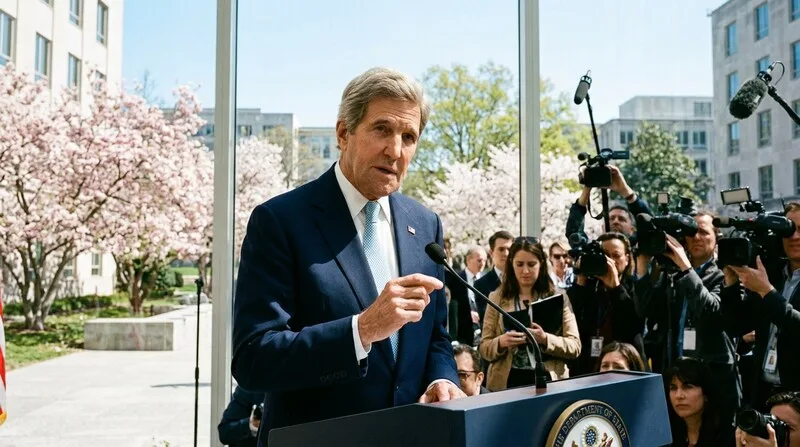
President Obama nominated Kerry to succeed Hillary Clinton as Secretary of State in December 2012. During his four years at Foggy Bottom, Kerry negotiated the Iran nuclear deal, co-authored the Paris climate agreement, and attempted a two-state Israeli-Palestinian peace framework. He returned to government as President Biden’s Special Presidential Envoy for Climate from 2021 to 2024, leading US climate diplomacy globally.
- John Kerry served as US Special Presidential Envoy for Climate (2021-2024) in the Biden administration — the first cabinet-level climate position in US history, making him the lead American negotiator at global climate summits including COP26, COP27, and COP28.
- He was the 2004 Democratic presidential nominee who lost to George W. Bush by 2.4 points — a close race in a wartime environment where Kerry's Vietnam veteran record was controversially attacked by the Swift Boat Veterans for Truth.
- Kerry served as Secretary of State (2013-2017) under Obama — negotiating the Iran nuclear deal (JCPOA) and co-authoring the Paris Climate Agreement, two of the most significant diplomatic achievements of the Obama era.
- He is a decorated Vietnam veteran and three-decade Massachusetts senator — representing Massachusetts from 1985-2013 in a seat he won after Ted Kennedy's retirement, and serving as chairman of the Senate Foreign Relations Committee.
Key Policy Areas
Foreign Policy & Diplomacy
Kerry spent three decades on the Senate Foreign Relations Committee before becoming its chairman, and then Secretary of State. As Secretary, he pursued an ambitious diplomatic agenda: the Iran nuclear deal (JCPOA, July 2015), which he co-negotiated over two years, the Paris climate agreement (December 2015), and extensive Middle East peace efforts. His diplomatic style was characterized by relentless personal engagement — he logged more miles than any previous Secretary of State. His work on Vietnam normalization in the 1990s helped repair a relationship fractured by the war he had protested.
Climate & Environment
climate polling became one of Kerry’s signature issues as Secretary of State and later as Biden’s Climate Envoy. He personally represented the US at critical climate negotiations and was a driving force behind the Paris Agreement’s structure and ambition. As Biden’s Special Envoy, he traveled extensively to negotiate bilateral climate commitments with China, India, and other major emitters — a role unprecedented in US diplomatic history that elevated climate to a top-tier foreign policy priority.
Veterans Affairs & Vietnam
Kerry’s record on veterans issues was shaped by his own Vietnam service and his transformation into an anti-war activist. In the Senate, he co-chaired the POW/MIA committee with John McCain, spending years investigating whether American prisoners remained in Vietnam after the war. Their committee’s conclusion — that no living prisoners remained — helped pave the way for the normalization of US-Vietnam relations in 1995. He worked closely with McCain throughout the 1990s and 2000s on Vietnam policy, a bipartisan partnership that was one of his most enduring Senate relationships.
Major Races
| Year | Race | Opponent | Result | Notes |
|---|---|---|---|---|
| 1984 | US Senate, Massachusetts | Ray Shamie (R) | Won 55% | Defeated Republican challenger for first term |
| 1990 | US Senate, Massachusetts | Jim Rappaport (R) | Won 57% | Re-elected; Gulf War debate raised his profile |
| 1996 | US Senate, Massachusetts | Bill Weld (R) | Won 52% | Closest Senate race; debates vs. popular Gov. Weld watched nationally |
| 2002 | US Senate, Massachusetts | JX Kenneally (R) | Won 80% | Dominant re-election while planning presidential bid |
| 2004 | President of the United States | George W. Bush (R) | Lost 251–286 EV | Decided in Ohio; Swift Boat Veterans campaign; Bush first to win majority since 1988 |
Kerry won the 2004 Democratic primary decisively after a strong performance in Iowa, defeating Howard Dean, John Edwards, and others. He chose Edwards as his running mate. The 2004 general election was one of the most bitterly contested of the modern era, dominated by the Iraq War, terrorism, and the Swift Boat Veterans campaign. Bush’s victory made him the first presidential candidate to win an outright popular vote majority since his father in 1988.
Historical Standing & Legacy
John Kerry’s reputation has been substantially rehabilitated by his post-2004 career. The 2004 loss, while painful, was a close election in difficult circumstances — an incumbent wartime president with a strong economy, a devastating opposition campaign, and a candidate who gave opponents ammunition with occasional rhetorical stumbles. Scholars of the 2004 campaign generally view it as a winnable election that Kerry’s campaign mishandled in specific ways, rather than a fundamental repudiation of his candidacy.
His record as Secretary of State (2013–2017) has given him a second legacy. The Iran deal, regardless of its ultimate fate after Trump’s withdrawal in 2018, was a remarkable diplomatic achievement — a multilateral agreement among countries with deeply conflicting interests, negotiated over years of sustained diplomacy. The Paris Agreement, which Kerry helped shape, remains the framework for international climate cooperation. His role as Climate Envoy under Biden extended his climate legacy further. He is now primarily regarded as one of the most consequential secretaries of state of the post-Cold War era, a legacy that has largely eclipsed the 2004 defeat.