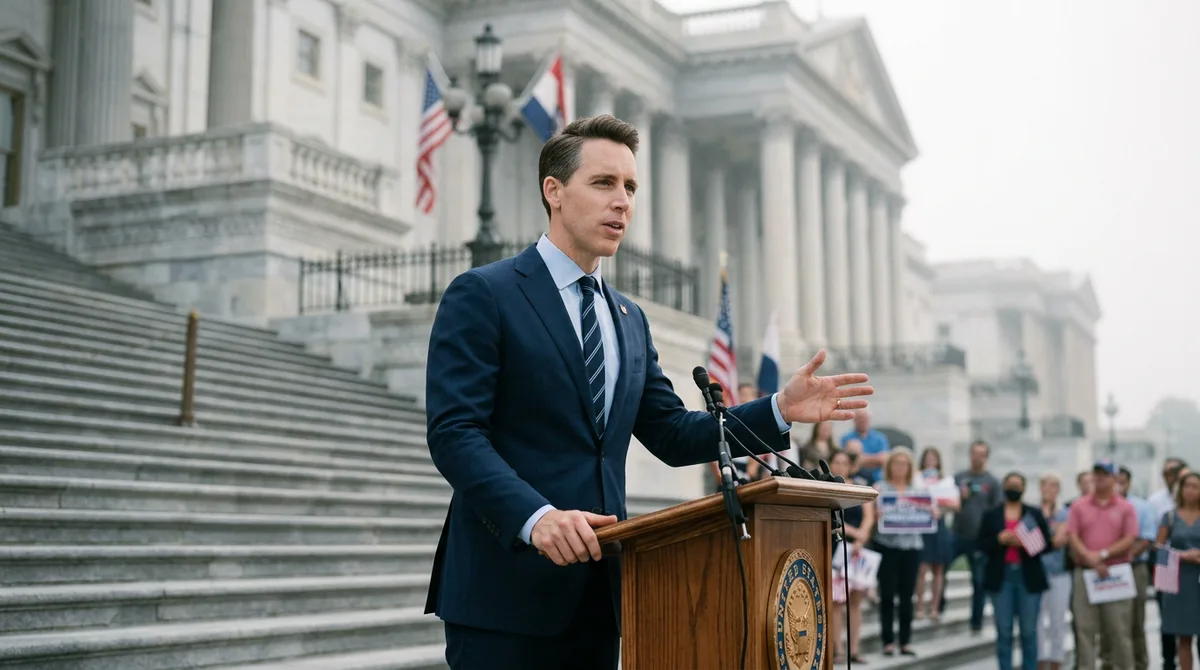
- Josh Hawley (R-MO) is a two-term Missouri senator re-elected in 2024 by 12 points, known for raising his fist in solidarity with protesters on January 6th and being one of the objectors to the certification of 2020 electoral votes.
- Missouri is R+15 — solidly Republican at the statewide level, and Hawley won his 2024 race easily despite Democratic hopes of making it competitive.
- He is a Yale Law graduate and former Missouri Attorney General who has staked out a distinctive "national conservative" position — supporting some economic populist policies (antitrust, Big Tech regulation) while remaining orthodox on cultural and immigration issues.
- Hawley is one of the few Republicans willing to challenge Silicon Valley from the right — co-sponsoring bills to break up Facebook, regulate social media for children, and limit tech company immunity under Section 230.
Biography
Joshua David Hawley was born on December 31, 1979, in Springdale, Arkansas, and grew up in Lexington, Missouri. He graduated from Stanford University with a degree in history and earned his JD from Yale Law School in 2006, where he was a member of the Yale Law Journal. He clerked for Judge Michael McConnell on the Tenth Circuit Court of Appeals and then for Chief Justice John Roberts on the Supreme Court — one of the most prestigious clerkship sequences in American law. He briefly practiced law and taught at the University of Missouri School of Law before entering politics at a young age.
Hawley won the Missouri Attorney General race in 2016 at age 36, defeating the incumbent Democrat by a significant margin. As AG, he pursued antitrust enforcement against large technology companies, positioning himself early on the issue that would define his Senate career. He ran for the US Senate in 2018, defeating two-term incumbent Democratic Senator Claire McCaskill. In the Senate he carved out a distinctive national profile as a right-wing populist intellectual — one of the few senators with genuine academic credibility who has pushed the Republican Party toward economic nationalism rather than traditional pro-business, free-trade conservatism.
Key Policy Areas
Anti-Big Tech
Hawley is the Senate’s most aggressive Republican critic of Amazon, Apple, Facebook, and Google. He has introduced structural breakup legislation, restrictions on social media addiction features, bans on foreign tech ownership, and liability for content moderation decisions — all positions that separate him sharply from Chamber of Commerce Republicanism.
Economic Nationalism
Hawley argues Republicans must abandon free-trade and pro-corporate policies in favor of American workers. He supports tariffs, domestic manufacturing incentives, and Chinese investment restrictions. His book The Tyranny of Big Tech argues that concentration of economic power in Silicon Valley threatens both prosperity and democratic governance.
Social Conservatism
Deeply influenced by Catholic social thought, Hawley has advocated for traditional family structures and male civic responsibility. His book Manhood (2023) argues American men face a crisis of purpose driven by liberal cultural dominance. He has opposed transgender rights legislation and supports broad religious liberty exemptions.
Electoral History
| Year | Office | Result | Margin |
|---|---|---|---|
| 2016 | Missouri Attorney General | Won | +6 pts |
| 2018 | U.S. Senate (defeated Claire McCaskill) | Won | +6 pts |
| 2028 | U.S. Senate (re-election, Class 1) | Likely Safe R | MO R+16 |
January 6 & Its Aftermath
Hawley became one of the most controversial figures associated with January 6, 2021. He was the first senator to announce plans to formally object to certifying Electoral College votes from Pennsylvania, and a widely circulated photograph captured him raising a fist in solidarity to protesters gathered outside the Capitol before the riot. After the Capitol attack, Simon & Schuster cancelled his book contract for The Tyranny of Big Tech; Hawley sued and settled, then published with Regnery to significant sales. He characterized the cancellation as Orwellian corporate censorship. Democrats and some Republicans called for his resignation; Hawley refused. He has never apologized and continues to defend the constitutional right to challenge certification on procedural grounds.
Frequently Asked Questions
Why is Josh Hawley famous for January 6?
The image of Hawley raising his fist to the crowd outside the Capitol on January 6 became one of the day's defining photographs. He was the first senator to announce he would object to certifying Electoral College votes. His book contract with Simon & Schuster was subsequently cancelled. He has never apologized.
What is Josh Hawley's stance on Big Tech?
Hawley is the Senate’s most aggressive Republican antitrust critic of Amazon, Apple, Facebook, and Google — introducing legislation for structural breakups, social media addiction restrictions, foreign ownership bans, and content moderation liability. This populist position separates him from most of his party’s donor base.
What is Josh Hawley's political ideology?
Hawley represents right-wing populist nationalism: social conservatism combined with economic nationalism, anti-Big Tech enforcement, and skepticism of free trade. He draws on Catholic social thought and nationalist political theory, arguing Republicans must shift from serving corporations to defending the working and middle class.
2028 Presidential Outlook
Hawley is frequently mentioned as a potential 2028 Republican presidential candidate, though he has not signaled formal intentions. His advantages are real: Yale Law credentials, a distinctive policy brand that separates him from traditional GOP donors, and appeal with the populist-nationalist base that Trump activated. His Senate majority is safe in Missouri, giving him financial freedom to campaign nationally without electoral risk through the 2028 cycle.
His challenges are significant. The January 6 photograph follows him in every national profile and makes him a polarizing figure even within the party. His populist-right positioning — while intellectually coherent — has found few major Republican donor networks willing to fund a challenge to the Vance/DeSantis tier. And in a crowded 2028 Republican field, his lane as an anti-Big Tech, economic nationalist may overlap with candidates who have both the credentials and the grassroots infrastructure he currently lacks.