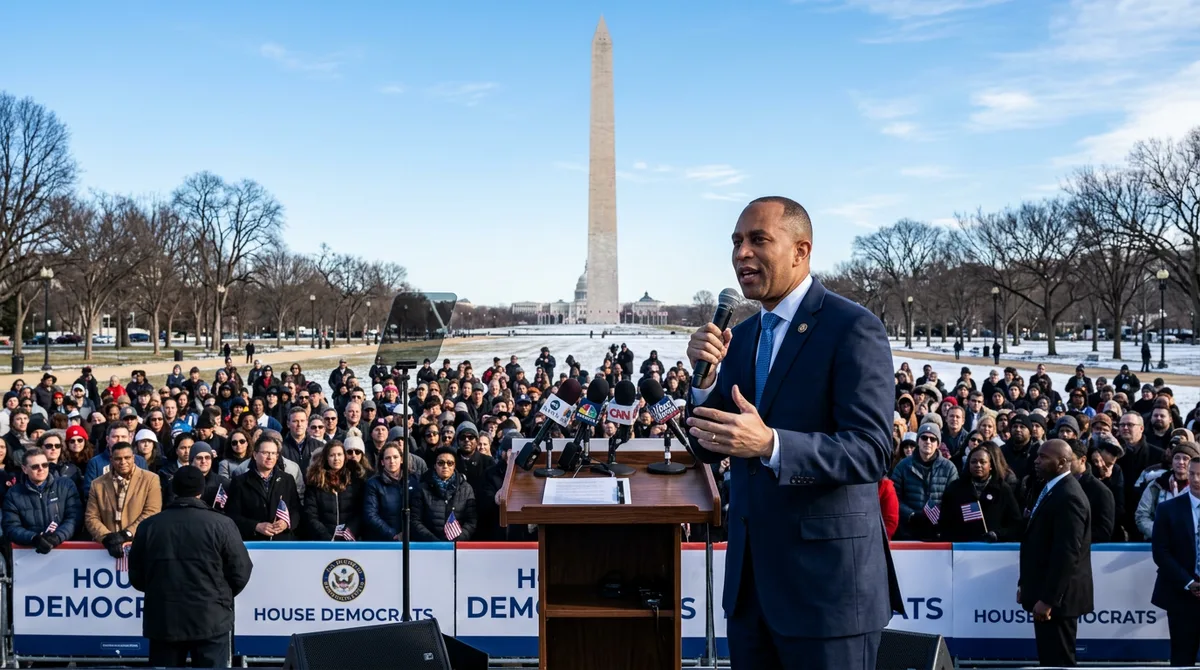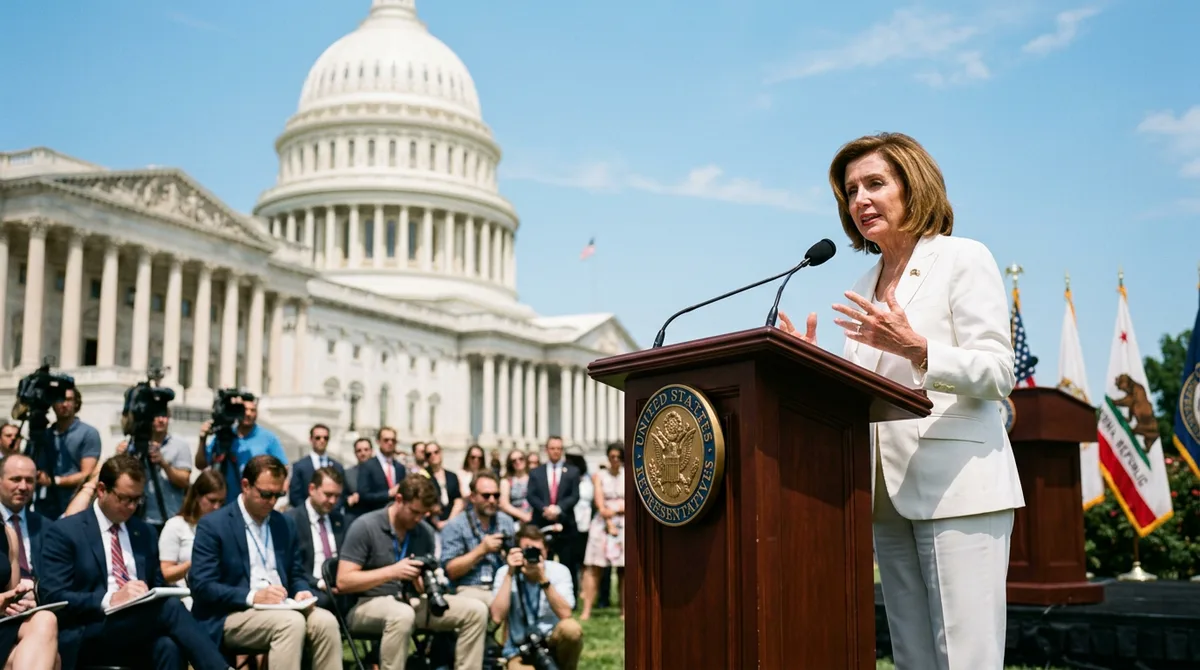
- Nancy Pelosi (D-CA) served as Speaker of the House twice (2007-2011, 2019-2023) — the only person in US history to serve two non-consecutive terms as Speaker and the first woman to hold the position.
- She guided the passage of the Affordable Care Act in 2010 — maneuvering the bill through a fractured House Democratic caucus against unanimous Republican opposition and significant internal Democratic skepticism about its political viability.
- Pelosi stepped down from House Democratic leadership in January 2023 — ending a 20-year run leading House Democrats — after Hakeem Jeffries was elected Minority Leader, making her the longest-serving Democratic House leader in history.
- California's 11th Congressional District (San Francisco) is D+47 — one of the safest Democratic seats in America, giving Pelosi the unassailable home base she needed to take controversial positions and accumulate the power needed to manage a fractious Democratic caucus.

Biography
Nancy Patricia Pelosi was born on March 26, 1940, in Baltimore, Maryland, into one of the most political families in the city’s history. Her father, Thomas D’Alesandro Jr., served five terms as Baltimore’s mayor and as a Maryland congressman; her brother, Thomas D’Alesandro III, was also mayor of Baltimore. She graduated from Trinity College in Washington in 1962, married Paul Pelosi in 1963, raised five children in San Francisco, and built a career in California Democratic Party politics over the following two decades, chairing the California Democratic Party from 1981 to 1983. In 1987 she won a special election to represent San Francisco in Congress and has held that seat continuously for nearly four decades.
Pelosi’s rise through House leadership was methodical. She became House majority Whip in 2002 and Minority Leader in 2003 — the first woman to lead a party in either chamber of Congress. When Democrats won the House majority in the 2006 midterms, she was elected Speaker: the first woman in American history to hold the position. Her first speakership (2007–2011) produced its defining legislative achievement in the Affordable Care Act, passed March 2010 under the most difficult circumstances. After Democrats lost the House in 2010’s Tea Party wave, Pelosi returned to Minority Leader, rebuilt the caucus, and recaptured the majority in 2018. She was elected Speaker a second time in January 2019 and presided over both Trump impeachments. She stepped down from leadership in January 2023, handing the gavel to Hakeem Jeffries.
Pelosi remains in the House as a member but without a formal leadership position. She continues to be one of the Democratic Party’s most prolific fundraisers — raising hundreds of millions for Democratic candidates over her career — and a trusted counsel to party leadership on matters of legislative strategy. Her successor Jeffries has led with a notably different style: where Pelosi was known for iron discipline and insider deal-making, Jeffries’ approach is more outward-facing and communicatively aggressive. Both approaches have their contexts; Pelosi’s was ideally suited to the legislative era she dominated.
Key Legislative Achievements
Affordable Care Act (2010)
After Democrats lost their 60-seat Senate supermajority in January 2010, most Washington insiders declared the ACA dead. Pelosi held the House caucus together, resolved the Stupak amendment on abortion funding through an executive order compromise, and passed the bill 219–212. It insures more than 20 million previously uninsured Americans. See: Healthcare & the ACA
Two Trump Impeachments
Pelosi presided over both impeachments of Donald Trump — the only president in American history to be impeached twice. The first (December 2019) centered on Ukraine pressure; the second (January 2021) charged incitement of insurrection following January 6th. The second passed 232–197 with 10 Republican votes, the most bipartisan presidential impeachment ever.
Dodd-Frank & ARRA
Under Pelosi’s first speakership, Congress also passed the American Recovery and Reinvestment Act of 2009 ($831B economic stimulus) and the Dodd-Frank Wall Street Reform Act of 2010, the most sweeping financial regulation since the Great Depression. Combined with the ACA, her 2009–2011 tenure produced more major legislation than any Congress in decades.
Political Legacy & Polarization
Few figures illustrate American partisan polarization as vividly as Nancy Pelosi. Among Democrats she is regarded as a legislative virtuoso — a Speaker who delivered results that multiple predecessors could not, most notably the ACA — and as a trailblazer for women in leadership. Among Republicans she has been the premier fundraising villain for two decades, appearing in thousands of attack ads and serving as a reliable mobilizing force for conservative donors. Her national net approval has ranged from roughly −5% to −15% in recent years, reflecting near-universal name recognition and partisan sorting rather than genuine disapproval of her legislative record.
The moment that defined her public image for a generation came on February 4, 2020. At the conclusion of Donald Trump’s State of the Union address, Pelosi tore her printed copy of his speech in half on live national television, standing directly behind and above the president. The image was replayed millions of times. Pelosi described the speech as “a manifesto of mistruths.” Trump had declined to shake her hand at the start of the evening. Her response to January 6th — coordinating evacuation of Congress, communicating directly with military leadership about her concerns, and driving the second impeachment through the House within one week — is regarded by historians as consequential crisis management under acute pressure.
She handed power to Hakeem Jeffries in January 2023 after 20 years in leadership. Jeffries, at 52, represents a generational shift: younger, more diverse, Brooklyn-raised rather than San Francisco donor-class. Pelosi’s institutional legacy — the coalition she built, the fundraising infrastructure she created, the procedural discipline she imposed — will shape the House Democratic caucus well beyond her active service.
What This Means for the 2026 Elections
Still the Republican fundraising villain: Pelosi’s face remains a standard fixture in Republican fundraising emails and attack ads in 2026 even without a formal leadership role. In competitive House races, challengers will attempt to tie Democratic incumbents to Pelosi’s San Francisco identity. Democrats in swing districts have learned to either embrace her legislative record while separating themselves from her cultural brand, or to emphasize their independence from party leadership.
The Jeffries comparison: Hakeem Jeffries as Minority Leader operates with a thinner margin than Pelosi enjoyed in her speakership years. Democrats need a net gain of roughly 4 seats to retake the House majority in 2026. Pelosi’s institutional knowledge and donor network will be crucial to that effort even from the backbench — she spent 2023–2025 actively recruiting candidates and raising money for targeted districts.
Her ACA legacy on the ballot: Republican efforts to cut Medicaid as part of the 2025–2026 budget reconciliation process have made the ACA’s legacy newly relevant in 2026 competitive races. Pelosi’s role in passing the law is a direct connection point for Democrats defending the program. See: Healthcare & ACA polling
Watch: The Affordable Care Act & Medicare Legacy
The ACA — Pelosi's defining legislative achievement, passed 219–212 in 2010 after she held a fractured House caucus together against unanimous Republican opposition — continues to insure more than 20 million Americans and remains the most-debated domestic policy of the past two decades. See healthcare polling.
Frequently Asked Questions
What is Nancy Pelosi's most important legislative achievement?
The Affordable Care Act (2010) is Pelosi's defining achievement. After the bill appeared dead in January 2010 when Democrats lost their Senate supermajority, Pelosi held the House caucus together, navigated the Stupak abortion funding dispute, and passed the ACA 219-212. It insured more than 20 million previously uninsured Americans and remains the largest expansion of US healthcare since Medicare in 1965.
How many times did Pelosi impeach Donald Trump?
Twice — making Trump the only president in American history to be impeached twice. The first impeachment (December 2019) charged abuse of power and obstruction over Ukraine. The second (January 2021) charged incitement of insurrection after the Capitol riot. The second passed 232-197 with 10 Republican votes, the most bipartisan presidential impeachment ever. The Senate acquitted Trump both times.
Why did Nancy Pelosi tear up Trump's State of the Union speech?
At the end of Trump's February 4, 2020 State of the Union address, Pelosi tore the printed speech in half on live television, standing directly behind the president at the podium. She described the speech as "a manifesto of mistruths." Trump had declined to shake her hand at the start of the evening. The image became one of the most replayed moments of the Trump-Pelosi political rivalry.
Is Nancy Pelosi still in Congress?
Yes. As of 2026, Pelosi still represents her San Francisco district in the House, which she has held since 1987. She stepped down from House Democratic leadership in January 2023, handing the Minority Leader role to Hakeem Jeffries. She no longer holds a formal leadership position but remains an influential fundraiser and institutional voice within the Democratic Party.
What did Pelosi do on January 6th, 2021?
During the Capitol insurrection, Pelosi was evacuated from the House chamber. She coordinated directly with military and law enforcement leadership, expressing concerns about Trump's intentions in phone conversations later made public. Within one week, she drove the second impeachment of Trump through the House 232-197 — a 232-197 vote that included 10 Republican members, the most bipartisan presidential impeachment in US history.
Electoral History
| Year | Race | Result | Notes |
|---|---|---|---|
| 1987 | US House — CA-5 (special election) | Won | Won special election to fill seat vacated by Sala Burton; first elected to Congress |
| 1988–2022 | US House — San Francisco (re-elections) | Won (18x) | Re-elected continuously; typically 70-80%+ in her safely Democratic district |
| 2007 | Speaker of the House | Elected | First woman Speaker in US history; Democrats won 31 seats in 2006 midterms |
| 2019 | Speaker of the House (second term) | Elected | Democrats flipped 41 House seats in the 2018 midterms to retake the majority |
| 2022 | US House — final election as leader | Won | Won re-election; stepped down from leadership after Democrats lost House majority by 4 seats |