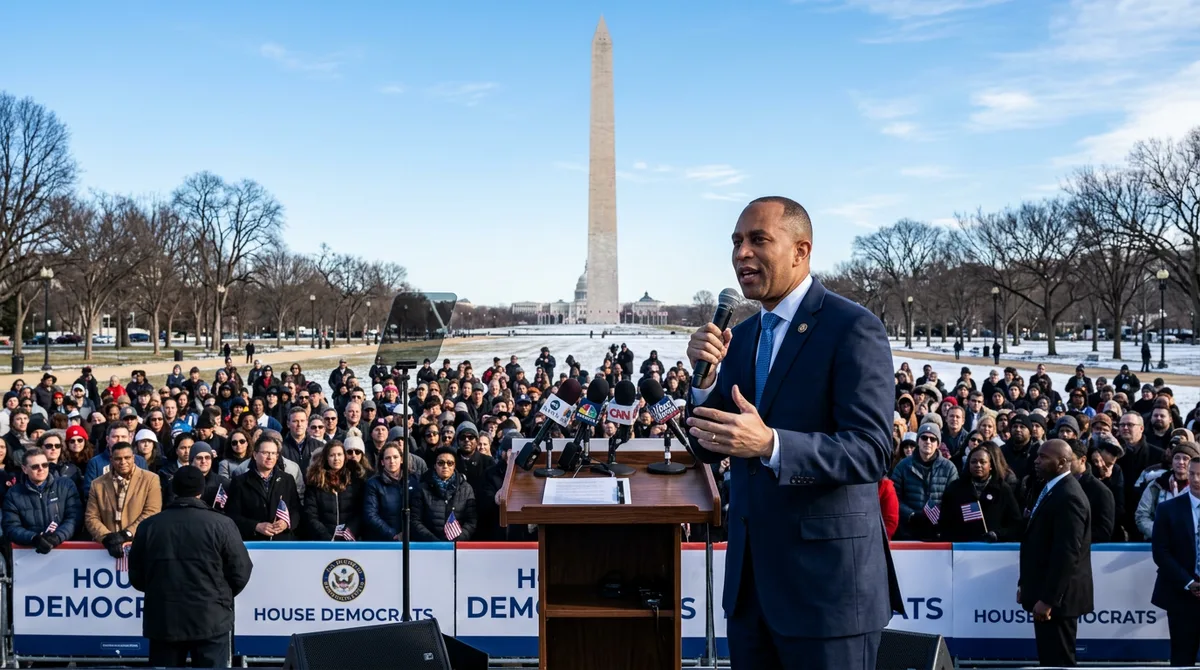
- Hakeem Jeffries (D-NY) was elected House Minority Leader in November 2022 — succeeding Nancy Pelosi and becoming the first Black American to lead a party caucus in the history of the US Congress.
- He represents New York's 8th Congressional District (Brooklyn/Queens) — a D+40 safe seat he has held since 2013, giving him the secure home base needed to lead House Democrats from opposition.
- Jeffries was a corporate litigator and New York state legislator before entering Congress — his legal background and pragmatic centrist positioning within the Democratic caucus made him the consensus choice for leader when Pelosi announced her retirement.
- As Minority Leader, Jeffries has positioned House Democrats as a check on Republican extremism — successfully negotiating Democratic votes to save Kevin McCarthy's speakership when it was under threat and keeping Democratic caucus unity on key votes.
Biography
Hakeem Sekou Jeffries was born on August 4, 1970, in Brooklyn, New York, and raised in the Crown Heights neighborhood. His father was a New York State social services employee and his mother worked as a guidance counselor. Jeffries attended Binghamton University, where he studied political science, and earned his law degree from New York University School of Law in 1997.
He worked as a corporate attorney at Paul, Weiss, Rifkind, Wharton and Garrison and Viacom before entering politics. Jeffries served in the New York State Assembly from 2007 to 2012, representing Brooklyn districts, where he developed a reputation as a skilled legislator focused on criminal justice reform and economic development in underserved communities.
Jeffries was first elected to the US House of Representatives in 2012, succeeding retiring Democrat Edolphus Towns in a district covering parts of Brooklyn and Queens. He was re-elected by wide margins in subsequent elections and rose quickly through the House Democratic caucus, serving on the House Budget Committee and the House Judiciary Committee, where he gained national visibility during Donald Trump’s first impeachment proceedings in 2019 as one of the House managers.
Jeffries was elected House Democratic Caucus Chair in 2019, the fifth-ranking position in House Democratic leadership. When Nancy Pelosi announced her retirement from leadership in November 2022, Jeffries was the consensus choice to succeed her. He was elected House Minority Leader by the full Democratic caucus in November 2022, becoming the first Black legislator in American history to lead a major party in either chamber of Congress.
As Minority Leader, Jeffries has been praised for his discipline in holding together a caucus that spans the progressive wing and moderate suburban Democrats. He has made the 2026 House majority the central focus of his leadership, calculating that a five-seat pickup is within reach if economic dissatisfaction with the Trump administration continues. His approval ratings among Democrats are high, and he has been consistently effective at keeping divisive intra-party fights from consuming the caucus’s public messaging.
Key Policy Positions
Economic Justice
Jeffries supports higher wages, housing affordability, student debt relief and opposing what he frames as Republican “tax cuts for the wealthy.” He positions himself as a pragmatic progressive who can deliver results rather than rhetoric — a contrast to both the far left and the corporate center of the party. His economic messaging in 2026 focuses heavily on tariffs as a consumer tax that hits working families.
Criminal Justice
A former defense attorney, Jeffries has championed police accountability and sentencing reform while also emphasizing public safety. He supported the George Floyd Justice in Policing Act and has backed federal sentencing reform to reduce mandatory minimums for non-violent drug offenses. He explicitly rejects the “defund the police” framing that hurt Democrats in 2020.
Democracy Protection
Jeffries is a vocal critic of what he describes as Republican attempts to restrict voting access and undermine democratic institutions. He has led House Democratic efforts to call attention to executive overreach under the Trump administration, framing it as a constitutional crisis. His floor speeches — often using an alphabetic framework — have become a signature rhetorical style. Pressed directly on Meet the Press about whether Democrats would move to impeach Trump if they retake the House, Jeffries declined to rule it out, saying the party had not "ruled anything in or ruled anything out."
2026 Midterm Relevance
The 2026 midterms are the defining moment of Jeffries’ leadership tenure. Democrats need a net gain of just 5 House seats to claim the majority — the smallest pickup target the party has faced heading into a midterm as the out-of-power party in decades. The generic congressional ballot has shown Democrats with a modest lead, and Trump’s approval ratings in swing districts have been persistently below 50%.
Jeffries’ strategy focuses on approximately 30 competitive suburban districts where Trump’s 2024 margin was narrow. His target list is concentrated in the Philadelphia suburbs, Atlanta’s northern exurbs, Maricopa County in Arizona, and Michigan’s Oakland County. The messaging framework he has built around healthcare protection (opposing Medicaid cuts), economic relief (opposing tariffs as a consumer tax), and institutional defense has polled well in focus groups.
If Democrats retake the House in November 2026, Jeffries would become Speaker of the House in January 2027 — the first Black person ever elected Speaker of the House — and a near-certain major candidate for the 2028 Democratic presidential nomination. That outcome would also reshape the Democratic Party’s internal balance of power significantly, elevating the pragmatic center over both the progressive left and the moderate centrists.
Electoral History
| Year | Office | Result | Margin |
|---|---|---|---|
| 2012 | U.S. House, NY-8 (succeeded Towns) | Won | D+60 |
| 2014–2020 | U.S. House, NY-8 (re-elections) | Won (4x) | D+60–75 |
| 2022 | U.S. House, NY-8 + elected Minority Leader | Won | Caucus: unanimous |
| 2024 | U.S. House, NY-8 (re-election) | Won | D+65 |
Frequently Asked Questions
Who is Hakeem Jeffries?
Hakeem Jeffries is the House Minority Leader and representative for New York’s 8th congressional district (Brooklyn and Queens). He became Minority Leader in January 2023, succeeding Nancy Pelosi, as the first Black legislator to lead a major party in either chamber of Congress.
How many seats do Democrats need for Jeffries to become Speaker?
Democrats hold 213 seats; the majority threshold is 218. A net gain of 5 seats in the 2026 midterms would put Jeffries in line to become Speaker when the 120th Congress convenes in January 2027. The 5-seat threshold is the smallest required pickup for the out-of-power party since modern competitive two-party House elections began.
Is Hakeem Jeffries running for president in 2028?
Jeffries has not announced a presidential campaign and says his focus is on the House. He is frequently mentioned as a potential 2028 candidate, particularly if Democrats win the House in 2026 and he becomes Speaker. A Speaker Jeffries would have national visibility and fundraising power that would make a 2028 run viable.
What is Jeffries’ strategy to win back the House majority?
Jeffries targets roughly 30 suburban districts won by Trump with narrow 2024 margins. His three-pillar message: healthcare protection (opposing Medicaid cuts in any reconciliation bill), economic relief (framing tariffs as a consumer tax), and institutional defense. The strategy mirrors how Democrats won the 2018 House majority — suburban-focused, healthcare-anchored, framed as a check on presidential power.
How does Jeffries manage the progressive vs. moderate tension in the Democratic caucus?
Jeffries avoids taking public sides in ideological fights between the progressive AOC/Sanders wing and centrist Democrats from swing districts. He keeps the caucus united by focusing on procedural opposition to Republican legislation, using the minority’s limited tools strategically, and managing the shared goal of the House majority. He has been notably more effective at this than his predecessors.