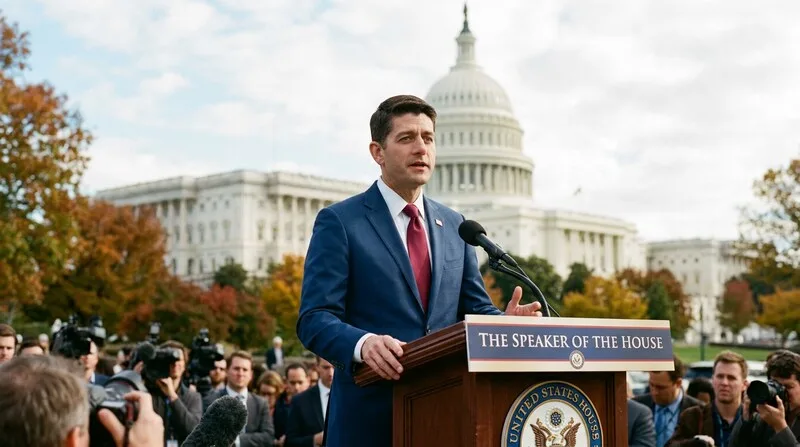
- Paul Ryan (R-WI) served as Speaker of the House (2015-2019) — the youngest Speaker in 150 years at age 45, who oversaw the passage of the Tax Cuts and Jobs Act of 2017 before announcing his retirement from Congress.
- He was the 2012 Republican vice presidential nominee alongside Mitt Romney — chosen for his budget expertise and political skills, his "Path to Prosperity" budget blueprints defined Republican fiscal thinking for a decade.
- Ryan represented Wisconsin's 1st Congressional District (Janesville) for 20 years (1999-2019) — building his reputation on the House Budget Committee as a policy wonk focused on entitlement reform, becoming the leading Republican voice on Social Security and Medicare restructuring.
- His retirement was driven in part by his frustration with Trump's governing style — Ryan was privately critical of Trump on trade, deficits, and character but rarely publicly challenged him, a tension that defined his speakership and shaped his legacy.
Biography
Paul Ryan grew up in Janesville, Wisconsin, the seat of Rock County in southern Wisconsin’s manufacturing heartland. He attended Miami University in Ohio and interned for Jack Kemp — the former NFL quarterback turned congressman and housing secretary who was the intellectual godfather of supply-side economics within the Republican Party. Ryan idolized Kemp and absorbed his conviction that tax cuts and market economics could lift all Americans, including the poor. He was elected to Congress from Wisconsin’s First District in 1998 at age 28, defeating the incumbent in a cycle that otherwise went poorly for Republicans. He became known early in his congressional career as the party’s most serious budget thinker — an Ayn Rand devotee (he later distanced himself from Rand’s atheism while maintaining her economic framework) who was genuinely fluent in fiscal policy at a level unusual in either party. Mitt Romney selected him as VP running mate in August 2012, elevating his national profile. As Budget Committee chairman, Ryan authored a series of “Path to Prosperity” budgets that proposed restructuring Medicare as a premium-support (voucher) system, converting Medicaid to block grants, cutting discretionary spending, and reducing top marginal tax rates. Democrats ran a famous campaign ad showing a Ryan-like figure pushing a wheelchair-bound elderly woman off a cliff. The budgets were never enacted but defined Republican fiscal thinking for nearly a decade.
Ryan became Speaker of the House in October 2015 after John Boehner resigned in exhaustion from managing the House Freedom Caucus. He agreed to take the job only after extracting promises of support from all Republican factions, including the Freedom Caucus — promises that proved difficult to honor in practice. His speakership coincided with Trump’s 2016 election and the first two years of his presidency. Ryan’s relationship with Trump was one of the defining dysfunctions of the 118th Congress. After the Access Hollywood tape in October 2016, he told House Republicans he was “done” with Trump and would not defend him — but continued serving as Speaker after Trump’s election. His major legislative achievement was the Tax Cuts and Jobs Act of December 2017, a $1.5 trillion tax reduction that cut the corporate rate from 35% to 21%, reduced individual rates, and eliminated the individual mandate of the ACA. His primary legislative goal — repealing the Affordable Care Act — failed repeatedly. The most dramatic failure was the “skinny repeal” in July 2017, which John McCain killed with his 1:30 a.m. thumbs-down vote on the Senate floor. Ryan announced he would not seek re-election in March 2018, citing family, and left Congress in January 2019.
After leaving Congress, Ryan joined the board of Fox Corporation — the parent company of Fox News — a decision widely noted as ironic given his private dismay at how Fox covered Trump and the political reality the network had helped create. He has not written a memoir. He lives in Janesville with his wife Janna and their three children. His legacy within the Republican Party is that of a man whose brand — serious policy, fiscal discipline, Medicare reform, supply-side orthodoxy — effectively ceased to exist as a viable political force after Trump’s 2016 election. The Tax Cuts and Jobs Act is his most durable legislative achievement, though critics note it added substantially to the deficit he spent his career warning about. Younger Republicans view him as a relic of a policy-focused conservatism that the base never actually demanded; Democrats view him as the politician who nearly privatized Medicare and whose tax cuts primarily benefited corporations and the wealthy. Neither view is entirely wrong.
Key Policy Areas
Budget & Fiscal Policy
Ryan’s political identity was built on fiscal policy. His “Path to Prosperity” budget proposals (2011, 2012, and subsequent versions) were the most detailed deficit-reduction plans offered by a major party politician in the Obama era. The central element was converting Medicare from a defined-benefit program into premium support — giving seniors a fixed payment to purchase private insurance, rather than a guaranteed benefit. The proposal was enormously controversial and never enacted. Ryan consistently argued that without entitlement reform, the federal debt was unsustainable. Critics noted that his tax cuts added to the very debt he warned about, and that premium support would in practice shift healthcare costs onto seniors rather than control system-wide spending.
Healthcare & ACA Repeal
Ryan spent years promising to repeal the Affordable Care Act and arrived as Speaker with a Republican majority and a Republican president — what appeared to be the optimal conditions to deliver. He failed. The American Health Care Act, the House replacement bill, passed the House in May 2017 but was significantly altered in the Senate. The “skinny repeal” — a scaled-down Senate version — was killed by John McCain’s July 2017 thumbs-down vote, preserving the ACA. The failure was partly legislative (the Senate’s constraints) and partly substantive (the difficulty of repealing benefits already being used by millions of Americans). Ryan’s decade-long promise to repeal the ACA produced no legislative result.
Supply-Side Economics & Tax Reform
The Tax Cuts and Jobs Act of December 2017 was Ryan’s most significant enacted legislation. It cut the corporate income tax rate from 35% to 21%, reduced individual rates across the board, eliminated the ACA individual mandate, and nearly doubled the standard deduction. Ryan argued that corporate tax cuts would generate sufficient economy polling to partially offset the revenue loss; the Congressional Budget Office projected the law would add approximately $1.5 trillion to the deficit over ten years. Ryan had spent his career warning about deficit spending — the gap between his rhetoric and the TCJA’s fiscal impact was one of the central criticisms of his speakership legacy. The law was his clearest enactment of the Jack Kemp supply-side tradition he had internalized since his congressional internship.
| Year | Event | Result / Legacy |
|---|---|---|
| 1998 | Elected to Congress, WI-1, at age 28 | Interned for Jack Kemp; became the party's chief budget intellectual before 40 |
| 2011–2012 | "Path to Prosperity" budget proposals | Proposed converting Medicare to premium support (vouchers), Medicaid to block grants; never enacted; defined R fiscal thinking for a decade |
| Aug 2012 | Selected as Mitt Romney's VP running mate | Lost 206–332 EV; Ryan won his home district but helped nationalize the Medicare debate |
| Oct 2015 | Became Speaker of the House | Succeeded Boehner after Freedom Caucus driven resignation; extracted written support promises before accepting |
| Dec 2017 | Tax Cuts and Jobs Act signed | $1.5T tax cut; corporate rate 35% → 21%; top individual rate 39.6% → 37%; CBO projected +$1.5T deficit — the ultimate irony for a deficit hawk |
| Jul 27-28, 2017 | ACA "skinny repeal" failed 1:30am Senate vote | John McCain's thumbs-down killed Ryan's primary legislative promise; the ACA survived his entire tenure |
| Mar 2018 | Announced not seeking re-election | Republicans lost the House 194–235 in November; Ryan led the majority for the last time |
| Post-Congress | Joined Fox Corporation board | Parent company of Fox News — widely noted as ironic; he privately blamed Fox's Trump coverage for what he saw as the party's collapse |
Historical Legacy
Paul Ryan’s legacy is that of the Republican Party’s last serious policy intellectual — and the limits of what policy intellectualism can accomplish in an era of populist politics. His Ryan Budgets were the most detailed and substantive budget proposals offered by a major party politician in a generation. His Medicare restructuring proposal was politically courageous in the sense that it offered a genuine answer to the long-term fiscal trajectory rather than deferring the problem. None of it was enacted. The base that elected Republican majorities in 2010, 2014, and 2016 did not want Medicare restructured — they wanted cultural grievance addressed, immigration restricted, and elite institutions challenged. Ryan’s policy agenda and the Republican electorate’s actual priorities were misaligned in ways he only fully acknowledged after leaving office.
His three years as Speaker were defined by a central contradiction: he was the institutional Republican establishment trying to govern alongside a president who had explicitly run against everything the institutional Republican establishment represented. He could neither fully align with Trump — whose conduct he privately found repugnant — nor openly oppose him without destroying the majority he needed to pass any legislation at all. The Tax Cuts and Jobs Act passed; the ACA repeal failed; the deficit grew; the Freedom Caucus was never controlled; Trump’s behavior was never checked. Ryan’s Fox Corporation board seat — joining a company whose flagship channel had done more than any other single media institution to make Trumpism politically viable — remains the most difficult element of his post-congressional record to reconcile with the principled fiscal conservative he presented himself as during his career.
Watch: Paul Ryan RNC Vice-Presidential Acceptance Speech
Paul Ryan delivers his vice-presidential acceptance speech at the 2012 Republican National Convention in Tampa.
Frequently Asked Questions
Why did Paul Ryan leave Congress?
Ryan announced he would not seek re-election in March 2018 and left Congress in January 2019, citing family and a desire to return to Janesville, Wisconsin. The political context was plain: his relationship with Trump had become untenable, the Republican majority was expected to be lost in the 2018 midterms (it was, by 40 seats), and leading a House majority held no appeal. His primary legislative goal — repealing the ACA — had failed, and the broader “reform conservative” brand of Republicanism he represented — serious budget policy, entitlement reform, free trade — had no visible future in a Trump-era Republican Party. His departure was less a personal choice than a recognition that the institution he had tried to lead no longer existed in the form he had believed in when he arrived in Washington at age 28.
What is the Ryan Budget?
The Ryan Budget refers to a series of federal budget proposals Ryan authored as Budget Committee chairman beginning around 2008. The most famous versions — “The Path to Prosperity” — proposed converting Medicare from a defined-benefit program into a premium-support (voucher) system, converting Medicaid to block grants, cutting discretionary spending significantly, reducing top marginal tax rates, and achieving a balanced budget over a decade or more. Democrats attacked the Medicare restructuring in a famous campaign ad showing a Ryan-like figure pushing a wheelchair-bound grandmother off a cliff. The budgets were never enacted — they passed the House in some form but died in the Democratic Senate. They defined Ryan as the Republican Party’s chief policy intellectual for most of Obama’s presidency.
Was Paul Ryan a good Speaker of the House?
Ryan’s speakership produced one major legislative achievement — the Tax Cuts and Jobs Act of 2017 — and a series of significant failures, most notably the inability to repeal the ACA despite Republican control of both chambers and the presidency. He never controlled the House Freedom Caucus that had made John Boehner’s life impossible. His relationship with Trump was privately toxic and publicly managed but never resolved. He left with the House majority about to be lost. His defenders argue the structural constraints were overwhelming — a narrow majority, a Senate filibuster, an unpredictable president. His critics argue that a more skilled political operator could have achieved more, or at minimum done less to normalize conduct he privately found disqualifying. Neither assessment is unreasonable.