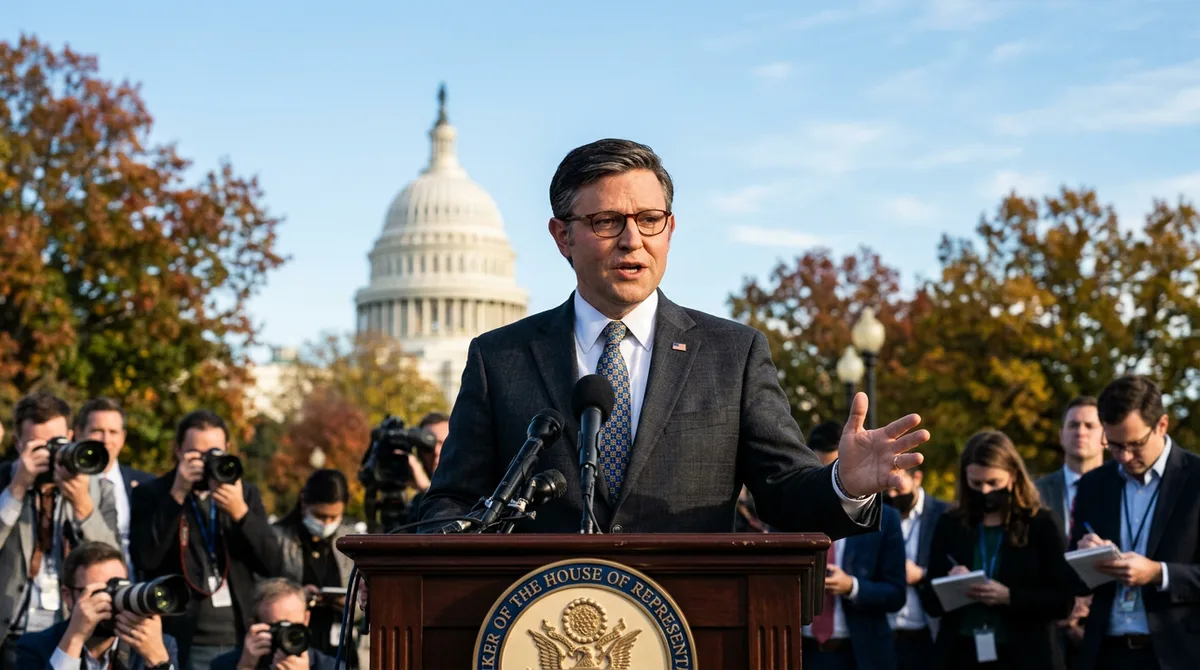
- Mike Johnson (R-LA) was elected Speaker of the House in October 2023 on a unanimous Republican vote after three previous Speaker nominees failed — chosen as a consensus candidate after weeks of House dysfunction following Kevin McCarthy's ouster.
- He is a constitutional lawyer and evangelical Christian from Shreveport, Louisiana — his legal background drove his involvement in challenging the 2020 election results, signing an amicus brief supporting the Texas lawsuit to overturn Biden's win in key states.
- Johnson's LA-4 district is R+21 — covering Shreveport and rural northwest Louisiana, it is a reliably Republican seat that gives him the safe home base needed to take controversial positions without electoral risk.
- As Speaker, Johnson negotiated continued Ukraine aid funding in 2024 despite significant Freedom Caucus opposition — a decision that showed his willingness to work with Democrats on national security while facing internal Republican pressure from the MAGA wing.

Biography
Michael Dean Johnson was born on January 30, 1972, in Shreveport, Louisiana. He grew up in northwest Louisiana and attended Louisiana State University, earning both his undergraduate degree and his law degree from LSU. After law school, he worked as a constitutional attorney and advocate for religious liberty organizations, including the Alliance Defending Freedom, where he argued cases related to religious expression and social conservatism.
Johnson served in the Louisiana House of Representatives from 2015 to 2016 before winning the US House majority for Louisiana's 4th congressional district in 2016. He is a deeply conservative Christian and has described the Bible as his worldview guide, a statement that attracted intense media attention when he became Speaker. His congressional record reflects this: strong opposition to abortion polling, opposition to same-sex marriage, consistent support for gun polling and skepticism of federal spending.
Johnson rose through House majority leadership relatively quickly, serving on the House Judiciary Committee and becoming vice chair of the House Republican Conference. He was elected House Republican Conference Chairman in 2022, the fourth-ranking leadership position in the House GOP. He played a significant role in the efforts to challenge the 2020 election results, helping to organize an amicus brief signed by 126 Republican House members supporting the Texas lawsuit that sought to invalidate electoral votes in four states — a lawsuit the Supreme Court declined to hear.
When Kevin McCarthy was removed as Speaker on October 3, 2023, by a motion to vacate filed by Rep. Matt Gaetz, the Republican base entered a chaotic selection process. Multiple nominees — including Steve Scalise, Jim Jordan and Tom Emmer — failed to secure the votes needed. Johnson emerged as a consensus choice on October 25, 2023, winning election as the 56th Speaker with the full support of the Republican caucus, aided by Trump's endorsement.
As Speaker, Johnson has navigated extraordinarily difficult terrain with a majority as narrow as 1–2 seats at times during the 118th Congress. He passed a government funding package with Democratic votes in March 2024 that enraged the Freedom Caucus, and he approved Ukraine military aid despite opposition from Trump-aligned members — a consequential vote that illustrated the constraints of his thin majority.
Key Policy Positions
Fiscal Conservatism
Johnson is a traditional fiscal conservative who supports significant federal spending cuts, reduced entitlement programs, and cutting the national debt. His budget reconciliation agenda in 2025 includes Medicaid reductions, food assistance cuts and other social spending rollbacks that have energized Democratic opposition ahead of 2026.
Social Conservatism
Johnson holds strong conservative positions on abortion (opposition to federal funding), opposition to same-sex marriage protections, religious liberty as a constitutional priority, and opposition to what he characterizes as progressive ideology in public education. He frames these positions explicitly through his Christian faith.
Trump Alignment
Johnson is tightly aligned with Trump's second-term agenda, advancing budget reconciliation that funds border security, deportation operations and extends the 2017 Tax Cuts and Jobs Act. Managing the tension between advancing the presidential agenda and protecting his members in competitive 2026 districts from politically difficult votes is his central leadership challenge.
2026 Midterm Relevance
Johnson's Speakership is directly at stake in the 2026 midterms. If Republicans lose 5 or more House seats, Democrats retake the majority and Hakeem Jeffries becomes Speaker. Protecting the Republican majority means protecting every competitive district — many of which are in suburban areas where the Medicaid cuts and tariff economics in the Republican budget reconciliation package are unpopular.
His challenge is managing competing demands: the Freedom Caucus demands aggressive conservative positions, while members from districts Biden or Harris won narrowly need room to moderate. Johnson's approach has generally prioritized keeping the caucus together on leadership-level votes while giving members maximum flexibility on messaging back home.
The passage or failure of the Republican budget reconciliation package — including how large Medicaid cuts ultimately prove to be — will be the single most important legislative variable shaping the 2026 competitive map.
Electoral History
| Year | Office | Result | Margin |
|---|---|---|---|
| 2015–2016 | Louisiana State House | Won (1 term) | Safe R |
| 2016 | U.S. House, LA-4 (first win) | Won | R+25+ |
| 2018–2022 | U.S. House, LA-4 (re-elections) | Won (3x) | R+30+ |
| Oct 2023 | Elected 56th Speaker of the House | Elected | 220–209 |
| 2024 | U.S. House, LA-4 (re-election) | Won | R+35+ |
Frequently Asked Questions
Who is Mike Johnson?
Mike Johnson is the 56th Speaker of the House, representing Louisiana's 4th congressional district. Elected Speaker in October 2023 after Kevin McCarthy's removal, Johnson is a constitutional lawyer and deeply conservative Christian who has aligned closely with the Trump administration's agenda.
How did Mike Johnson become Speaker?
Johnson became Speaker after Kevin McCarthy was removed by a motion to vacate in October 2023 — the first time in US history a Speaker was removed this way. After multiple failed candidates, Johnson emerged as a consensus choice with Trump's endorsement on October 25, 2023.
What are Johnson's biggest challenges as Speaker?
Managing a razor-thin majority while advancing the Trump legislative agenda and protecting members in competitive 2026 districts. Budget cuts, especially to Medicaid, risk becoming a political liability. Any defections by a handful of Republican members can block legislation, giving the Freedom Caucus significant leverage.