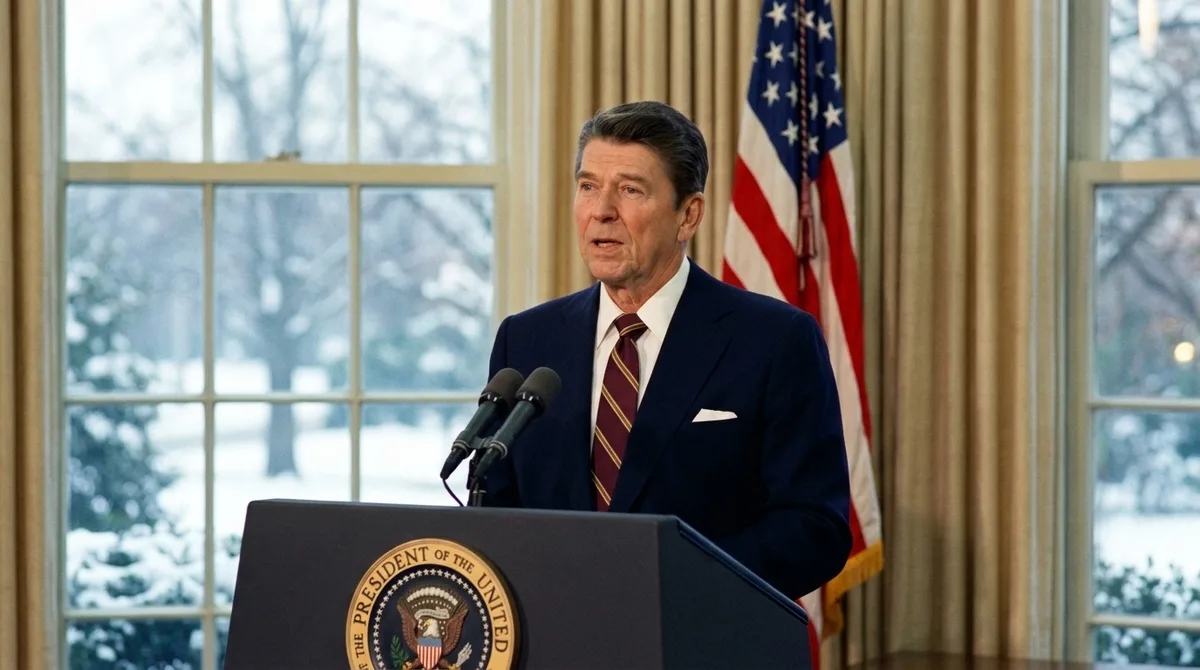
- Ronald Reagan served as the 40th President of the United States (1981-1989) — winning 49 states in 1984 against Walter Mondale in the largest Electoral College victory in modern history (525 votes), transforming American conservatism.
- Reaganomics — cutting the top marginal tax rate from 70% to 28%, deregulating industries, and reducing domestic spending — defined a generation of American economic policy and remains the template for Republican fiscal proposals decades later.
- Reagan's military buildup and confrontational stance toward the Soviet Union — calling it an "Evil Empire" — is credited by many historians as accelerating the Soviet collapse and ending the Cold War, though others attribute the outcome primarily to internal Soviet contradictions.
- He survived an assassination attempt in March 1981 — 69 days into his presidency — and his recovery and good humor ("I forgot to duck") became a defining moment of his presidency, reinforcing his image as an optimistic, unflappable leader.

Biography
Ronald Wilson Reagan was born on February 6, 1911, in Tampico, Illinois, the son of a shoe salesman. He grew up in Dixon, Illinois, attended Eureka College on a partial athletic scholarship, and worked as a radio sportscaster in the Midwest before moving to California in 1937. He became a contract actor at Warner Bros., appearing in more than 50 films over two decades — most famously as Notre Dame football legend George Gipp in “Knute Rockne, All American” (1940) and Drake McHugh in “Kings Row” (1942). During World War II he served in the Army Air Forces making training films, reaching the rank of captain. As president of the Screen Actors Guild from 1947 to 1952, he cooperated with the House Un-American Activities Committee investigations of Communist influence in Hollywood — a period that shaped his deep anti-communist convictions.
Originally a Democrat, Reagan shifted right through the 1950s, becoming a spokesman for General Electric and honing a stump speech on free enterprise and limited government. His nationally televised October 1964 speech for Barry Goldwater — “A Time for Choosing” — became the founding document of modern American conservatism and launched his political career. He was elected Governor of California in 1966, defeating incumbent Pat Brown by nearly a million votes, and served two terms through 1975. He ran for the Republican presidential nomination in 1968 and mounted a strong primary challenge to incumbent Gerald Ford in 1976, losing narrowly in a floor fight at the Kansas City convention. In 1980, running against President Carter amid 13.5% inflation, 444-day Iran hostage crisis, and a general sense of national malaise, Reagan won the presidency by a 489–49 Electoral College landslide. He was 69 years old — the oldest person to be elected president at that time.
Reagan survived an assassination attempt on March 30, 1981, when John Hinckley Jr. shot him outside the Washington Hilton. The bullet lodged an inch from his heart. His recovery — characterized by the quip to surgeons, “I hope you’re all Republicans” — earned him enormous public goodwill. He ran for re-election in 1984 against Walter Mondale and won 49 of 50 states, carrying 525 Electoral College votes to Mondale’s 13 — the largest Electoral College margin of any election in the modern era. He left office in January 1989 with a 63% approval rating. Reagan was diagnosed with Alzheimer’s disease in 1994 and died on June 5, 2004, at his home in Bel Air, California, at age 93.
Key Policy Areas
Reaganomics & the Economy
Reagan cut the top federal income tax rate from 70% to 50% in 1981 and ultimately to 28% via the 1986 Tax Reform Act — the most sweeping overhaul of the US tax code in decades. The 1981–1982 recession drove unemployment to 10.8% and his approval to 35%. From 1983 to 1989 the economy grew at an average annual rate of 4.4%, with GDP growth reaching 7.2% in 1984. He deregulated the savings and loan industry, airlines, and telecommunications. Critics note the national debt tripled from $994 billion to $2.9 trillion during his presidency, and income inequality increased sharply.
Cold War Strategy & INF Treaty
Reagan pursued the Reagan Doctrine — arming and funding anti-communist insurgencies in Afghanistan, Angola, and Nicaragua to bleed Soviet resources. His military buildup, including the Strategic Defense Initiative (“Star Wars”) missile shield, forced a costly Soviet arms race. His Berlin Wall speech in June 1987 — “Mr. Gorbachev, tear down this wall!” — became the defining rhetorical moment of the Cold War’s final decade. The Intermediate-Range Nuclear Forces Treaty, signed with Soviet leader Mikhail Gorbachev in December 1987, eliminated an entire class of nuclear weapons — the first arms reduction (not merely limitation) agreement in history.
Iran-Contra Affair
Exposed in November 1986, Iran-Contra was a covert operation in which administration officials secretly sold weapons to Iran — under an arms embargo — in exchange for American hostage releases in Lebanon, then illegally diverted the proceeds to fund Nicaraguan Contra rebels, bypassing a congressional prohibition (the Boland Amendment). NSC aide Oliver North managed the operation; National Security Advisor John Poindexter resigned. Reagan claimed ignorance of the diversion. His approval fell to 46%. The affair was the most serious constitutional crisis of his presidency and cast a shadow over his legacy that persists in historical evaluations.
Approval Ratings: The Full Arc
Reagan’s approval ratings tell a story of dramatic volatility followed by sustained recovery. He entered office in January 1981 with a 51% approval rating — a modest start. The 1981–1982 recession, which drove unemployment to 10.8%, pushed his approval down to 35% in January 1983 — among the lowest points for any post-war president. His political team, led by communications director Michael Deaver, managed his public image with extraordinary precision, and the economic recovery from 1983 onward steadily rebuilt his standing. By the 1984 election he was above 60%, and his 49-state landslide victory — carrying 525 Electoral College votes — was the most decisive presidential election result in the modern era.
The Iran-Contra revelations in late 1986 drove his approval back down to 46% — a 21-point drop in a month, among the fastest single-month collapses ever recorded. His recovery from that crisis, aided partly by the INF Treaty breakthrough in 1987 and a disciplined final two years in office, brought him back to 63% as he left office in January 1989. Reagan is now consistently ranked among the top ten presidents by historians, with his foreign policy record — particularly the Cold War endgame — rated far more highly than his domestic record on inequality and the deficit.
1984: The 49-State Landslide
The 1984 presidential election stands as one of the most decisive in modern American history. Reagan ran against former Vice President Walter Mondale of Minnesota on a platform of continued economy polling and strong Cold War resolve. The campaign’s defining moment came in the first presidential debate in Louisville, where Reagan appeared confused and unfocused, prompting genuine questions about his age (he was 73). In the second debate, asked directly about his age, Reagan delivered one of the most celebrated lines in presidential debate history: “I want you to know that also I will not make age an issue of this campaign. I am not going to exploit, for political purposes, my opponent’s youth and inexperience.” Even Mondale laughed.
On election night, Reagan carried 49 states — losing only Minnesota (Mondale’s home state, by 3,761 votes) and the District of Columbia. His 525 Electoral College votes to Mondale’s 13 remains the largest Electoral College margin of any presidential election in the modern era. He won 58.8% of the popular vote to Mondale’s 40.6%. The "Morning in America" advertising campaign — created by Tuesday Team adman Hal Riney and built around imagery of a recovered, optimistic nation — remains the most celebrated political ad in the history of American presidential campaigns.
| Category | Key Number | Context |
|---|---|---|
| 1980 Election | 489–49 EV; 50.7% vs Carter 41.0% | Carter's Iran hostage crisis + stagflation (13.5% inflation) ended Democratic presidency after one term |
| 1984 Election | 525–13 EV; 58.8% vs Mondale 40.6% | Largest Electoral College margin in modern era; carried 49 states; lost only MN by 3,761 votes |
| Top Tax Rate Cut | 70% → 28% (1981 ERTA + 1986 Tax Reform) | Most sweeping tax overhaul in decades; national debt tripled from $994B to $2.9T during his two terms |
| 1981-82 Recession Low Point | 10.8% unemployment; 35% approval (Jan 1983) | Worst unemployment since the Great Depression; among the lowest approval for any post-war president |
| 1984 Economic Boom | 7.2% GDP growth; 16M jobs created over 8 years | "Morning in America" — economy recovered fully from recession and grew consistently 1983-89 |
| Assassination Attempt | March 30, 1981 — bullet 1 inch from heart | John Hinckley Jr. shot Reagan outside Washington Hilton; Reagan quipped to surgeons "I hope you're all Republicans" |
| Iran-Contra Approval Drop | 60% → 46% in one month (Nov 1986) | Fastest single-month approval collapse of his presidency; arms-for-hostages deal exposed |
| INF Treaty | Signed December 8, 1987 | First agreement to eliminate (not merely limit) an entire class of nuclear weapons; Reagan-Gorbachev summit; Soviet Union dissolved 1991 |
Watch: Reagan's Berlin Wall Speech (1987)
Reagan's June 12, 1987 speech at the Brandenburg Gate — where he demanded "Mr. Gorbachev, tear down this wall!" — is widely considered the defining rhetorical moment of the Cold War's final decade. Via Reagan Library on YouTube.
Historical Legacy
Reagan’s legacy is the most contested of any post-war president. His admirers credit him with ending the Cold War, breaking stagflation, restoring American confidence after the Carter years, and reshaping the political landscape so thoroughly that even Democratic presidents subsequently operated within the framework he established. Bill Clinton’s declaration in 1996 that “the era of big government is over” was, in many ways, a concession to the Reagan revolution. George W. Bush and later Republican presidents governed in a world Reagan had shaped.
His critics focus on a different record: the tripling of the national debt, the widening of income inequality, the slow response to the AIDS epidemic (he did not publicly mention AIDS until 1987, six years into the crisis, by which time over 20,000 Americans had died), the Iran-Contra constitutional violations, and the deregulation of the savings and loan industry that contributed to a $160 billion bailout. His presidency also saw a sharp increase in incarceration rates and a weakening of labor unions. Reagan himself was diagnosed with Alzheimer’s disease in 1994 — raising retrospective questions about his cognitive capacity in his second term. He died on June 5, 2004. He ranks consistently in the top 10 in presidential historians’ polls, though his ranking has drifted downward slightly in recent years as the consequences of his economic policies are more fully assessed.
Frequently Asked Questions
What was Reaganomics and did it work?
Reaganomics cut the top income tax rate from 70% to 28%, reduced domestic spending, deregulated industry, and relied on tight monetary policy to kill inflation. After a brutal 1981–1982 recession (10.8% unemployment, 35% approval), the economy grew at 4.4% average annually through 1989. Critics: the national debt tripled to $2.9 trillion and income inequality widened sharply. Supporters: 16 million jobs, the end of stagflation, the longest peacetime expansion of the twentieth century.
What was the Iran-Contra affair?
Senior Reagan officials secretly sold weapons to Iran (under a US arms embargo) in exchange for the release of American hostages held in Lebanon by Iranian-backed Hezbollah. The proceeds were then illegally funneled to Nicaraguan Contra rebels, bypassing a congressional ban (the Boland Amendment). Exposed in November 1986. NSC aide Oliver North ran the operation; Reagan claimed ignorance of the diversion. His approval fell to 46%. It remains the gravest constitutional crisis of his presidency.
How did Reagan contribute to ending the Cold War?
Reagan armed anti-communist insurgencies under the Reagan Doctrine, forcing the USSR into costly military commitments. His defense buildup and SDI missile program accelerated Soviet economic strain. The 1987 INF Treaty with Gorbachev was the first agreement to eliminate an entire class of nuclear weapons. His “tear down this wall” Berlin speech in 1987 became the symbolic climax of Cold War confrontation. The Berlin Wall fell in November 1989 — ten months after he left office — and the USSR dissolved in 1991.