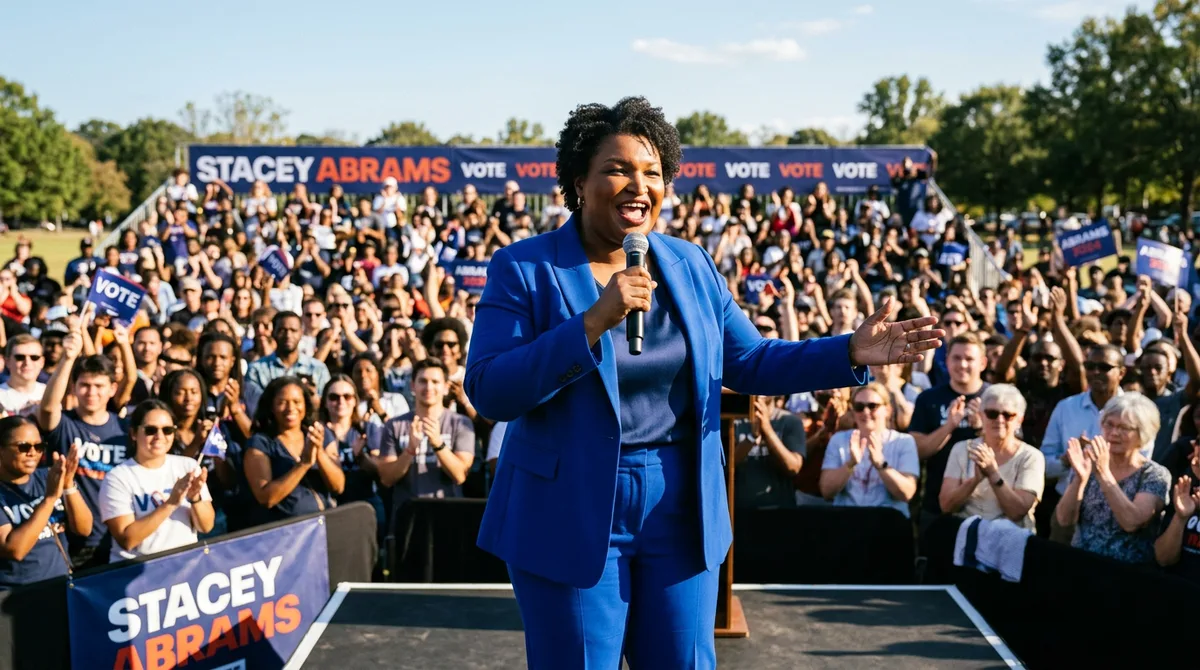
- Stacey Abrams (D-GA) lost two Georgia gubernatorial races to Brian Kemp — by 1.4 points in 2018 and 8 points in 2022 — but is credited with transforming Georgia into a competitive battleground state.
- Her voter registration organization Fair Fight Action registered hundreds of thousands of new voters in Georgia, contributing to Jon Ossoff and Raphael Warnock's 2021 Senate wins that gave Democrats the majority.
- Abrams is a lawyer, novelist, and entrepreneur who served 11 years in the Georgia House of Representatives — she has written romance novels under a pseudonym and published policy books under her own name.
- Her 2018 loss, which she has argued involved voter suppression, sparked a national conversation about voting access, voter roll purges, and election administration that shaped Democratic organizing strategy through 2024.

The Organizer Who Flipped Georgia
Stacey Abrams is the rare political figure whose electoral losses may ultimately matter more than a victory would have. She ran for Georgia governor in 2018 and lost by 1.4 percentage points — the closest governor’s race in Georgia in decades — to Brian Kemp in a contest that became a national flashpoint over voter suppression, minority voting rights, and the structural barriers to Democratic electoral success in a rapidly changing Southern state. Rather than retreat to private life or wait for the next electoral opening, she founded Fair Fight Action, a voting rights organization that over the next two years registered hundreds of thousands of new Georgia voters and helped build the Democratic coalition that flipped Georgia for Biden in November 2020 and produced two Democratic Senate seats in the January 2021 runoffs.
Abrams grew up in Gulfport, Mississippi and Decatur, Georgia, the second of six children in a working-poor family. She was the first African American woman to become a major-party gubernatorial nominee in American history when she won the 2018 Democratic primary. She had served in the Georgia House of Representatives from 2007 to 2017, including seven years as House majority Leader — the first Black woman to lead a party caucus in the Georgia General Assembly. She is also a Yale Law School graduate, former tax attorney, and prolific author — she has written multiple legal thrillers under a pen name as well as policy books on statehood, voting rights, and leadership. The breadth of her public intellectual work is unusual in contemporary politics.
Her 2022 governor rematch against Kemp was a decisive loss: 48.5% to 53.4%, a margin of nearly 8 points. The 2022 environment was far less favorable for Democrats than 2018 had been, and Kemp had meanwhile built a record as a competent governor who had defied Trump’s 2020 election pressure — earning bipartisan respect that insulated him from the anti-Republican wave Abrams needed. The 2022 defeat effectively ended her run of high-profile Georgia electoral politics, at least in the short term, though her national standing and the voter infrastructure she built remain significant assets for the Democratic Party.
Key Policy Areas & Work
Fair Fight Action
Abrams founded Fair Fight Action in 2018 immediately after her governor defeat, building it into one of the most well-funded voting rights organizations in the country. Its work focused on voter registration, ballot access protection, and election protection infrastructure. The organization registered an estimated 800,000 new Georgia voters between 2018 and 2020 and trained thousands of poll workers and election observers — groundwork credited with enabling Georgia’s 2020 Democratic victories.
Working-Class Priorities
Abrams’ gubernatorial platforms centered on Medicaid under the Affordable Care Act (which Georgia had not accepted), minimum wage increases, and investment in rural broadband and public education. She framed these as economic development arguments as much as equity arguments — particularly Medicaid, which she argued would bring billions of federal dollars into Georgia and create tens of thousands of jobs in the rural health care sector.
2028 Considerations
Abrams’ national profile remained high after her 2022 loss. She was seriously discussed as a potential Senate candidate in 2026 (for Jon Ossoff’s seat) and as a 2028 presidential contender. Her ability to mobilize large small-dollar donations nationally, her strong media presence, and her record as a strategist and organizer give her a national standing that exceeds her electoral record. Georgia’s Senate seats — Ossoff in 2026 and Warnock in 2028 — are potential future electoral opportunities.
Electoral History
| Year | Race | Result | Margin |
|---|---|---|---|
| 2022 | Georgia Governor | Kemp (R) 53.4% — Abrams (D) 45.7% | R +7.7 |
| 2018 | Georgia Governor | Kemp (R) 50.2% — Abrams (D) 48.8% | R +1.4 |
| 2016 | Georgia House (minority leader) | Re-elected unopposed | D win |
| 2012 | Georgia House (89th district) | Re-elected with 77.2% | D +54 |
| 2010 | Georgia House (89th district) | Re-elected with 78.4% | D +56 |
| 2006 | Georgia House (89th district) | First elected; ~65% | D win |
The 2018 Non-Concession and Its Consequences
Abrams’ decision not to issue a traditional concession speech after the 2018 election was one of the most discussed and debated political acts of that cycle. She acknowledged the mathematical result but framed it as an “outrage” rather than a clean democratic verdict — pointing specifically to Brian Kemp’s dual role as both the Republican candidate and the sitting Georgia Secretary of State overseeing the election, and to documented controversies: the closure of hundreds of polling places in predominantly Black counties, the “exact match” voter registration law that flagged registrations for minor discrepancies (hyphenation, middle name abbreviations), and the purge of roughly 340,000 voter registrations in the months before the election.
Her critics — including some Democrats — argued she was undermining democratic norms in a way that echoed Donald Trump’s own election denial patterns, and that the refusal to concede gracefully damaged her standing. Her defenders argued she was correctly identifying structural voter suppression that had been documented by journalists and academics, and that treating it as a normal election would obscure real injustice. The argument remains contested. What is clear is that the controversy elevated her nationally, made Fair Fight Action’s voter registration mission broadly legible, and produced the organizing infrastructure that made Georgia’s 2020 Democratic victories possible.