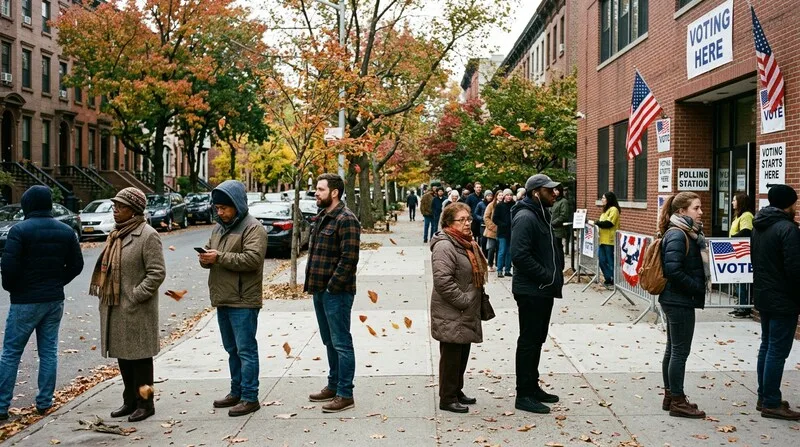
- 2024 structural shift: Trump's "Swamp the Vote" programs significantly narrowed Democratic early-vote leads in NV, GA, AZ, NC — the assumption that early-vote leads = D leads is no longer reliable
- Georgia: 3 weeks in-person early + 2 Saturdays (decisive in 2021 runoffs + 2022 Warnock); Arizona: PEVL auto-sends mail ballots; Wisconsin: photo ID required for absentee requests — suppresses D mail advantage in a toss-up state
- Early voting share settled at ~36% of 2022 ballots — permanently elevated from pre-pandemic 23% but below 2020 peak of 70%; 2026 projected at 40-45%
- Academic research: early voting mostly redistributes when people vote, not how many — operational value is locking in supporters before October surprises change their minds
The Three-Cycle Arc: 2020, 2022, 2024
Early voting's recent history unfolds in three distinct chapters. In 2020, COVID-driven anxiety about in-person voting, combined with aggressive Democratic investment in early voting programs and a Republican presidential campaign that actively discouraged its own voters from using mail ballots, produced the largest early-vote share in American electoral history. Democrats banked enormous early leads in key states while Republicans concentrated their turnout in Election Day voting — creating the multiday "blue shift" in results that Trump then falsely attributed to fraud.
In 2022, early voting settled back to approximately 36% of all ballots — still well above pre-2020 norms, indicating that the pandemic permanently expanded the early-vote universe. Democrats continued to hold significant early-vote leads in most battleground states, and the party's ground operations were built around early-vote programs. Republican field operations remained skeptical of mail ballots, a legacy of Trump's 2020 messaging that still suppressed Republican mail-ballot participation even in states where Republican officials had expanded early-voting access.
In 2024, the Trump campaign systematically reversed course. Programs with names like "Swamp the Vote" recruited Republican early and mail voters in Nevada, Georgia, Arizona, and North Carolina. The result was a measurable narrowing of Democratic early-vote leads, with Republicans matching or exceeding Democratic early returns in some states. The structural assumption that early-vote leads meant Democratic leads was no longer reliable. Both parties now have serious early-vote infrastructure, which changes the strategic value of these programs for 2026.

Key States: Early Vote Rules and 2024 Partisan Lean
| State | Early In-Person | Mail Ballot Access | Key Rule Feature | 2024 Early Vote Lean | 2026 Race |
|---|---|---|---|---|---|
| Georgia | 3 weeks + 2 Saturdays | Excuse required | Drop boxes (reduced post-2020) | Even / slight R | Senate: Ossoff |
| Arizona | 27 days | Permanent list (PEVL) | Auto-sends mail to opt-ins | D+8 mail | Senate: Open |
| Wisconsin | 2 weeks | Must request w/ photo ID | No drop boxes (court ruling) | D+4 (down from D+14 in 2020) | Senate: Johnson |
| Nevada | 2 weeks | All-mail to all registered | Universal mail distribution | D+6 mail | Senate: Rosen |
| Pennsylvania | None (precincts only) | Act 77 — no excuse | Naked ballot rule; curing varies | D+12 mail | Senate: McCormick |
| Michigan | 9 days | No-excuse absentee | 9-day in-person early added 2022 | D+7 mail | Senate: Slotkin |
| North Carolina | 3 weeks | No-excuse absentee | Same-day registration at early sites | Even | Senate: Tillis |
| Florida | 2 weeks | No-excuse absentee | Strict signature match enforcement | R+5 mail | Gov only (no Senate 2026) |
2024 early vote lean refers to the partisan composition of returned early/mail ballots before Election Day, not final results. Mail-ballot leads do not translate directly to vote leads as Republican Election Day voting typically exceeds Democratic.
States That Permanently Expanded Mail Voting After the Pandemic (2020–2026)
Seven states have adopted universal all-mail elections as of 2026 — meaning every registered voter automatically receives a mail ballot without needing to request one. Three of these states permanently expanded to all-mail voting during the 2020 COVID pandemic and have not reversed the change:
| State | Year Adopted All-Mail | How Expanded | 2026 Senate Race |
|---|---|---|---|
| Colorado | 2013 | Legislature — first major all-mail state | Bennet (D, up 2028) |
| Oregon | 2000 | Ballot initiative — oldest all-mail system | Merkley (D, up 2026) |
| Washington | 2011 | Legislature | Cantwell (D, up 2026) |
| Hawaii | 2020 (permanent) | COVID law made permanent — legislature | Hirono (D, up 2026) |
| Montana | 2020 (permanent) | COVID law made permanent — counties first | Daines (R, up 2026) |
| Alaska | 2020 (permanent) | COVID law made permanent — state ballot | Sullivan (R, up 2026) |
| Utah | 2019 | Legislature — phased from 2012 | Lee (R, up 2028) |
Of the three states that permanently expanded mail voting during the pandemic, Hawaii and Montana acted through the legislature, while Alaska's expansion was cemented through state ballot measures. No state that adopted universal mail voting during or after 2020 has reversed the change — suggesting the policy becomes institutionally durable once in place, regardless of which party controls the legislature.
Beyond the all-mail states, a second tier permanently expanded no-excuse absentee access after 2020: Nevada (automatic distribution to all registered voters), Pennsylvania (Act 77 survived Republican repeal attempts), Michigan (Proposal 3 — 2022 constitutional amendment), and Connecticut (2022 constitutional amendment). These states did not permanently expand to all-mail but removed barriers to mail ballot requests, raising the baseline of mail-ballot access nationwide.
What Each Party Is Doing for 2026
Protecting the Mail Infrastructure
Democrats have invested heavily in mail-ballot programs over two cycles. Their infrastructure now includes voter registration drives, PEVL opt-in programs in Arizona, automatic mail-ballot applications in Pennsylvania, and sophisticated voter file modeling to identify low-propensity voters who can be converted to early mail voters. Democrats' edge in mail voting reflects years of organizational investment and the demographic composition of their coalition — college-educated suburban women and older Black voters who plan ahead and vote by mail. Maintaining this edge in 2026 requires active voter contact, not passive infrastructure.
Building Early-Vote Programs From Scratch
Following 2024's systematic early-vote investment, the RNC and state Republican parties are building permanent early-vote operations. The challenge is cultural: years of anti-mail-ballot messaging from Trump and conservative media created genuine resistance among Republican base voters. Programs need to overcome "my vote might not count" skepticism while building new habits among first-time early voters. Republicans' advantage is that their voter universe in Georgia, Arizona, and Nevada is large enough that even modest improvements in early-vote participation produce significant absolute gains. Whether those gains persist in a non-presidential year is the key 2026 question.
Locking In Votes, Not Generating Them
Academic research consistently finds that early voting redistributes when people vote more than it creates new voters. The real strategic value for campaigns is different: early voters are locked in before October surprises, late-breaking scandals, or October news events can change their minds. A voter who has already returned their mail ballot cannot be affected by a late-October negative ad or an unexpected debate. For campaigns with uncertain environments — and 2026's environment is deeply uncertain given tariff volatility and the ongoing reconciliation fight — locking in persuadable voters early is operationally valuable regardless of aggregate turnout effects.


