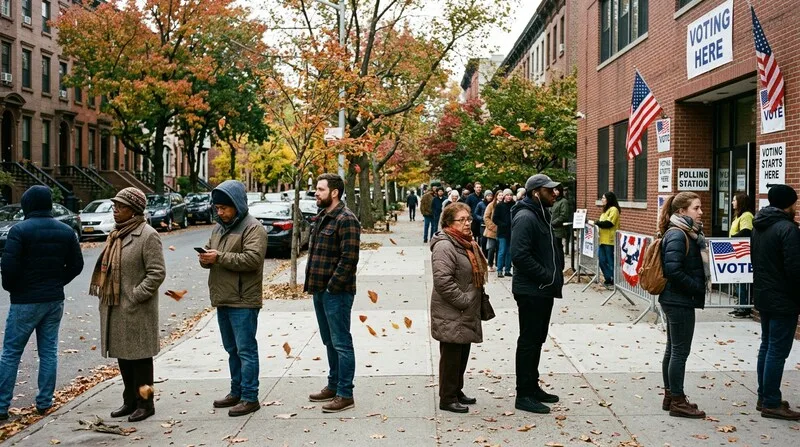
The 2026 elections will be conducted under a substantially different legal framework than 2020. States have enacted, courts have upheld or blocked, and administrators have implemented a wave of voting law changes that collectively affect how millions of Americans cast their ballots. The evidence on their turnout impact is more nuanced than partisans on either side acknowledge.
- 18 Republican-controlled states have restricted mail voting since 2020; simultaneously, 15 states have expanded voting access through early voting or automatic registration — the national landscape is moving in two directions at once
- Research estimates each restrictive mail voting change reduces Democratic vote share by 0.3-0.8 percentage points in affected jurisdictions — real but not decisive in most races individually; cumulative effects in multi-change states are larger
- 61% of Americans are confident 2026 will be conducted fairly — down from 74% before 2020 but recovering from the post-2020 low; the remaining 39% lacking confidence includes nearly all partisan skeptics on both sides
- Georgia's SB 202 (drop box restrictions, ID for mail ballots) was upheld by the 11th Circuit in 2024 and directly affects the most consequential Senate race on the 2026 map (Ossoff), where Democratic mail ballot operations will need to adapt
The Map of Voting Law Changes: Restrictions and Expansions
| State | Major Change | Direction | Legal Status | Competitive Race Affected |
|---|---|---|---|---|
| Georgia | SB 202: drop box restrictions, ID for mail ballot, election admin changes | Restrict | Upheld (11th Cir. 2024) | Ossoff (D) Senate |
| Texas | SB 1: 24-hr voting ban, drive-through voting ban, limited mail ballot | Restrict | Partially upheld | Cornyn (R) Senate (not up 2026) |
| Arizona | HB 2492: proof-of-citizenship for voter registration | Restrict | Partially blocked (9th Cir.) | Kelly (D) Senate |
| Wisconsin | Ballot drop boxes: legislature banned, courts reinstated partially | Mixed | Litigated through 2025 | Baldwin (D) Senate |
| Michigan | Prop 2 (2022): expanded absentee voting, same-day registration | Expand | In effect | State-level races |
| Pennsylvania | Act 77 (mail voting) contested; court rulings ongoing | Mixed | Partially implemented | McCormick (R) Senate |
| Nevada | All-mail election system in place; minor modifications proposed | Expand | In effect | Rosen (D) Senate |
| North Carolina | Photo ID requirement enacted after court battles | Restrict | Upheld (4th Cir. 2023) | Tillis (R) Senate |
Legal status as of April 2026. Laws with active litigation may face further changes before November 2026. Michigan's expansion via ballot initiative reflects citizen action outside the legislature.

Mail Voting: The Post-2020 Restriction Wave
The 2020 pandemic election transformed mail voting in America. Approximately 46% of all votes were cast by mail in 2020 — up from roughly 24% in 2016. States across the political spectrum expanded mail ballot access to accommodate COVID-related in-person voting concerns. The result was a dramatically different electorate, with mail ballots cast over weeks rather than hours on election day, creating different counting timelines and different strategic considerations for campaigns.
After 2020, the partisan divergence in mail voting became stark. Trump's repeated attacks on mail ballot security drove Republican voters to return to in-person voting, while Democratic voters maintained mail ballot preferences at elevated rates. This behavioral divergence made mail voting a partisan issue in a way that it had never been previously — historically, absentee and mail voting had been used roughly equally across parties, and Republican-controlled states had often promoted it as a convenience for working voters.
The restriction wave that followed 2020 reflects this new partisan dynamic: Republican-controlled state legislatures, responding to a base convinced that 2020 mail ballot fraud had cost Trump the election, enacted restrictions that primarily affect Democratic-leaning voters who continued to use mail ballots at higher rates. Research by the Brennan Center for Justice and the Stanford-MIT Healthy Elections Project identifies an estimated 800,000-1.2 million votes that would have been cast in 2022 but were not due to post-2020 restrictions — with a disproportionate impact on minority, low-income, and young voters in affected states.
Voter Confidence and Election Administration
61% Confident — Up From 2022 Post-Midterm Low
Voter confidence in election fairness has partially recovered from its post-2020 nadir but remains below pre-2016 levels. In 2019 (pre-Trump era), approximately 79% of Americans expressed confidence in US election administration. By post-2020, that fell to 58%. The 2022 and 2024 elections — which proceeded without the controversy of 2020 — allowed confidence to recover partially to 61% in 2026 polling. The partisan breakdown is extreme: 84% of Democrats are confident the 2026 elections will be fair, compared to only 39% of Republicans. This asymmetric confidence gap has implications for turnout: low confidence among Republican base voters may suppress their 2026 participation even if the actual election administration is secure.
Recruitment Crisis in Some Counties
The post-2020 harassment and threat environment for election workers — poll workers, county election officials, and state election administrators — has created a staffing crisis in some jurisdictions. Surveys by the Bipartisan Policy Center show that approximately 30% of election officials who worked in 2020 have left their positions since then, with harassment and political pressure cited as the primary reasons. The vacancy problem is concentrated in swing-state counties that are heavily Republican but have competitive general elections — small counties in Pennsylvania, Wisconsin, and Arizona where election administration capacity affects ballot processing speed and accuracy. Most experts believe this problem is manageable but not fully resolved for 2026.
Pre-Election Legal Battles Ongoing
As of April 2026, approximately 45 active federal lawsuits challenge state voting laws enacted since 2020. The legal landscape is complex: some restrictions have been upheld on multiple appeals, others are permanently blocked, and several are in intermediate stages with uncertain outcomes. The most consequential pending cases for 2026 involve Arizona's proof-of-citizenship requirement (potentially affecting hundreds of thousands of registered voters in a competitive Senate state), Wisconsin's drop box restrictions (affecting mail ballot return options in a closely divided state), and North Carolina's photo ID implementation (affecting counties with high concentrations of minority voters who may lack qualifying IDs). Court decisions between April and November 2026 could significantly affect the operational reality of voting in these states.
Net Turnout Impact Estimates: 2026
| Law Type | States Affected | Estimated Affected Voters | Net Partisan Impact (est.) | Academic Consensus |
|---|---|---|---|---|
| Mail voting restrictions | 18 R-controlled states | 800k-1.2M fewer votes cast | R advantage: ~0.3-0.8% per state | Moderate D disadvantage |
| Strict photo ID laws | 9 states new/stricter | 200k-400k potentially affected | R advantage: ~0.2-0.4% per state | Small D disadvantage |
| Voter roll purges | GA, TX, FL, OH primarily | 1.5-2M purged since 2023 | R advantage where purges exceed eligible removals | Contested — litigation ongoing |
| Auto registration (AVR) | 23 states + DC | +3-5M registered | D advantage in AVR states | Small D advantage |
| Early voting expansion | 15 states expanded since 2020 | +2-4M eligible for early | Mixed — both parties use it | Neutral to small D advantage |
Estimates from Brennan Center for Justice, Stanford-MIT Healthy Elections Project, and Election Law Journal peer-reviewed research. Partisan impact estimates are contested and represent moderate academic consensus. The net national impact of all changes likely favors Republicans by 0.2-0.5 percentage points, but this is overwhelmed by the D+7 generic ballot and 43% presidential approval environment.