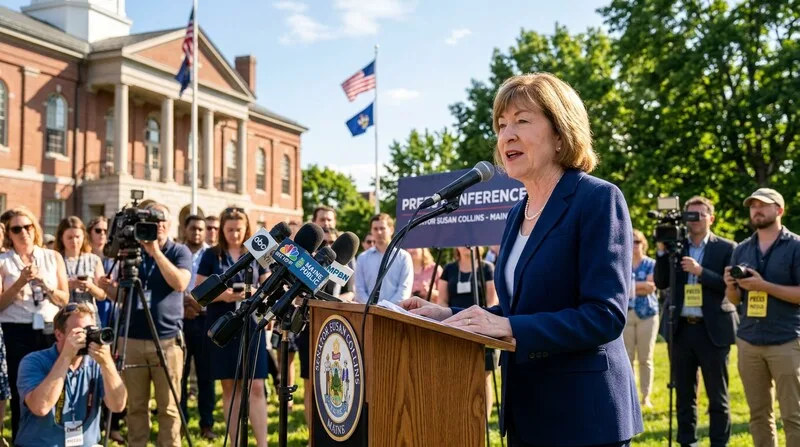
- Collins' moderate brand is backed by a substantive voting record: she voted against ACA repeal (2017), supported Planned Parenthood funding, backed bipartisan gun safety (2022), and voted to convict Trump in both impeachment trials.
- Her electoral track record is extraordinary: 30 years of winning a D+7 state by margins that no other Republican senator in a comparable state has matched.
- Jared Golden represents the only Democrat with a credible profile to challenge Collins: a veteran, rural Mainers' representative, and the House Democrat who has most consistently broken from his party — the anti-Collins Democrat.
- Collins' vulnerabilities center on Medicaid (Maine's rural hospitals depend on it), her 2018 Kavanaugh vote (still resonant with Maine women), and any future votes that align her with Trump over Maine voters' interests.
- Forecaster rating: Lean R — Collins is favored, but her personal-vote advantages are not infinite, and the Democratic environment of 2026 combined with Golden's specific profile makes this genuinely competitive.
The Collins Brand: Three Decades of Moderate Identity
Susan Collins has represented Maine in the Senate since 1997 — nearly three decades of building a political identity that is explicitly centered on moderation, bipartisanship, and independence from both parties' most partisan wings. She has been the top recipient of political goodwill from Maine's large independent and unenrolled voter population (roughly 40% of the electorate) and has consistently won election in a state that has shifted decisively Democratic at the presidential level since 2008.
The Collins brand is not simply a performance of centrism — it is backed by a substantive record of crossover votes on the issues Maine voters care most about. She voted against the 2017 ACA repeal when her vote was decisive, earning lasting credit with the state's healthcare-focused electorate. She has supported Planned Parenthood funding, unlike virtually all other Senate Republicans. She backed bipartisan gun safety legislation in 2022. And she voted to convict Trump in his second impeachment trial — a vote that cost her with the national Republican base but built credibility with Maine's independent voters. Each of these votes is a deposit into the trust account that allows her to win re-election in a blue-trending state.

Collins Electoral History: The Ticket-Splitting Record
| Year | Collins Margin | Presidential Top of Ticket | Presidential Margin | Ticket-Split |
|---|---|---|---|---|
| 2002 | +18.4 (Collins) | R (Bush) | Bush +5.3 | +13 |
| 2008 | +23.6 (Collins) | D (Obama) | Obama +17.1 | +40.7 — extraordinary |
| 2014 | +36.9 (Collins) | R (midterm) | — | Dominant non-presidential cycle |
| 2020 | +8.6 (Collins) | D (Biden) | Biden +9.0 | +17.6 — massive split |
| 2026 | TBD (Collins) | R midterm | — | Non-presidential; Collins advantage? |
Jared Golden: The Anti-Collins Democrat
The reason Jared Golden is considered the most dangerous potential challenger to Collins is that he represents a mirror image of her brand. Golden, who served two terms representing Maine's 2nd congressional district, is a Democrat who explicitly distances himself from national Democratic Party positions on gun rights, fiscal policy, and trade — exactly the three-dimensional dissent that Collins uses within the Republican Party. He is a Marine veteran, which neutralizes the military-credential advantage that Collins has never particularly claimed but that Republicans typically use against Democrats.
Golden's 2024 loss in ME-2 was driven by a national Republican environment and his own heterodox positioning on the assault weapons ban (he voted against it), which depressed Democratic base turnout. In a Senate race against Collins, those same characteristics that hurt him in a House base-mobilization election would be assets: being the Democrat who breaks with his party on guns, spending, and some social issues makes him the exact kind of candidate who can compete for the Collins ticket-splitter.
Collins's Vulnerabilities: What Could Finally Beat Her
Kavanaugh Fallout
Collins's 2018 floor speech supporting Brett Kavanaugh's confirmation — in which she argued he would not overturn Roe v. Wade — became definitively problematic after Dobbs. Many Maine women who were Collins ticket-splitters viewed the Kavanaugh vote as a personal betrayal. The Dobbs-mobilization effect in 2022 hit her standing among college-educated Maine women, and abortion rights remain a top-tier issue in the state.
DOGE and Federal Services
Maine has the oldest median age of any state in the country, making it disproportionately dependent on federal healthcare programs (Medicare, Medicaid, VA) and Social Security. DOGE-related cuts to federal services and threats to entitlement programs are particularly salient in Maine. Collins has opposed some DOGE actions but her Senate caucus membership makes clean separation difficult.
The 2026 Environment
Collins has never run in a true Democratic wave environment as a Senate incumbent. Her 2020 victory was won in a tight national environment where the expected Democratic wave underperformed. A D+5 or greater national environment in 2026 would put unprecedented pressure on her personal brand premium. History suggests she can absorb a 10-point swing; a 15+ point national Democratic environment would be genuinely threatening.