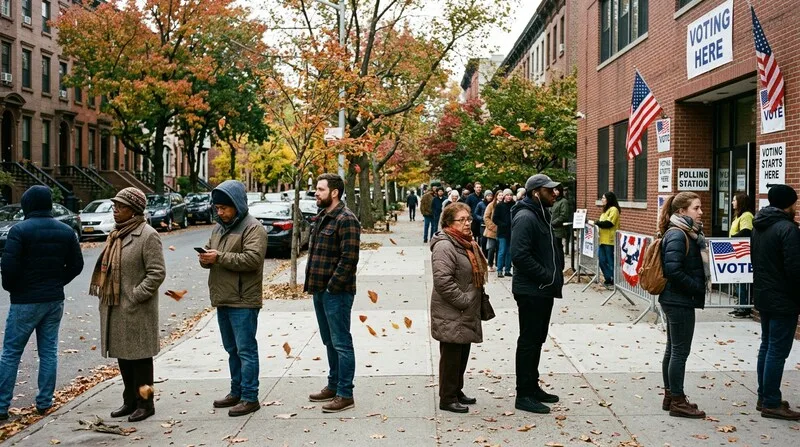
- 2026 state legislative elections carry long-term consequence beyond the cycle: chambers flipped in 2026 will draw congressional district maps for 2032 — potentially affecting 5–10 US House seats per large state.
- Democrats have targeted Wisconsin and Pennsylvania as the highest-priority chamber flip states: both have narrow Republican majorities and significant suburban swing districts that have moved toward Democrats since 2016.
- Wisconsin's state assembly and senate chambers are priority targets for both parties given the state's 2026 Senate race and the governor's veto power over redistricting — control of the legislature shapes Wisconsin's maps for a decade.
- Republican legislative trifectas in Florida, Texas, and Georgia provide significant structural advantages in redistricting; Democrats' path to reclaiming competitiveness in those states runs partly through state legislative pickups.
- State legislative races are typically underfunded relative to statewide offices, making small investment differentials capable of producing outsized seat gains in a favorable national environment.
Key Chamber Flip Opportunities for Democrats in 2026
| State / Chamber | Current Control | Margin | D Flip Rating | Trifecta Impact |
|---|---|---|---|---|
| WI State Senate | R | R+3 seats | Lean D to flip | Creates D trifecta with Evers gov. |
| PA State Senate | R | R+4 seats | Toss-Up | D trifecta if gov. flips |
| MI State Senate | D (narrow) | D+1 | D likely hold | Maintain D trifecta |
| AZ State House | R | R+2 | Toss-Up | Partial D trifecta possible |
| NH State House | R | R+6 | Lean D (large chamber) | D can flip with strong wave |
| NC State House | R | R+5 | Lean R hold | Gov. Cooper legacy factor |

Why 2026 State Results Shape 2032 Congressional Maps
After the 2030 Census, all 435 congressional districts will be redrawn. Typically, state legislatures draw these maps with minimal independent oversight (excepting states with independent redistricting commissions). This means the party controlling the legislature in 2031 controls the congressional map until 2041.
Republicans aggressively used their 2020 election gains to gerrymander critical states in 2021: Georgia, Texas, North Carolina, Ohio, and Florida all produced maps that gave Republicans structural advantages. Democrats counter-gerrymandered in Illinois and Maryland, but net net, the 2021 maps gave Republicans roughly 8–12 “bonus” House seats.
In 2026, Democrats can begin recapturing state-level power needed to reduce this structural deficit after 2030. Winning Wisconsin, Pennsylvania, and Arizona legislative chambers — combined with winning or holding governors in those states — sets up Democrats for fairer 2030 maps. The consequence of losing state legislative elections in 2026 compounds over the entire next decade of congressional elections.
Wisconsin: The Most Watched State Chamber in 2026
Wisconsin's state Senate is the single most consequential state legislative chamber for 2026. Republicans currently hold a 22-11 majority, but Democrats only need to flip 3 seats to achieve a majority — and the Wisconsin Senate has a favorable map for Democrats in 2026 because the seats up for election this cycle include several in Madison and Milwaukee suburbs that have been trending blue for a decade. Governor Tony Evers has demonstrated that Democrats can win statewide in Wisconsin even in difficult environments. A Democratic state Senate combined with Evers's continued veto power would create the first Democratic trifecta in Wisconsin in over a decade.
The consequences for redistricting are enormous. Wisconsin's current congressional maps were drawn by the Republican legislature in 2021 and later revised by a Republican-dominated state Supreme Court. A Democratic-controlled legislature after 2026 cannot immediately redraw maps (those are fixed through 2030), but a Democratic trifecta positions Wisconsin Democrats to draw the 2031 maps after the Census — potentially flipping 2-3 Wisconsin House seats from the structural Republican advantage they currently enjoy. Wisconsin's 6 congressional seats are split 3D-3R in a state that leans very slightly Democratic; fairer maps could move that to 4D-2R.
For a deeper look at state-level power, see the Democratic Governors 2026 analysis and how governor's office control interacts with legislative chambers on redistricting strategy.
Pennsylvania: The Other High-Stakes State Legislature
Pennsylvania's state legislature is the second most consequential chamber system after Wisconsin. Democrats control the state House by a single seat (102-101), while Republicans hold the state Senate 28-22. If Democrats win the governorship in 2026 and hold the state House, the only missing piece for a Pennsylvania trifecta is flipping four state Senate seats — a difficult but achievable goal in a favorable Democratic environment.
Pennsylvania's congressional implications dwarf Wisconsin's. The state has 17 congressional seats currently split 9D-8R, drawn after a 2018 state Supreme Court intervention. A Democratic trifecta in Pennsylvania after 2030 would allow Democrats to produce maps that could realistically move the delegation to 11D-6R or even 12D-5R — a net swing of 2-4 seats nationally just from one state's redistricting. Republicans would face the reverse scenario: losing Pennsylvania's legislative chambers would cost them what has been a structural advantage in congressional map-drawing.
The Pennsylvania state Senate map that is up in 2026 includes competitive suburban Philadelphia and Pittsburgh districts that have been trending Democratic. If the national environment favors Democrats by 4-6 points, the chamber is within reach. See the full breakdown in our House Majority Math analysis for how Pennsylvania congressional seats factor into national control math.
Republican Trifecta States: Where the Map Holds and Where It Cracks
| State | Current Control | Vulnerability (2026) | Key Chamber | 2030 Redistricting Stakes |
|---|---|---|---|---|
| Georgia | R Trifecta | Low — Gov. Kemp term-limited, open race | Both chambers R+10 | High — 14 congressional seats, GOP-drawn |
| North Carolina | R Legislature | Medium — D Gov. Cooper term-limited | State House R+5 | Very High — 14 seats, contested after courts |
| Texas | R Trifecta | Very Low — Deep R structural advantage | Both chambers R+20 | Highest — 38 congressional seats |
| Florida | R Trifecta (supermajority) | Very Low — DeSantis redraws locked | Both chambers R+25 | High — 28 congressional seats |
| Michigan | D Trifecta | Low for D — hold with strong env. | State Senate D+1 | High — 13 seats, new Dem maps could hold |
| Kansas | R Legislature | Medium — D Gov. Kelly term-limited | State Senate R+10 | Low — only 4 congressional seats |