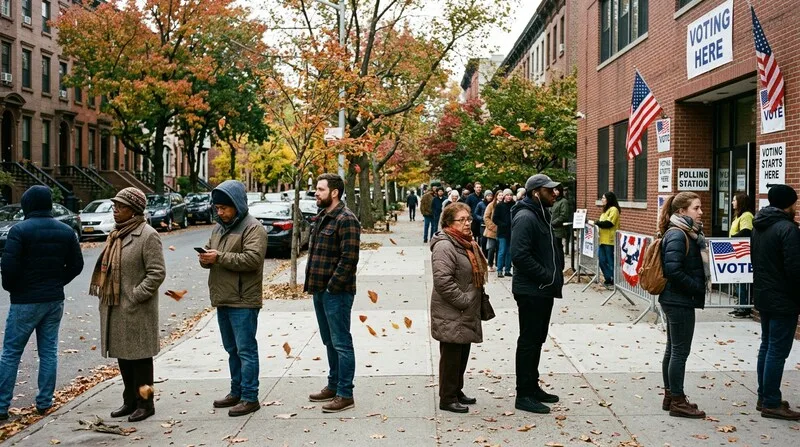
Thirty-five states now have voter ID requirements, early voting windows have been compressed in key battlegrounds, and the federal preclearance regime that once restrained discriminatory changes lies effectively dismantled. With the 2026 midterms approaching, the rules of the ballot are themselves contested terrain — and the polling shows voters feel it.
- 35 states now have voter ID laws as of 2026, with 20 requiring strict photo identification — the largest geographic expansion of ID requirements in modern electoral history.
- Academic research estimates strict voter ID laws suppress low-income turnout by approximately 4%, with disproportionate impact on Black, Latino, and young voters who are less likely to hold qualifying ID.
- 59% of Americans favor making it easier to vote, with broad public support for expanded access — but that majority is paired with 72% support for requiring some form of voter identification.
- 14 active federal lawsuits are currently challenging state voting restrictions under the Voting Rights Act, following Supreme Court rulings in 2013 and 2023 that narrowed federal oversight authority.
- Voting access is a turnout multiplier: states with same-day registration and expanded mail voting consistently show 3–6 point higher turnout than comparable states with restrictive regimes.
The Erosion of Federal Voting Protections
The legal architecture protecting voting access has contracted sharply since 2013. The Supreme Court's Shelby County decision eliminated the formula used to determine which jurisdictions required federal preclearance before changing voting laws. A 2023 follow-on ruling further narrowed Section 2 enforcement, making private litigation more difficult. The practical result: states previously subject to oversight can now implement voting changes without federal review, and legal challenges come after the fact rather than before.
Congressional attempts to restore these protections have failed twice. The John Lewis Voting Rights Advancement Act cleared the House in 2021 but died in the Senate filibuster. A narrower 2023 compromise also stalled. As of the 2026 cycle, no federal legislation restoring preclearance is expected. The burden has shifted entirely to post-hoc litigation, which is slower, more expensive, and often produces rulings too late to affect the election in question.
State-Level Restrictions: The Scorecard
Public Opinion: Broad Support for Access, Partisan Split on How
National polling shows 59% of Americans favor making it easier to vote, compared to 28% who want stricter requirements and 13% who prefer the status quo. But this broad preference for access conceals significant disagreement on specific mechanisms. Voter ID requirements — when framed as "showing ID to vote" — poll at 70-75% support overall, including among many Democrats and Black voters. The polling shifts when questions specify strict photo-only ID, exclusion of student IDs, or lack of free ID availability.
Early voting enjoys strong bipartisan support in principle: 73% favor having at least two weeks of early voting, and 68% support no-excuse absentee ballots. These numbers cross party lines significantly — even 55% of Republicans support extended early voting. The gap between these poll numbers and the restrictive legislation enacted in Republican-controlled states reflects the power of legislative majorities to act against majority public preferences when political motivations are strong.
The 2026 Battleground: Where Access Will Define the Outcome
Voting access is not a uniform background condition — it is actively contested terrain in the states that matter most. In Georgia, where the Senate seat is competitive and multiple House races are toss-ups, the 2021 voting law changes remain under litigation. In Wisconsin, student voter ID restrictions will face a college electorate that leaned Democratic in 2024. In Arizona, the proof-of-citizenship rule for federal elections is on appeal but could remain in effect through November 2026. For Democrats, the math is direct: every point of suppression in a 3-point race is decisive. For Republicans, the argument is integrity over access — a frame that continues to poll well within their coalition. Related: Voting Rights 2026: Full Analysis.
Frequently Asked Questions
How many states have strict voter ID laws in 2026?
35 states have some form of voter ID requirement. 20 require strict government-issued photo ID. Studies estimate these laws depress turnout among low-income and minority voters by 2-5 points in affected states.
What happened to the 2023 Voting Rights Act update?
The John Lewis Voting Rights Advancement Act passed the House in 2021 but failed in the Senate filibuster. A narrower 2023 version also stalled. No federal restoration of preclearance authority is expected before the 2026 election.
How does early voting restriction affect turnout?
Early voting expansion increases turnout by 2-4 points, with larger effects for low-income and elderly voters. States with 14+ days of early voting averaged 4.2 points higher turnout in 2024 versus states with 7 or fewer days.