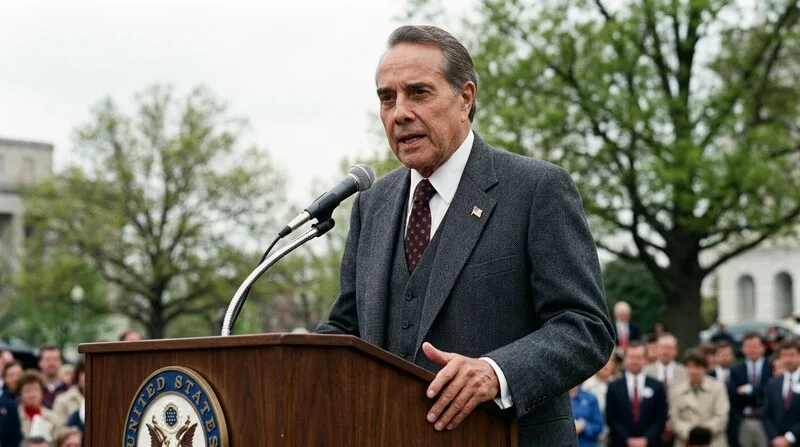
- Bob Dole (1923-2021) was the 1996 Republican presidential nominee who lost to Bill Clinton by 8.5 points — a campaign that struggled to articulate a compelling economic message against an incumbent president presiding over a strong economy.
- He served as Senate Majority Leader (1985-1987, 1995-1996) — one of the most consequential legislative leaders of the late 20th century, shepherding Reagan-era tax cuts and later negotiating deficit reduction deals with Democratic presidents.
- Dole was a World War II combat veteran who was severely wounded in Italy in 1945 — losing the use of his right arm and spending years in recovery — whose physical disability and military service were central to his identity and political persona.
- He was one of the most consequential disability rights advocates in Congress — playing a key role in passing the Americans with Disabilities Act of 1990, legislation that transformed access and civil rights for Americans with disabilities.
Biography
Robert Joseph Dole was born on July 22, 1923, in Russell, Kansas, a small town on the high plains that shaped his stoic midwestern character. He was an outstanding athlete at the University of Kansas before enlisting in the Army in 1942, and it was in the mountains of northern Italy in April 1945, just weeks before Germany's surrender, that his life changed forever. Leading a patrol against a German machine gun position, he was struck by enemy fire that shattered his right shoulder and severed the nerves to his arm, leaving him paralyzed and bleeding on the hillside. He spent 39 months in military hospitals, underwent multiple surgeries, and emerged permanently disabled — without the use of his right arm — but with a psychological resilience and a sense of purpose that propelled his entire public career. He carried a pen in his right hand throughout his life to signal it was not available for handshakes, a gesture that became one of the most recognizable images in American politics.
Dole entered Kansas politics after completing his law degree, serving in the Kansas legislature and as Russell County Attorney before winning a seat in the US House in 1960. He won election to the Senate in 1968 and became one of the chamber's most formidable legislative operators — serving as chairman of the Republican National Committee (1971–1973) during the Watergate era, then rising through Senate majority leadership to become Majority Leader. He earned a reputation for sharp, self-deprecating wit (he joked that his Presidential Medal of Freedom was given to him "for the years I can't remember"), genuine bipartisan dealmaking, and a legislative productivity that produced the Tax Reform Act of 1986, the Social Security rescue of 1983, and the Americans with Disabilities Act of 1990. He was Gerald Ford's running mate in 1976, losing to Carter-Mondale, then pursued the presidency in 1980 (losing to Reagan) and 1988 (losing to Bush) before finally winning the Republican nomination in 1996.
Dole resigned his Senate majority in June 1996 to campaign full-time for the presidency, a gamble that underscored his seriousness but cost him the institutional power base that had defined his career. He lost to President Bill Clinton 159–379 in the Electoral College in November 1996. After his defeat, he returned to private life with a grace and good humor that enhanced his reputation — appearing in television advertisements, co-authoring books with McGovern (including a joint effort on World War II), and remaining a revered figure in Washington's bipartisan establishment. He was awarded the Congressional Gold Medal in 2018 and the Presidential Medal of Freedom in 2018. He died on December 5, 2021, in Washington, at the age of 98.
Key Policy Areas
Senate Leadership
Dole's greatest strength was as a legislative strategist. He understood the Senate's procedural intricacies better than almost anyone of his era and knew how to build the cross-party coalitions necessary to pass major legislation. The Tax Reform Act of 1986 — the most sweeping restructuring of the federal tax code since World War II — required Dole to manage a deeply fractious Republican base while negotiating with the Reagan White House and House Democrats. His 1983 Social Security rescue, brokered with Tip O'Neill and the Reagan administration, saved the program from near-term insolvency. As Majority Leader in 1995–1996, he managed the Republican revolution's legislative agenda after the 1994 midterms while trying to prevent Newt Gingrich's shutdown strategy from becoming a political liability — a balance he ultimately failed to maintain.
Americans with Disabilities Act
The ADA is widely considered Dole's most important legislative achievement and the cause most personally meaningful to him. Signed by President George H.W. Bush on July 26, 1990, the ADA prohibits discrimination against 43 million Americans with disabilities in employment, transportation, public accommodations, and telecommunications. For Dole, who had spent decades navigating the world with a disabled arm — learning to type left-handed, adapting every daily task, and fighting the assumptions that disability implied incapacity — the legislation was not abstract policy but an expression of lived experience. He had lobbied for disability protections for years before the political conditions aligned in 1989–1990. The ADA is his clearest legacy: it transformed daily life for tens of millions of Americans and became the model for disability rights legislation in countries around the world.
Food & Agriculture
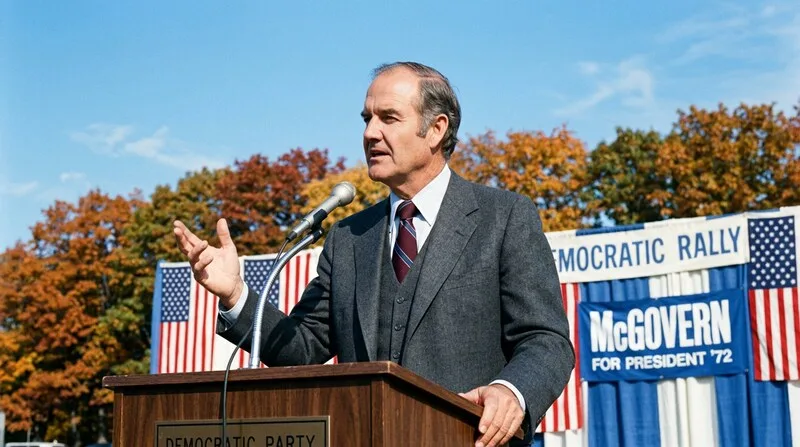
As a Kansas senator representing a major wheat-producing state, Dole was a consistent voice on agricultural and food policy for nearly three decades. He was a key architect of successive farm bills and was involved in trade negotiations affecting US agriculture. His most enduring food policy legacy came in partnership with his one-time political adversary George McGovern: the McGovern-Dole International Food for Education program, enacted in 2000, uses US agricultural commodities to provide school meals to children in low-income countries — incentivizing both school attendance and agricultural development. The collaboration between the 1972 liberal anti-war Democratic nominee and the 1996 conservative Republican nominee became one of Washington's most celebrated examples of bipartisan governance in service of a genuinely nonpartisan humanitarian goal.
Presidential Campaigns
| Year | Role | Opponent | Result | Notes |
|---|---|---|---|---|
| 1976 | VP Nominee (w/ Ford) | Carter/Mondale (D) | Lost | Ford-Dole lost 240–297 EV; close race |
| 1980 | Primary Candidate | Reagan (primary) | Lost primary | Reagan dominated; Dole exited early |
| 1988 | Primary Candidate | Bush (primary) | Lost primary | Won Iowa; lost New Hampshire, withdrew |
| 1996 | Presidential Nominee | Clinton (D) | Lost 159–379 EV | Dole 40.7%, Clinton 49.2%, Perot 8.4% |
Dole's 1996 defeat to Clinton was shaped by structural factors more than campaign failures. Clinton presided over the strongest peacetime economy in a generation, and no incumbent president since Hoover in 1932 had been denied a second term in a strong economy. Dole's attempt to shift the race with a promised 15% across-the-board tax cut — a dramatic departure from his three-decade record as a fiscal hawk — was seen as desperate and unconvincing. Ross Perot's 8.4% independent candidacy drew disproportionately from voters who might otherwise have backed Dole.
Historical Standing & Legacy
Bob Dole's historical reputation rests primarily on his legislative record rather than his presidential ambitions. As Senate Majority Leader and a key figure in six Congresses, he helped shape the Tax Reform Act of 1986, the 1983 Social Security rescue, and the ADA — three pieces of legislation that continue to govern core aspects of American life. The ADA in particular stands as a monument to the bipartisan governance that Dole embodied: it passed with overwhelming support from both parties because Dole had spent years building relationships and trust across the aisle.
His post-political life enhanced rather than diminished his standing. He accepted his 1996 defeat with grace, remained active in public life, supported the WWII Memorial (he was one of its primary advocates), and forged a remarkable friendship with George McGovern that produced joint book projects and the food aid program that bears both their names. When he appeared in a wheelchair at the US Capitol to pay respects to former President George H.W. Bush in December 2018, the image of the 95-year-old veteran struggling to his feet to salute his former commander captured something essential about his character. He was buried at Arlington National Cemetery with full military honors.
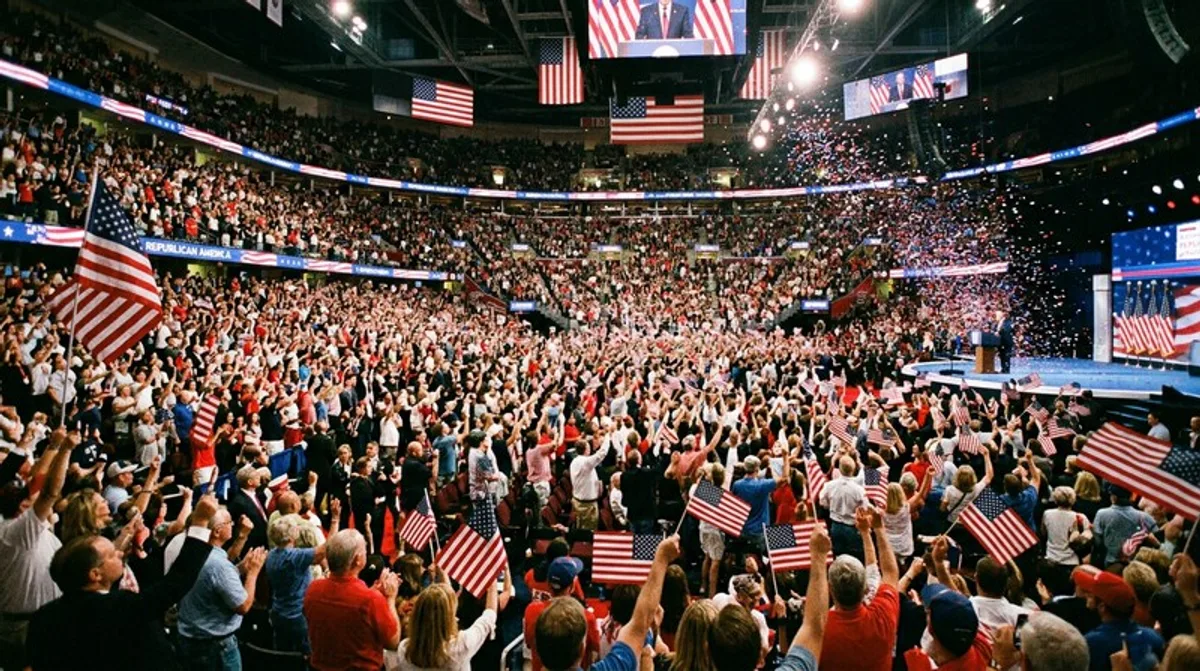
Watch: Bob Dole 1996 RNC Acceptance Speech
Bob Dole delivers his acceptance speech at the 1996 Republican National Convention in San Diego.