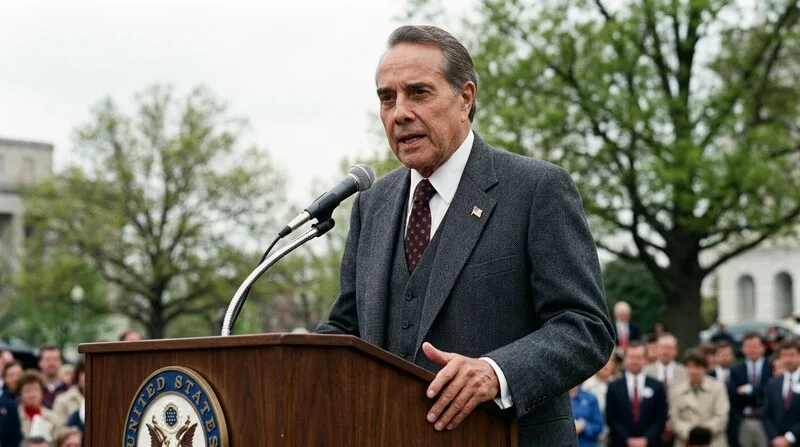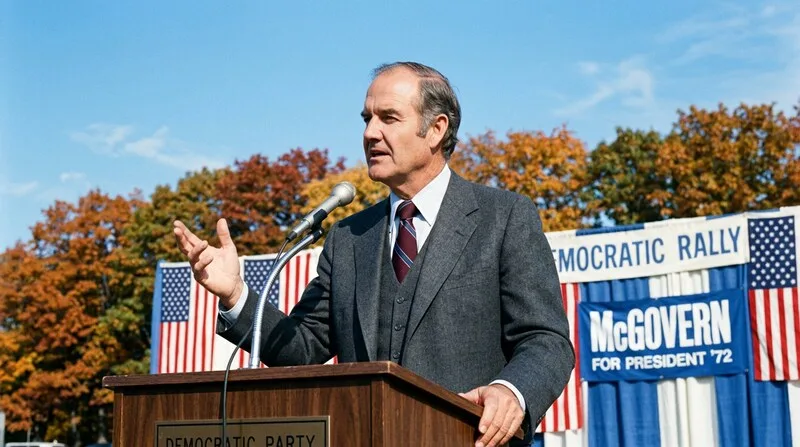
- George McGovern (1922-2012) was the 1972 Democratic presidential nominee who lost to Richard Nixon by 23 points — carrying only Massachusetts and D.C. in one of the largest Electoral College defeats in modern history.
- His candidacy was built on opposition to the Vietnam War — "Come home, America" was his campaign slogan — winning the nomination through the reformed post-1968 primary process but unable to overcome Nixon's incumbency advantage and the "dirty tricks" of Watergate.
- McGovern was a World War II B-24 bomber pilot — flying 35 combat missions over Europe — whose military heroism gave him credentials that should have blunted attacks on his dovish Vietnam stance but didn't in the 1972 political environment.
- He served as US Senator from South Dakota (1963-1981) and was one of the most consistent progressive voices of his era on poverty, hunger, and peace — his later career focused on global hunger policy as a UN ambassador and advocate.

Biography
George Stanley McGovern was born on July 19, 1922, in Avon, South Dakota, the son of a Methodist minister. He attended Dakota Wesleyan University before enlisting in the Army Air Forces in 1943, becoming one of the most decorated B-24 Liberator bomber pilots of World War II. Flying 35 combat missions over Nazi-occupied Europe, McGovern earned the Distinguished Flying Cross for extraordinary heroism after keeping his damaged aircraft aloft long enough for his crew to survive, then landing on a Adriatic island airstrip against enormous odds. He witnessed colleagues die on missions that killed the majority of their crews, an experience that seared into him the human cost of war and shaped every political position he would hold for the rest of his life. After the war he earned a PhD in American History from Northwestern University and entered Democratic politics in South Dakota, a heavily Republican state he helped transform.
McGovern won South Dakota's lone House majority in 1956 and 1958, then served briefly as director of the Food for Peace program under President Kennedy before winning a Senate majority in 1962. As a senator, he became one of the earliest and most consistent voices against the Vietnam War, delivering a prescient floor speech in 1963 warning of catastrophe. His 1972 presidential campaign was built entirely on ending the war and was animated by a grassroots movement of students, activists, and peace Democrats. He won the Democratic nomination through the reformed primary process that his own McGovern-Fraser Commission had created — opening the party to more voices but also producing a convention that alienated the traditional labor and machine Democratic establishment. His slogan, "Come home, America," captured the moral clarity of his campaign and the reason it struggled to build a majority coalition.
McGovern lost to Nixon in one of the most catastrophic defeats in presidential history — 520 Electoral College votes to 17, carrying only Massachusetts and the District of Columbia. The loss left a scar on the Democratic Party that lasted decades, with "another McGovern" becoming shorthand for unelectability. McGovern returned to the Senate and continued his work on nutrition policy and international food aid until losing his seat in the 1980 Reagan wave. In later years he ran an inn in Connecticut, wrote extensively, and remained one of the most intellectually consistent voices in American liberalism. He died on October 21, 2012, in Sioux Falls, South Dakota, at the age of 90.
Key Policy Areas
Vietnam & Anti-War
McGovern was one of the Senate's first and most committed opponents of the Vietnam War, speaking out as early as 1963 and co-sponsoring the McGovern-Hatfield Amendment in 1970 — which would have required the withdrawal of all US troops from Vietnam within a year. It failed both times it came to a vote, but it established a benchmark for the anti-war movement in Congress. His 1972 campaign made immediate withdrawal its central promise, and he was able to frame his position with unusual moral authority: a combat veteran with 35 missions who had seen war firsthand was not accusing American soldiers of anything — he was accusing their commanders and the politicians who sent them. His campaign mobilized the largest student political operation in American history to that point, and his Senate leadership on Vietnam helped accelerate the political collapse of the war's domestic support.
Hunger & Food Policy
McGovern's most durable legislative legacy may be in nutrition policy. As chair of the Senate Select Committee on Nutrition and Human Needs (1968–1977), he turned hunger in America into a political issue, holding hearings that documented child malnutrition in the Mississippi Delta and Appalachia and producing landmark expansions of the school lunch program and food stamps (SNAP). His 1977 Dietary Goals for the United States was the first official federal document linking diet to chronic disease — recommending reduced consumption of red meat, fat, and sugar — and faced ferocious resistance from the beef and dairy industries. On the international side, his Food for Peace work under Kennedy and the later McGovern-Dole International Food for Education program (signed into law in 2000 with Republican Bob Dole) became the model for US food aid to the developing world, feeding tens of millions of children in impoverished nations.
Democratic Party Reform
The 1968 Democratic convention in Chicago, where anti-war delegates were steamrolled by a party machine controlled by Hubert Humphrey without a single primary victory, produced a crisis of legitimacy that the party had to resolve. McGovern chaired the Commission on Party Structure and Delegate Selection (the McGovern-Fraser Commission) whose 1971 reforms opened Democratic primaries to proportional representation, required demographic diversity in delegations, and stripped power from party bosses. The reforms democratized the nomination process but also fragmented the party's coalition: the 1972 convention that nominated McGovern was dominated by activist groups and was widely mocked as unrepresentative of the broader Democratic electorate. The reforms created the modern primary system that all subsequent Democratic candidates have navigated — for better and worse.
1972 Presidential Election
| Candidate | Party | Popular Vote % | Electoral Votes | States Won |
|---|---|---|---|---|
| Richard Nixon | Republican | 60.7% | 520 | 49 states |
| George McGovern | Democratic | 37.5% | 17 | Massachusetts + D.C. |
McGovern's 17 electoral votes represent one of the smallest totals for a major-party presidential nominee in American history. Nixon's 49-state sweep was the second-largest in the Electoral College era, behind only FDR's 46-state victory in 1936. The margin was shaped by multiple converging factors: the Eagleton affair (McGovern's VP pick Thomas Eagleton was forced off the ticket after revelations of psychiatric treatment), a Democratic Party fractured between McGovern's anti-war left and the traditional labor-machine wing that sat on its hands, and Nixon's incumbency advantages including the opening to China, Soviet détente, and the Vietnam drawdown. Nixon carried every Southern state, every Midwestern state, every Western state, and every border state.
The Eagleton Affair: Campaign Collapse
The most damaging single episode of McGovern's presidential campaign began on July 25, 1972 — just days after the Democratic convention — when it was revealed that his VP pick, Missouri Senator Thomas Eagleton, had been hospitalized three times for psychiatric disorders and had received electroconvulsive therapy. McGovern had not vetted Eagleton adequately; the selection had been made under severe time pressure in the chaotic final hours of the convention.
McGovern's handling of the crisis was catastrophically indecisive. He initially declared he was "1000 percent" behind Eagleton, then 11 days later reversed himself and asked Eagleton to withdraw from the ticket. The episode encapsulated the competency questions that dogged the McGovern campaign throughout: it raised doubts about his vetting process, his ability to stand by a decision, and his basic readiness for the executive function. Sargent Shriver, the first director of the Peace Corps and brother-in-law of John F. Kennedy, replaced Eagleton — but the damage was done.
The Eagleton affair consumed three critical weeks of general-election campaigning, dominated headlines that should have been focused on Nixon, and allowed the Nixon campaign to define McGovern as an unreliable improviser before he could define himself. Polls showed McGovern's already-difficult position deteriorating sharply in the weeks following the revelations. No subsequent presidential campaign has made a comparable unvetted VP selection error.
Historical Standing & Legacy
George McGovern occupies a paradoxical place in American political history. His 1972 defeat became the defining cautionary tale of the Democratic left for two generations — the proof text that ideological purity was incompatible with winning the presidency. After nearly every subsequent Democratic nominee moved toward the center, strategists justified the move by invoking McGovern's catastrophic loss. The word "McGovernism" became a pejorative in centrist Democratic circles, deployed to warn against platforms perceived as too progressive to survive a general election.
Yet McGovern's individual positions on most issues were vindicated by history. He was right about Vietnam at a moment when the bipartisan foreign policy establishment was wrong. His nutrition work produced lasting improvements in public health and global food security. His democratic reforms of the primary process, whatever their unintended consequences, opened the party to millions of voters who had been excluded by machine politics. He remained intellectually consistent and personally decent across a 50-year public career, and when he died in 2012, tributes came from across the political spectrum.
Watch: George McGovern 1972 Democratic Convention Acceptance Speech
George McGovern delivers his acceptance speech at the 1972 Democratic National Convention in Miami.