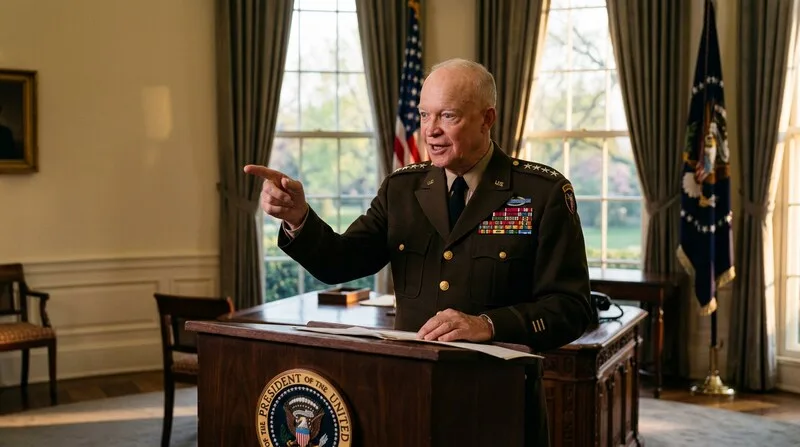
- Dwight Eisenhower served as the 34th President of the United States (1953-1961) — the Supreme Allied Commander in World War II who became a two-term president, presiding over American prosperity, the Korean War armistice, and the early Cold War.
- His farewell address warned of the growing power of the military-industrial complex — the alliance between defense contractors and the Pentagon that he said could distort national priorities — a prescient warning that remains one of the most quoted presidential speeches.
- Eisenhower signed the Interstate Highway System Act (1956) — the largest public works project in American history, building 41,000 miles of highways — and the Civil Rights Act of 1957, the first federal civil rights legislation since Reconstruction.
- He presided over the 1954 Supreme Court decision Brown v. Board of Education and used federal troops to enforce school integration in Little Rock in 1957 — reluctantly but firmly establishing federal authority over state segregation policies.

Biography
Dwight David Eisenhower was born on October 14, 1890, in Denison, Texas, the third of seven sons in a deeply religious, modestly circumstanced family. He grew up in Abilene, Kansas, a small railroad and cattle town on the Kansas plains that shaped his plainspoken, disciplined character. He won an appointment to the United States Military Academy at West Point, graduating in 1915 in what became known as the “class the stars fell on” — 59 of his classmates became generals. He spent the interwar years in relative obscurity, serving as an aide to General Douglas MacArthur in the Philippines and mastering the emerging doctrine of mechanized armored warfare.
World War II transformed Eisenhower from a little-known staff officer into the most prominent military figure of the twentieth century. After the United States entered the war in December 1941, Army Chief of Staff George Marshall recognized Eisenhower’s exceptional organizational and diplomatic skills and vaulted him over hundreds of more senior officers. He commanded the Allied invasion of North Africa (1942), Sicily (1943), and Italy before being appointed Supreme Commander of Allied Expeditionary Forces in Europe in December 1943. On June 6, 1944 — D-Day — he launched Operation Overlord, the Normandy landings that placed 156,000 Allied troops on five French beaches and opened the decisive second front in Western Europe. Germany surrendered unconditionally on May 7, 1945. Eisenhower accepted Germany’s surrender at Reims. He returned home to an enormous ticker-tape parade in New York City and a hero’s welcome that made him the most admired man in America.
Both major political parties sought to draft him as their presidential candidate in 1948 and again in 1952. He accepted the Republican nomination in 1952, defeated Adlai Stevenson in a landslide — winning 442 Electoral College votes — and was re-elected in 1956 by an even larger margin of 457 Electoral College votes. He left office in January 1961 at the age of 70, still among the most popular presidents in the country’s history. He died on March 28, 1969, in Washington, D.C.
Key Policy Areas
Interstate Highway System
The Federal-Aid Highway Act of 1956 was arguably the most consequential domestic legislation of the post-war era. It funded a 47,000-mile national network of divided, limited-access highways — the largest public works project in American history — at a total cost of $114 billion (1956 dollars). Eisenhower had been influenced both by his experience driving across America in a 1919 Army convoy (which took 62 days) and by the German Autobahn network he observed during the war. The Interstate system transformed American commerce, suburban development, and daily life in ways that persist to the present day.
Cold War & Korean Armistice
Eisenhower had campaigned on ending the Korean War and fulfilled that promise within seven months of taking office, signing the armistice agreement in July 1953. His Cold War strategy relied on “massive retaliation” — the threat of overwhelming nuclear force — as a cost-effective alternative to maintaining a vast conventional army. He kept military spending in check while confronting Soviet power, resisting pressure to intervene in Hungary (1956) and at Suez (1956). He authorized the CIA’s U-2 spy plane program, which produced the intelligence picture of Soviet military capability. When a U-2 was shot down over the USSR in 1960, he was forced to admit the program’s existence — one of the defining Cold War embarrassments of his presidency.
NASA, Civil Rights & Moderate Republicanism
After the Soviet Union shocked the world with the Sputnik launch in October 1957, Eisenhower created the National Aeronautics and Space Administration (NASA) in 1958, laying the foundation for the American space program that would eventually land men on the Moon. On civil rights, he is often underrated: he signed the Civil Rights Acts of 1957 and 1960 (the first civil rights legislation since Reconstruction) and, critically, sent the 101st Airborne Division to Little Rock, Arkansas in September 1957 to enforce the desegregation of Central High School over the objections of Governor Orval Faubus. A moderate Republican, Eisenhower accepted and expanded the New Deal programs he inherited — increasing Social Security coverage and establishing the Department of Health, Education and Welfare.
Approval Ratings: Sustained Popularity
Eisenhower’s approval ratings were remarkable for their sustained high level across two full terms. His approval averaged 64% across his entire presidency — a figure no other president polled in the modern era has matched over a comparable period. He entered office in January 1953 with a 68% approval rating, and while his numbers dipped into the high 50s during the 1957–1958 recession and the U-2 affair in 1960, they never fell below 48%. He left office in January 1961 with a 59% approval rating.
His popularity rested on several foundations: the resolution of the Korean War, a generally prosperous economy, and a calm, competent administrative style that reassured the country during a period of significant Cold War anxiety. Americans trusted Eisenhower in a way that is nearly impossible to replicate in the media environment of later decades. The “I Like Ike” slogan of 1952 was not mere political marketing — it captured a genuine national affection for a man whose life had been defined by military service and sacrifice. His farewell address warning about the “military-industrial complex” enhanced his reputation further in subsequent decades.
1952 & 1956: Back-to-Back Landslides
The 1952 presidential election ended twenty years of Democratic control of the White House. Running against Democratic Governor Adlai Stevenson of Illinois, Eisenhower carried 39 states and 442 Electoral College votes to Stevenson’s 89, winning 55.2% of the popular vote. He cracked the Democratic Solid South, carrying Texas, Florida, Virginia, Tennessee, and Oklahoma — a sign of the regional realignment that would reshape American politics over the following decades. His running mate was the 39-year-old California Senator Richard Nixon, whose “Checkers speech” during a campaign finance controversy became one of the first defining moments of the television age. See the full 1952 election breakdown.
In 1956, with the Korean War over and the economy strong, Eisenhower ran against Stevenson again and won even more decisively: 457 Electoral College votes to 73, with 57.4% of the popular vote. He carried 41 states. His margin was so overwhelming that it stood as the largest Republican Electoral College total for decades. The 1956 result confirmed what the 1952 result had suggested: Eisenhower’s personal popularity transcended partisan politics and reached voters who would never normally vote Republican. See the full 1956 election breakdown.
| Category | Key Number | Context |
|---|---|---|
| 1952 Election Victory | 442 EV — 55.2% popular vote | Ended 20 years of Democratic White House; cracked the Solid South (TX, FL, VA, TN, OK) |
| 1956 Re-election | 457 EV — 57.4% popular vote | Largest Republican Electoral College total for decades; carried 41 of 48 states |
| Korean War Armistice | Signed July 27, 1953 | 7 months into his presidency; fulfilled central campaign promise; ended 3-year conflict, 36,000 US deaths |
| Interstate Highway System | 47,000 miles — $114 billion (1956 dollars) | Largest public works project in US history; Federal-Aid Highway Act signed June 1956 |
| Average Approval Rating | 64% (entire 8-year presidency) | Highest sustained average of any president in the modern polling era |
| Budget Balanced | 3 times out of 8 years in office | Fiscal discipline despite Cold War military demands; moderate Republican spending philosophy |
| Little Rock Desegregation | 101st Airborne deployed September 1957 | Enforced Brown v. Board; overrode Arkansas Gov. Faubus; 9 Black students entered Central High School |
| Farewell Address Warning | "Military-industrial complex" — January 17, 1961 | Delivered 3 days before Kennedy's inauguration; one of the most quoted and debated presidential speeches in history |
Historical Legacy
Eisenhower’s historical reputation has risen substantially since the 1960s, when many historians dismissed him as a passive caretaker president. Later scholarship — particularly the opening of his presidential papers — revealed a highly engaged and strategically sophisticated executive who operated through what political scientists call “hidden-hand” leadership: delegating visible decisions to subordinates while retaining real control behind the scenes. He is now consistently ranked in the top ten presidents in historical polls, frequently in the top five.
His most durable achievements are the Interstate Highway System, which transformed America’s physical infrastructure, and the creation of NASA, which established American dominance in space exploration. His farewell address warning against the military-industrial complex — delivered January 17, 1961, three days before John F. Kennedy’s inauguration — is one of the most quoted and debated presidential speeches in American history. A five-star general who nevertheless resisted military spending increases and intervention in Indochina, Eisenhower represents a tradition of Republican moderation and fiscal restraint that his party has largely abandoned in subsequent decades.
Frequently Asked Questions
What did Eisenhower achieve as president?
Eisenhower negotiated the Korean War armistice (1953), built the 47,000-mile Interstate Highway System (1956), created NASA (1958), sent troops to enforce school desegregation at Little Rock (1957), signed the first civil rights legislation since Reconstruction, and balanced the federal budget three times. His farewell address warning about the “military-industrial complex” (1961) is one of the most cited presidential speeches in American history.
What was Eisenhower’s role in World War II?
Eisenhower served as Supreme Commander of Allied Forces in Europe, commanding the invasions of North Africa, Sicily, and Italy before leading Operation Overlord — the D-Day landings on June 6, 1944. He accepted Germany’s unconditional surrender at Reims on May 7, 1945. His organizational genius and diplomatic skill in managing the competing national egos of the Allied coalition was as important as his operational command.
How did Eisenhower win two presidential landslides?
Eisenhower defeated Adlai Stevenson twice — winning 442 Electoral College votes in 1952 and 457 in 1956. His personal popularity as a WWII hero, the end of the Korean War, and a prosperous economy made him the most popular president of the twentieth century by approval average. His moderate Republicanism — accepting New Deal programs, expanding Social Security, enforcing civil rights — built a broad coalition that extended well beyond the Republican base.