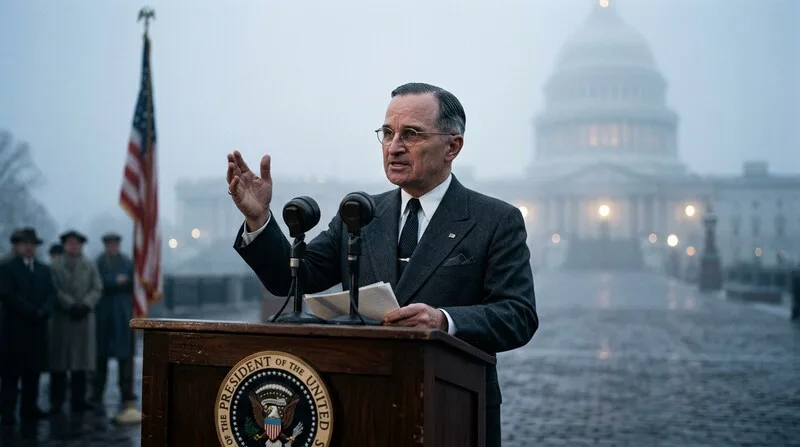
- Harry Truman (1884-1972) served as the 33rd President of the United States (1945-1953) — succeeding FDR on his death, ending World War II, and presiding over the beginning of the Cold War, the founding of NATO, and the Korean War.
- The decision to drop atomic bombs on Hiroshima and Nagasaki in August 1945 — killing between 130,000 and 226,000 people — remains the most consequential and debated military decision in American history, made entirely by Truman without consultation.
- Truman won the 1948 election against all expectations — defeating Republican Thomas Dewey after every poll predicted his loss, in the most famous upset in presidential election history, producing the iconic "Dewey Defeats Truman" headline.
- He issued Executive Order 9981 in 1948, desegregating the US military — the most significant civil rights action by any president since Lincoln, taken over strong Southern Democratic opposition and against the advice of several senior military commanders.
Biography
Harry S. Truman was born on May 8, 1884, in Lamar, Missouri, the son of a mule trader and farmer. He grew up in Independence, Missouri, the small-town Midwest that shaped his no-nonsense, plainspoken character. Unlike most of his presidential predecessors, he never attended college — a fact that made him unusual among post-war presidents and that his critics used against him, and that his admirers cited as evidence of his common-man authenticity. He worked as a bank clerk, then as a farmer on his family’s land in Grandview, Missouri, for eleven years. In World War I he served as a captain in the Missouri National Guard, commanding an artillery battery in France, where he demonstrated leadership under fire that would characterize his later career.
Truman entered politics through the Pendergast machine — the notoriously corrupt Democratic political organization that controlled Kansas City — serving as a county judge (essentially a county administrator) before being elected to the US Senate from Missouri in 1934. In the Senate he chaired the Truman Committee investigating waste and fraud in wartime defense contracts, saving an estimated $15 billion and earning a national reputation for integrity. In 1944, at Roosevelt’s request, he replaced the incumbent Vice President Henry Wallace on the Democratic ticket — a decision of enormous consequence, since Roosevelt’s declining health was visible to insiders. On April 12, 1945, just 82 days after being inaugurated as vice president, Truman was summoned to the White House and told that Roosevelt had died. “Boys, if you ever pray, pray for me now,” he told reporters the next morning. “I don’t know if you fellas ever had a load of hay fall on you, but when they told me yesterday what had happened, I felt like the moon, the stars, and all the planets had fallen on me.”
Truman served the remainder of FDR’s term and won the presidency in his own right in the famous 1948 upset. He declined to run for a third term in 1952 — the 22nd Amendment did not apply to him since he was already in office when it was ratified — and retired to Independence, Missouri. He died on December 26, 1972, at age 88.
Key Policy Areas
Atomic Bomb & End of WWII
Truman had been in office less than four months when he authorized the use of atomic weapons against Japan. The bomb dropped on Hiroshima on August 6, 1945, killed approximately 80,000 people immediately and destroyed five square miles of the city. A second bomb struck Nagasaki on August 9, killing approximately 40,000. Japan announced its surrender on August 15. Truman always defended the decision as having prevented a far more costly land invasion. He had not been told of the Manhattan Project until after FDR’s death — his first briefing came from Secretary of War Henry Stimson on April 25, 1945, thirteen days after he became president.
Marshall Plan, NATO & Containment
Truman’s foreign policy achievements were transformative and enduring. The Truman Doctrine (March 1947) declared the US would support free peoples resisting communist subversion, providing $400 million to Greece and Turkey. The Marshall Plan (1948–1952) provided $13.3 billion to rebuild Western Europe, preventing communist takeover in France and Italy. The Berlin Airlift (1948–1949) countered the Soviet blockade of West Berlin with 278,000 flights over 15 months. NATO was founded in April 1949 — the first peacetime military alliance in American history. The National Security Act of 1947 created the CIA, the NSC, the Joint Chiefs of Staff, and the modern national security structure that still exists.
Korean War & MacArthur
When North Korea invaded South Korea in June 1950, Truman committed US forces without a formal declaration of war, calling it a “police action.” General Douglas MacArthur’s brilliant Inchon landing in September 1950 reversed the initial collapse, but his subsequent advance to the Chinese border provoked a massive Chinese intervention that pushed UN forces back below the 38th parallel. MacArthur publicly demanded escalation against China — including possible nuclear strikes — in direct defiance of Truman’s policy. In April 1951, Truman fired MacArthur for insubordination — a courageous assertion of civilian control over the military that was deeply unpopular at the time. The war killed 36,000 Americans and ended in a stalemate armistice in 1953 — under Eisenhower.
Approval Ratings: From Hero to Lowest Ever
Truman’s approval ratings traced one of the most dramatic arcs in the history of presidential polling. He entered office with enormous goodwill after FDR’s death and the Allied victory, posting approval ratings in the mid-80s in April and May 1945. After the Japanese surrender in August 1945, his approval hit 82% — the highest of his presidency. The post-war period brought rapid decline: reconversion to a peacetime economy brought inflation, labor strikes, and shortages, pushing his approval into the 30s by 1946 and contributing to a Democratic massacre in the 1946 midterms that handed Republicans control of both chambers for the first time since 1933.
His 1948 upset reelection temporarily restored his standing, and the early stages of the Korean War, seen as a principled response to communist aggression, were initially popular. But as the war ground on, casualties mounted, and no end appeared in sight, his approval collapsed. In February 1952, Gallup recorded a 22% approval rating for Truman — at the time the lowest ever recorded for a sitting president, a record that stood until the Nixon and George W. Bush eras. He did not run for re-election in 1952. His historical reputation has risen substantially since then: he is now consistently ranked in the top ten presidents, with his Cold War architecture — Truman Doctrine, Marshall Plan, NATO, containment — seen as foundational achievements that shaped the Western order for fifty years.
1948: “Dewey Defeats Truman”
The 1948 presidential election is the greatest upset in American political history and the most famous failure of polling and punditry. Every major indicator suggested Truman would lose. The Democratic Party had fractured: southern conservatives bolted to form the States’ Rights (“Dixiecrat”) Party under South Carolina Governor Strom Thurmond, running on a platform opposing civil rights; liberals frustrated with Truman’s foreign policy backed former Vice President Henry Wallace’s Progressive Party candidacy. Against this fragmented coalition, Republican Governor Thomas Dewey of New York — polished, organized, and running a cautious front-runner’s campaign — seemed a near-certain winner.
Gallup, Roper, and Crossley all stopped polling weeks before election day, confident of the result. On election eve, Newsweek polled 50 leading political reporters — all 50 predicted a Dewey victory. The Chicago Tribune, determined not to miss its early-edition deadline, printed “DEWEY DEFEATS TRUMAN” in 96-point type on its front page. Truman, who had gone to bed early on election night believing he had lost, woke up at 4 a.m. to learn he had carried the Midwest. Final result: Truman 303 Electoral College votes, Dewey 189, Thurmond 39. He won the popular vote 49.6% to 45.1%. The photograph of Truman grinning and holding up the erroneous Tribune front page remains one of the most reproduced images in American political history. See the full 1948 election breakdown.
| Event / Decision | Key Number | Context |
|---|---|---|
| Hiroshima (Aug 6, 1945) | ~80,000 killed immediately | First atomic bomb used in warfare; Truman had been president 117 days; wasn't briefed on Manhattan Project until Apr 25 |
| Nagasaki (Aug 9, 1945) | ~40,000 killed immediately | Japan surrendered Aug 15 — ending WWII; Truman argued it prevented ~500,000 US casualties from land invasion |
| Peak Approval | 82% (Gallup, September 1945) | Shortly after Japan's surrender; the highest of his presidency |
| 1948 Election Upset | 303–189 EV; 49.6% vs Dewey's 45.1% | "Dewey Defeats Truman" Tribune front page; every major poll predicted a Dewey win |
| Marshall Plan | $13.3 billion to 16 nations (1948–1952) | Rebuilt Western Europe, prevented communist electoral victories in France and Italy; most successful foreign aid in US history |
| NATO Founded | April 4, 1949 | First peacetime military alliance in US history; framework still governs Euro-Atlantic security 75 years later |
| Korean War | 36,000 US deaths; armistice July 1953 | Committed US forces in June 1950; fired Gen. MacArthur April 1951 for public insubordination — defining assertion of civilian control |
| Lowest Approval | 22% (Gallup, February 1952) | Then-record low for any president; driven by Korean War stalemate, corruption scandals, and inflation |
Historical Legacy
Truman left office in January 1953 as one of the most unpopular presidents in history. His rehabilitation began almost immediately. The Cold War architecture he built — the Truman Doctrine, the Marshall Plan, NATO, and the containment strategy — proved so durable and effective that every subsequent president, Republican and Democrat alike, governed within the framework he established. George Marshall, Dean Acheson, and the national security team Truman assembled is widely considered the finest foreign policy team any American president has ever had.
His domestic record includes the desegregation of the US military by executive order in 1948 — a significant civil rights act that preceded the Civil Rights movement by a decade — and the Fair Deal proposals (national health insurance, federal aid to education, civil rights legislation) that were mostly blocked by Congress but anticipated the Great Society programs of the 1960s. His firing of General MacArthur is now seen as a definitive assertion of civilian control over the military, upheld at enormous political cost. His directness, his unpretentiousness, and his willingness to make hard decisions without looking back have made him a model of presidential character for historians. He ranks consistently in the top five to ten in presidential historians’ polls — the greatest reputational comeback in presidential history.
Watch: Harry Truman at the 1948 Democratic Convention
Harry Truman delivers his acceptance speech at the 1948 Democratic National Convention — the speech that launched his legendary come-from-behind presidential campaign.
Frequently Asked Questions
Why did Truman drop the atomic bomb on Japan?
Truman authorized the atomic bombs on Hiroshima (August 6, 1945) and Nagasaki (August 9, 1945) to end the Pacific War without a land invasion of Japan. Military planners estimated a conventional invasion of Japan’s home islands would cost 250,000 to 1 million American casualties. Japan surrendered on August 15. Truman always defended the decision as having saved more lives on both sides than the alternative. It remains one of the most debated decisions in military history.
What was the Marshall Plan?
The Marshall Plan (1948–1952) provided $13.3 billion in economic aid to 16 Western European nations to rebuild after WWII. Named after Secretary of State George Marshall, it rebuilt European economies, stabilized democracies threatened by communist parties, and is considered the most successful foreign policy program in American history. It formed the economic foundation of the NATO alliance and the Cold War Western order.
How did Truman win the 1948 election against all predictions?
Truman ran a relentless 30,000-mile whistle-stop train campaign, attacking the Republican-controlled “Do-Nothing Congress.” Every major poll and newspaper predicted a Dewey victory — the Chicago Tribune famously printed “DEWEY DEFEATS TRUMAN.” Truman won 303–189 in the Electoral College, 49.6% of the popular vote. The election exposed the limits of early polling methods and became the defining symbol of the underdog political victory.