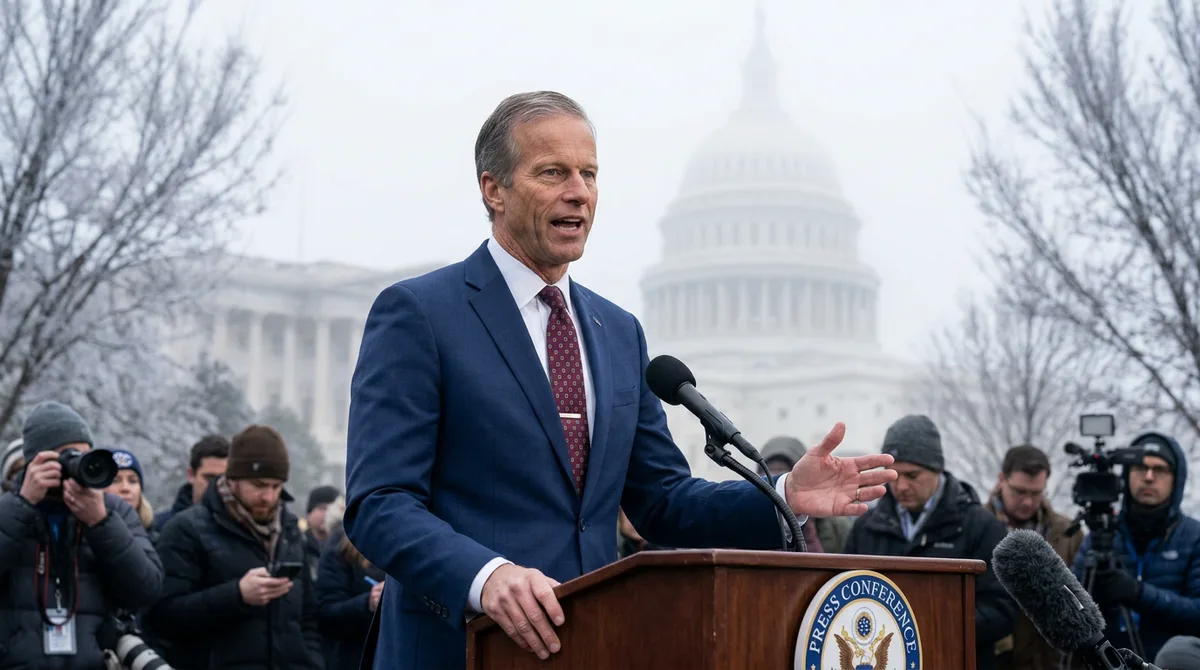
Senate Majority Leader
John Thune became Senate majority Leader in January 2025 following Mitch McConnell's decision to step down from Senate leadership — ending an 18-year run that was arguably the most consequential Senate leadership tenure in American history. Thune's election as Majority Leader by his Republican colleagues marked a generational transition for Senate Republicans: from McConnell's hyper-partisan, process-oriented approach to what Thune represents — a more conventionally conservative but somewhat less combustible style of Republican Senate leadership.
Thune brings to the Majority Leader role a reputation as a skilled legislator who understands farm policy, tax law, and the operational mechanics of the Senate. His path to leadership ran through years as Republican Whip (assistant leader) under McConnell, where he mastered the vote-counting and floor management skills that the Majority Leader position requires. South Dakota is one of the most Republican states in the country, so Thune has never faced competitive general elections — his political challenges have come from Trump loyalists who viewed his conditional Trump criticism in 2021 as disqualifying. He survived those challenges by positioning himself as a reliable Republican who could work with Trump when needed without becoming entirely subordinate to MAGA politics.
As Majority Leader, Thune faces the fundamental challenge facing all Senate majority leaders in the Trump era: managing the demands of a highly factional caucus, passing a budget reconciliation bill that delivers Trump's tax cut extensions and new priorities, and maintaining an image of Senate competence and independence while deferring to a White House that views Congress primarily as an obstacle to manage. The job is arguably harder than McConnell's at peak power because the Senate Republican base in 2025 contains ideological extremes that McConnell himself never had to manage at this scale.
- John Thune (R-SD) was elected Senate Majority Leader in November 2024 after Mitch McConnell stepped down from leadership, making him the top Republican in the Senate with the 119th Congress.
- South Dakota is R+25 — one of the most Republican states, and Thune has won his last three re-elections by margins exceeding 20 points, giving him the safe home-state base needed to lead Senate Republicans.
- As Majority Leader, Thune must balance Trump's legislative agenda with Senate norms — including deciding whether to change filibuster rules, which he has historically defended, to advance the Republican agenda with 53 votes.
- He served as Senate Majority Whip under McConnell for six years before ascending to leader — a tenure that gave him deep knowledge of Republican senators' priorities and the political dynamics of the caucus.
Key Policy Areas
Farm Policy Champion
Thune has been a consistent advocate for South Dakota agriculture throughout his Senate career. The Farm Bill, crop insurance programs, commodity support prices, and trade policy affecting agricultural exports are central to his legislative work. His position on the Senate Agriculture Committee has made him one of the most influential voices on farm policy in Congress.
Fiscal Conservative
Thune has been a consistent advocate for tax cuts, deficit reduction, and limiting government spending throughout his career. He was a key architect of the 2017 Tax Cuts and Jobs Act. As Majority Leader, he must navigate the tension between deficit hawks in his caucus and the Trump administration's appetite for tax cuts without offsetting spending reductions.
Institutionalist Republican
Thune represents the institutionalist wing of the Republican Party that believes in the Senate as an independent institution. His 2021 criticism of Trump's election denialism earned Trump's enmity, but he survived primary threats in South Dakota. As Majority Leader, he must balance institutional prerogatives with the demands of a president who has repeatedly tested the boundaries of executive power.
Electoral History
| Year | Race | Result | Margin |
|---|---|---|---|
| 2022 | South Dakota Senate (re-election) | Thune 65.6% — Brian Bengs (D) 31.6% | R +34 |
| 2016 | South Dakota Senate (re-election) | Thune 71.8% — Jay Williams (D) 28.2% | R +43.6 |
| 2010 | South Dakota Senate (re-election) | Thune 100% | Uncontested |
| 2004 | South Dakota Senate (open) | Thune 51.0% — Tom Daschle (D, inc.) 49.0% | R +1.0 |
| 2002 | South Dakota House | Thune 52.9% — Stephanie Herseth 47.1% | R +5.8 |
| 1996 | South Dakota House (open) | Thune 57.6% — Tim Johnson 40.0% | R +17.6 |
The 2004 Upset: Defeating Senate Majority Leader Daschle
Thune's most historically significant election was his 2004 defeat of Tom Daschle — at the time the Senate Minority Leader and one of the most nationally prominent Democrats in the country. Daschle was the single most powerful Democrat in elected office after John Kerry (who was running for president), and defeating him required overcoming enormous institutional advantages and national fundraising that Daschle could tap.
The race was nationalized from the start. Republicans saw it as a chance to decapitate Democratic Senate leadership. Democrats poured money into South Dakota to protect Daschle. The outcome — Thune 51%, Daschle 49%, a margin of roughly 4,500 votes — sent shockwaves through Washington and contributed to the sense that 2004 was a genuinely transformative Republican year (Bush also won re-election convincingly and Republicans expanded their Senate majority). Thune has never faced a remotely competitive general election since.
Watch: Thune on Senate Floor
Senate Majority Leader Thune managing Republican floor strategy — the core of his leadership role as the Senate's top Republican and successor to Mitch McConnell. As Majority Leader he must advance Trump's legislative agenda while managing a fractional caucus and the 60-vote filibuster threshold.