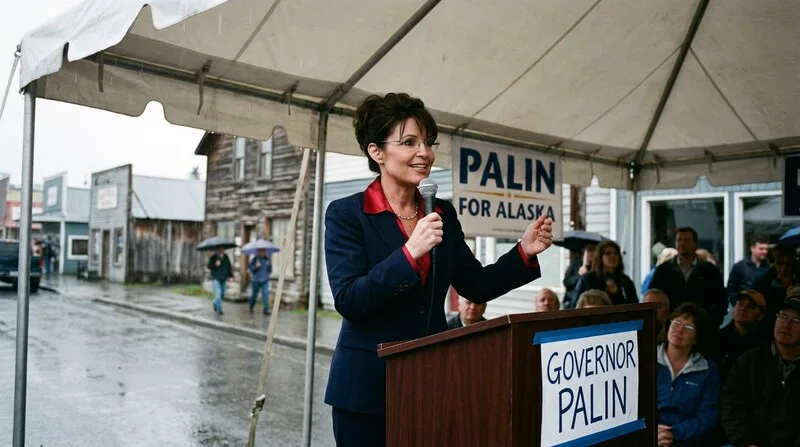
Biography
Sarah Palin grew up in Wasilla, Alaska — a small city north of Anchorage — and attended the University of Idaho, earning a journalism degree in 1987. She served on the Wasilla city council and then as mayor from 1996 to 2002, before serving on Alaska’s Oil and Gas Conservation Commission. In 2006, she was elected Alaska’s governor at age 42 — the youngest governor in Alaska history and the first woman to hold the office. She arrived with an 80% approval rating, built partly on a reformist record challenging the established Alaska Republican political machine and oil industry relationships she regarded as corrupt. Her national anonymity ended abruptly on August 29, 2008, when John McCain selected her as his vice-presidential running mate — a choice kept secret until the announcement, designed to energize the Republican base, attract women voters disillusioned by Hillary Clinton’s primary loss, and inject anti-establishment energy into a campaign that was trailing Obama. Her speech at the Republican National Convention, including the line “What’s the difference between a hockey mom and a pit bull? Lipstick,” electrified the Republican crowd and briefly gave the McCain-Palin ticket a polling lead.
The 2008 campaign exposed significant weaknesses that her convention performance had obscured. A series of high-profile interviews — most damagingly with CBS anchor Katie Couric — revealed shallow policy preparation. Her answer that Alaska’s proximity to Russia gave her foreign policy experience became the basis for Tina Fey’s devastating Saturday Night Live parody (“I can see Russia from my house”), though Palin’s actual statement was “you can actually see Russia from land here in Alaska.” She was unable to name a single newspaper or magazine she regularly read. Internal McCain campaign tensions about her readiness were extensive and later published in multiple post-campaign books. She resigned as Alaska governor on July 3, 2009, with 17 months remaining in her term, citing “lame duck” status and a series of ethics complaints she described as politically motivated. The resignation was widely seen as disqualifying for future high office. She subsequently became a Fox News contributor, appeared in the reality television series Sarah Palin’s Alaska, and became one of the Tea Party movement’s most prominent national figures. She divorced Todd Palin in 2019 after 31 years of marriage.
Palin ran for Alaska’s at-large US House majority in 2022 following the death of longtime congressman Don Young. She lost to Democrat Mary Peltola in both the August 2022 special election and the November 2022 general election under Alaska’s new ranked-choice voting system — a system Palin herself had opposed. The losses effectively ended her career as an elected official. Her historical legacy is complex and contested. She is widely credited — or blamed — with mainstreaming the political template that Trump subsequently perfected: outsider authenticity, reflexive media hostility, cultural grievance as the organizing principle of politics, base mobilization over coalition-building, and policy detail as a weakness rather than a strength. She endorsed Trump in the January 2016 Iowa primary — one of the first major Republican figures to do so — providing him crucial credibility with the evangelical and populist conservative voters she had cultivated. The Palin playbook and the MAGA movement are different in scale but continuous in method.
- Sarah Palin was the 2008 Republican vice presidential nominee — chosen by John McCain as a surprise pick, she energized the Republican base but ultimately her performance in interviews (notably with Katie Couric) became a liability for the ticket.
- She resigned as Governor of Alaska in July 2009 — halfway through her first term — citing the cost of ethics investigations, a decision that surprised Alaska Republicans and effectively ended her path to conventional elected office.
- Palin's candidacy pioneered the populist, anti-media, anti-establishment political style that would define the Tea Party movement and eventually Trump's 2016 campaign — she was in many ways the prototype for the MAGA political aesthetic.
- She lost the 2022 Alaska special election to Democrat Mary Peltola — becoming the first Democrat to represent Alaska in Congress in 50 years — in a race decided by Alaska's ranked-choice voting system in what many saw as a rebuke of her political style.

Key Policy Areas
Alaska Energy & “Drill Baby Drill”
Palin’s most substantive policy record was in energy. As Alaska governor, she negotiated the Alaska Gasline Inducement Act, a major natural gas pipeline project, and was a consistent advocate for expanded drilling in the Arctic National Wildlife Refuge and elsewhere. Her “Drill Baby Drill” slogan at the 2008 Republican convention became one of the defining phrases of the campaign. She combined genuine knowledge of Alaska energy policy with a broader anti-regulation, anti-environmentalist posture that was central to her appeal to the Republican base. Her pre-national record as a regulator of the Alaska oil industry — challenging established relationships — was more nuanced than her campaign persona suggested.
Anti-Establishment Populism
Palin’s most durable political contribution was not policy but posture. She popularized a version of Republican politics organized around hostility to elites — media, academics, coastal professionals — and the affirmation of “real Americans” as a distinct and superior category. The Tea Party movement she helped build framed itself as grassroots resistance to both parties’ establishment, though it was largely channeled into Republican base politics. Her endorsement of Trump in January 2016 was consequential because she gave him credibility with the evangelical and rural conservative voters who had been her core constituency since 2008. The anti-elite, anti-media, anti-expert framework she normalized in Republican politics is the direct ancestor of MAGA.
Social Conservatism
Palin held consistently hard-right social conservative positions. She opposed abortion without exception, including in cases of rape and incest — a position that was to the right of the official Republican Party platform in 2008 and required careful management by the McCain campaign. She was a lifetime NRA member and staunch Second Amendment advocate. Her evangelical Christian faith was central to her public identity and her appeal to the Republican base. Her decision to carry her son Trig to term after his Down syndrome diagnosis was widely cited as a demonstration of her anti-abortion convictions in practice. She opposed same-sex marriage. Her social conservative record gave her immediate credibility with the Christian right wing of the Republican Party that McCain had struggled to energize.
| Year | Event | Significance |
|---|---|---|
| 2006 | Elected Alaska Governor (defeated incumbent Frank Murkowski in primary) | Ran as reformer against her own party's machine; won general 48.3% |
| Aug 2008 | Named McCain's VP pick | Second woman on a major-party presidential ticket; initial enthusiasm then disillusionment as unscripted interviews raised doubts |
| Nov 2008 | McCain-Palin lost 173-365 electoral votes | Exit polls showed 60% of voters saw Palin as unqualified; energized base but hurt ticket with independents |
| Jul 2009 | Resigned as governor with 18 months left | Cited ethics investigations and legal costs; enabled $12M book deal and Fox News career |
| 2010-2015 | Fox News contributor, Tea Party figurehead, "Going Rogue" 11M copies | Pioneered the celebrity-politics style that Trump later scaled nationally |
| Jan 2016 | Endorsed Donald Trump for president | Legitimized Trump with evangelical and populist base at critical early primary moment |
| Aug 2022 | Lost AK-At Large House special election to Mary Peltola (D) | First ranked-choice voting election in Alaska; Palin split vote with Nick Begich (R) |
| Nov 2022 | Lost same seat again to Peltola in regular election | Ranked-choice voting again decisive; Begich voters preferred Peltola as 2nd choice over Palin |
Historical Legacy
The core debate about Sarah Palin’s legacy is whether she represents a cause or a symptom. Did she create the conditions for Trumpism, or did she simply recognize and articulate forces already present in the Republican electorate? The evidence supports both. Her convention speech in 2008 revealed a genuine hunger in the Republican base for a politics of cultural identity and anti-elite grievance that the party’s establishment — represented by McCain — had never offered. She gave that hunger a language and a face. Trump gave it a governing program.
The trajectory of her post-2008 career — Fox News, reality television, Tea Party speaking circuit, two congressional losses in Alaska — illustrates the difference between being the precursor to a political movement and being able to sustain a political career within it. She introduced a template she could not herself execute at scale. Her early Trump endorsement in January 2016, at a moment when his campaign’s viability was still contested, was probably the most consequential political act of her post-2008 career. The candidate she endorsed became the president who transformed the party she had previewed.
Frequently Asked Questions
Who is Sarah Palin and why was she important?
Palin was Alaska’s governor and the 2008 Republican vice-presidential nominee. She matters historically less for what she accomplished in office than for the political template she introduced nationally: anti-elite rhetoric, media hostility as a political identity, cultural grievance as an organizing principle, and base mobilization over coalition-building. Eight years before Trump, she demonstrated that a significant portion of the Republican electorate would respond powerfully to a candidate who positioned themselves against expertise, institutions, and the media. Her early endorsement of Trump in January 2016 directly contributed to his viability in the Iowa primary. Most analysts see her as the figure who made MAGA-style politics nationally visible for the first time.
Did Sarah Palin lose her 2022 congressional race?
Yes, twice. Palin ran for Alaska’s at-large House majority in both the August 2022 special election and the November 2022 general election following the death of Don Young. She lost both to Democrat Mary Peltola under Alaska’s ranked-choice voting system. In ranked-choice voting, her first-round totals were competitive, but when second-choice votes from Republican Nick Begich were redistributed, enough of them went to Peltola to produce a Democratic victory. Palin had opposed ranked-choice voting and her losses were partly attributed to the mechanics of a system that requires candidates to build coalitions beyond their base — a discipline that has never been Palin’s political strength. The defeats effectively ended her career as a candidate for elective office.
What is Sarah Palin’s connection to the Tea Party?
After resigning as Alaska governor in July 2009, Palin became one of the Tea Party movement’s most prominent national faces. She spoke at Tea Party rallies across the country, popularized the phrase “death panels” during the ACA debate, and used her Fox News platform to build a national audience for the movement’s anti-establishment, anti-spending, anti-Obama politics. Her endorsements in 2010 Republican primaries helped elect several Tea Party candidates. The movement she helped build was organizationally significant but also revealed the limits of her political influence — many candidates she backed lost, and the Tea Party’s institutional influence faded after 2012. The cultural and rhetorical framework she helped establish, however, persisted and became the foundation for MAGA politics after 2015.