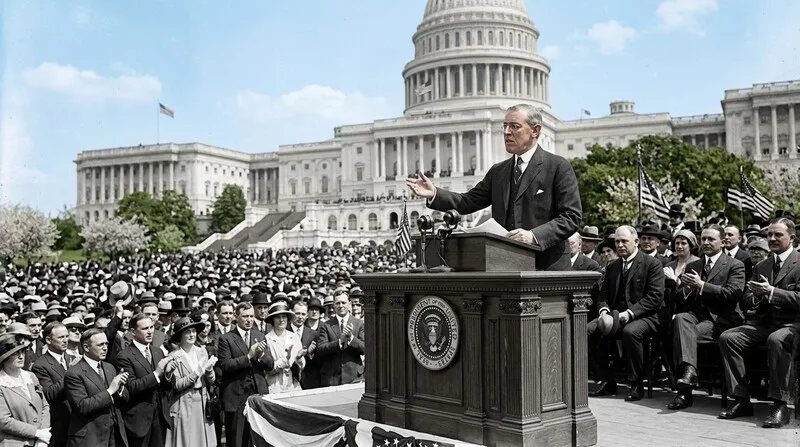
- Woodrow Wilson was the 28th President of the United States (1913-1921) — winning the 1912 election in a three-way race when Theodore Roosevelt's Progressive Party split the Republican vote, then winning re-election in 1916.
- His domestic legacy includes the Federal Reserve Act, the Clayton Antitrust Act, and the Federal Trade Commission — the most significant federal regulatory expansion since the Progressive Era, transforming the American economy's institutional infrastructure.
- Wilson led the US through World War I and proposed the League of Nations — his Fourteen Points speech outlined a vision for international order that shaped the post-war settlement, even though the Senate refused to ratify US membership in the League.
- His record is deeply complicated by his virulent racial segregation of the federal government — reversing decades of Black federal employment gains, screening the KKK-glorifying film Birth of a Nation at the White House, and opposing federal anti-lynching legislation.
Biography
Thomas Woodrow Wilson was born on December 28, 1856, in Staunton, Virginia, the son of a Presbyterian minister. He grew up in the South during and after the Civil War and Reconstruction — formative experiences that instilled a deep Christian moralism and a regressive racial worldview that would mark his presidency. He earned his doctorate from Johns Hopkins University (1886), the first president to hold a Ph.D., and became a distinguished political scientist and constitutional historian. He was president of Princeton University from 1902 to 1910, where he modernized the curriculum and fought, unsuccessfully, to abolish the exclusive eating clubs he saw as bastions of privilege — foreshadowing the progressive battles of his presidency.
Wilson was elected Governor of New Jersey in 1910 on a reform platform and immediately broke with the Democratic machine bosses who had backed him, pushing through a sweeping legislative program. His record in Trenton made him a national figure and the leading candidate for the 1912 Democratic presidential nomination. He won the nomination on the 46th ballot of a deadlocked Democratic convention in Baltimore, then capitalized on the Republican split between Theodore Roosevelt and William Howard Taft to win the presidency with 435 Electoral College votes — one of the largest ever — despite winning only 41.8% of the popular vote. He was re-elected in 1916 by the narrowest of margins, winning 277–254 Electoral College votes in a race not decided until California’s returns came in the day after the election.
His second term was consumed by the First World War. He had kept the US out of the conflict for nearly three years; after Germany resumed unrestricted submarine warfare and the revelation of the Zimmermann Telegram, he led the country into war in April 1917 and then to the Paris Peace Conference in January 1919, the first sitting president to visit Europe. His attempt to win Senate ratification of the Treaty of Versailles and US membership in the League of Nations ended in failure, defeat, and personal catastrophe when he suffered a massive stroke in October 1919. He served out his term largely incapacitated, leaving the White House in March 1921, and died in Washington on February 3, 1924.
Key Policy Areas
WWI & Peace
Wilson declared war in April 1917 (“The world must be made safe for democracy”) after Germany resumed unrestricted submarine warfare and the Zimmermann Telegram was revealed. His Fourteen Points — presented to Congress in January 1918 — outlined his vision for a postwar order: open diplomacy, freedom of the seas, arms reduction, national self-determination, and above all, a League of Nations. At the Paris Peace Conference (January–June 1919), he secured the League’s inclusion in the Treaty of Versailles but had to accept compromises that undermined his other principles — particularly the harsh reparations imposed on Germany that many historians argue contributed to the rise of Nazism.
The New Freedom
Wilson’s domestic program, the “New Freedom,” reshaped American government. The Federal Reserve Act (1913) created the central banking system that governs American monetary policy today — perhaps the most consequential single piece of domestic legislation of the 20th century. The Underwood Tariff (1913) dramatically reduced tariffs and implemented the new graduated income tax enabled by the 16th Amendment. The Clayton Antitrust Act (1914) strengthened antitrust enforcement. The Federal Trade Commission (1914) created a regulatory agency for commerce. The Adamson Act (1916) established the 8-hour workday for railroad workers. Together these created much of the regulatory architecture of modern American capitalism.
Race & Civil Rights
Wilson’s record on race was a catastrophic regression. Within weeks of taking office, his administration segregated the previously integrated federal civil service, removing Black Americans from positions they had held since Reconstruction. Black federal workers were physically separated from whites, assigned inferior facilities, and fired in large numbers. Wilson screened The Birth of a Nation (1915) — the film that helped revive the KKK — at a White House screening and reportedly declared: “It is like writing history with lightning, and my only regret is that it is all so terribly true.” His record is a reminder that progressive reform and racial justice have not always marched together in American history.
Presidential Elections (1912 & 1916)
| Year | Opponent(s) | Wilson % | EV Won | Context |
|---|---|---|---|---|
| 1912 | T. Roosevelt (Bull Moose), Taft (R) | 41.8% | 435 / 531 | Three-way race; Roosevelt/Taft split Republican vote |
| 1916 | Charles Evans Hughes (R) | 49.2% | 277 / 531 | Closest race of Wilson era; decided by California |
The 1912 election is unique in American history — the only presidential contest in which a third-party candidate (Theodore Roosevelt) finished second. Wilson won one of the largest Electoral College majorities ever recorded despite receiving fewer votes than any major-party winner in modern history. The 1916 race was one of the closest in history: Hughes went to bed believing he had won (the New York Times printed an early edition calling him the winner) before California’s late returns gave Wilson the state by 3,773 votes and the presidency by 277–254 in the Electoral College.
The League of Nations & Senate Defeat
Wilson arrived at the Paris Peace Conference in January 1919 as the most celebrated leader in the world — crowds in Paris, London, and Rome greeted him with a fervor approaching religious awe. He secured the inclusion of the League of Nations Covenant in the Treaty of Versailles, with its central provision (Article X) obligating member nations to respect and preserve each other’s territorial integrity.
At home, Senate Republicans under Henry Cabot Lodge were deeply skeptical. Lodge drafted 14 “reservations” to the treaty, particularly targeting Article X as an unconstitutional delegation of Congress’s war-making power. Wilson refused to accept any modifications — a decision born of pride, political calculation, and, increasingly, deteriorating health.
In September 1919, Wilson embarked on an 8,000-mile speaking tour across the country to build public pressure on wavering senators. On September 25, he collapsed in Pueblo, Colorado, after a speech. His train rushed back to Washington, and on October 2, he suffered a massive cerebrovascular stroke that paralyzed his left side and severely impaired his cognitive function. The Senate rejected the treaty (with reservations) 39–55 in November 1919 and again (without) 38–53 in March 1920. The United States never joined the League of Nations — a body Wilson had designed and that, without American membership and power, proved unable to prevent the catastrophe of World War II.
Historical Standing
Wilson consistently ranks among the top dozen or so presidents in scholarly surveys, reflecting his consequential legislative achievements and his redefinition of American foreign policy. C-SPAN’s 2021 Presidential Historians Survey ranked him 13th overall. His Federal Reserve Act, his Fourteen Points, and the League of Nations concept — foundational to the postwar United Nations — represent genuine and lasting achievements.
His ranking has declined over time as historians have increasingly weighted his devastating record on race. Princeton University removed his name from its Woodrow Wilson School of Public and International Affairs in June 2020, citing his segregationist policies. The reassessment of Wilson’s legacy mirrors a broader reckoning in American historical memory with the gap between progressive rhetoric and racial injustice in the Progressive Era.
Watch: Woodrow Wilson War Speech 1917
President Woodrow Wilson delivers his War Message to Congress on April 2, 1917, bringing the United States into World War I.