Biography
Timothy Eugene Scott was born on September 19, 1965, in North Charleston, South Carolina. He was raised primarily by his mother, Frances Scott, after his parents divorced when he was 7. He grew up in poverty in a small house in North Charleston and has described the family sometimes going days without eating. His trajectory changed when he befriended John Moniz, a Chick-fil-A franchise owner who became a mentor and introduced him to conservative principles of entrepreneurship and self-reliance. Scott graduated from Charleston Southern University in 1988 with a degree in political science and went on to found his own insurance agency before entering politics.
He was elected to the Charleston County Council in 1995, then to the South Carolina House of Representatives in 1998, and then to the US House of Representatives in 2010 as part of the Tea Party wave that swept Republicans into the House majority. In January 2013, South Carolina Governor Nikki Haley appointed him to fill the Senate majority vacated by Jim DeMint, making him the first Black Republican senator from the South since Reconstruction — since Blanche Bruce of Mississippi left the Senate in 1881. Scott was elected in his own right in 2014, winning by 61%, and re-elected in 2016 (61%) and 2022 (63%), each time demonstrating a cross-racial coalition unusual for a Republican in a Southern state.
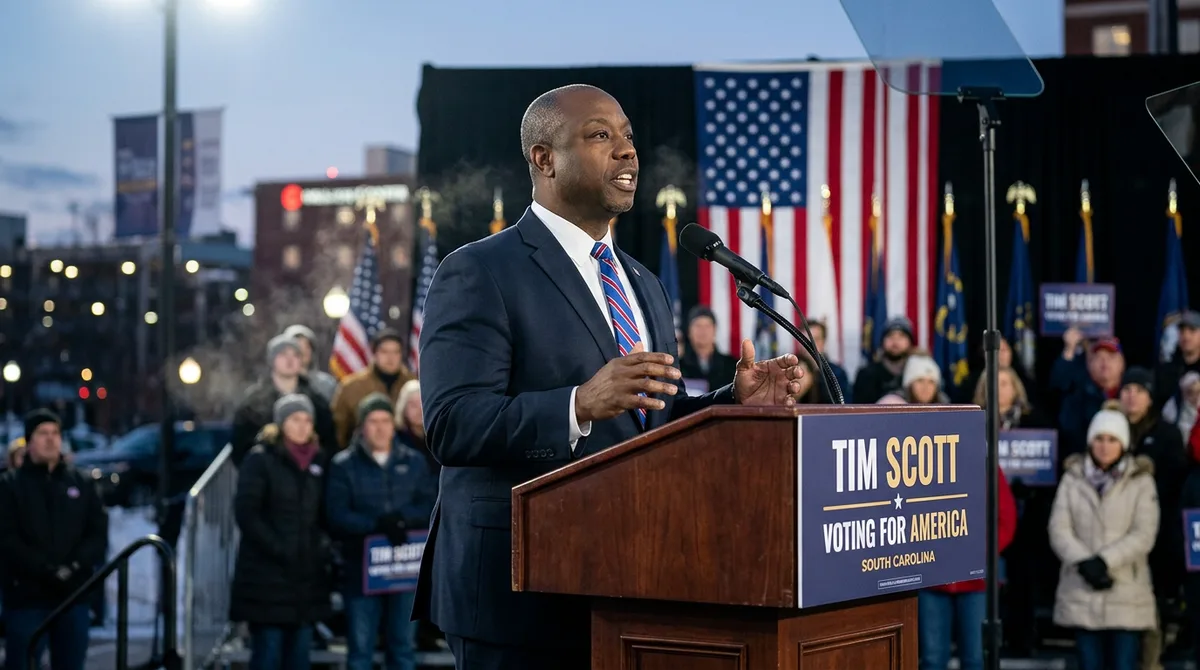
In May 2023, Scott entered the Republican presidential primary, positioning himself as an optimistic alternative to the culture-war messaging that dominated the field. His campaign emphasized his personal biography and the theme that America is “not a racist country.” He suspended his campaign in November 2023 after never breaking through against Donald Trump's dominant position in the polls, and subsequently endorsed Trump. He was considered for the vice presidential slot before Trump selected JD Vance. Scott remains in the Senate, having been re-elected in 2022 and serving through 2028.
- Tim Scott (R-SC) ran for president in 2024 — dropping out in November 2023 before the Iowa caucuses — and serves as US Senate Majority Whip under John Thune, the first Black senator to serve as Senate majority whip.
- He won re-election to South Carolina's Senate seat in 2022 by 26 points — a decisive win in a deeply Republican state — and is one of the few Black Republicans in the Senate, a position that shapes his approach to both racial equity and conservative policy.
- South Carolina is R+12 — and Scott has won each of his Senate races easily, giving him the security to take on leadership roles that require managing the political dynamics of a diverse Republican caucus.
- Scott is a self-described example of the American Dream — raised by a single mother in poverty in North Charleston, becoming a successful businessman and politician — whose personal biography forms the core of his political message on economic mobility and individual opportunity.

Key Policy Areas
Opportunity Zones
Scott's signature legislative achievement is the Opportunity Zones program, created as part of the 2017 Tax Cuts and Jobs Act. The program designates over 8,700 economically distressed census tracts where investors can defer or eliminate capital gains taxes on investments. Proponents credit it with channeling billions in private capital into low-income communities. Critics argue the investments have disproportionately benefited wealthy developers and luxury projects rather than low-income residents. Scott frames Opportunity Zones as a market-based alternative to direct government spending — a way to bring private investment to underserved communities without expanding the federal bureaucracy.
Police Reform & Criminal Justice
Following George Floyd's murder in May 2020, Scott drafted the JUSTICE Act — the Republican Senate's response to police reform demands. The bill included requirements for police departments to report use-of-force incidents to a federal database, provisions to discourage chokeholds, and grants for body cameras. Democrats argued it was too weak, and the bill did not advance. Scott's willingness to engage seriously with police reform questions placed him in an unusual position within the Senate Republican base and drew both praise from moderates and criticism from those who wanted a harder line. He has also spoken on the Senate floor about his own experiences being stopped by police because of his race — a rare moment of personal testimony from a Republican senator.
Defense & Social Conservatism
Beyond Opportunity Zones, Scott's voting record is solidly conservative. He is a consistent supporter of strong defense budgets, has advocated hawkish positions on China, Iran, and Israel, and supports robust immigration polling. On social issues, he is a strong opponent of abortion at all stages and has rated 100% by National Right to Life. He opposed same-sex marriage. He gave the Republican response to Biden's April 2021 address to Congress — a nationally watched speech in which he argued that America is “not a racist country” and offered his personal biography as evidence — which drew enormous viewer response, both positive and sharply critical. His approval rating in South Carolina consistently runs around 60%, among the stronger numbers for any Southern Republican senator.
Tim Scott’s South Carolina Career: A History-Making Electoral Record
| Year | Office / Event | Result | Significance |
|---|---|---|---|
| Jan 2013 | Appointed to US Senate by Gov. Nikki Haley | First Black R senator from South since Reconstruction (since 1881) | First use of 25th Amendment’s analogous state-level power to place Black Republican in Southern Senate seat |
| 2014 | Won Senate special election in own right | 61% vs. Democrat Joyce Dickerson | Broad crossover coalition in a state ~73% white; validated appointee status with election |
| 2016 | Won full 6-year term | 61% vs. Thomas Dixon | Re-election confirmed durable SC coalition; gave him 2022 as next major test |
| Apr 2021 | Delivered Republican response to Biden’s address to Congress | National TV audience; “America is not a racist country” | Most-watched Republican rebuttal since Obama era; drew national praise and criticism; launched 2024 presidential speculation |
| 2022 | Won re-election | 63% vs. Democrat Krystle Matthews | Largest margin of his three elections; entering presidential race with strong home base |
| Nov 2023 | Suspended 2024 presidential campaign | Never broke 5% in national R polls vs. Trump | Endorsed Trump; considered for VP (passed over for Vance); national profile sustained despite loss |
Current Standing & Legacy
Tim Scott occupies a distinctive and sometimes paradoxical position in American politics. He is the Senate's only Black Republican, serving a state that is roughly 27% Black while winning elections with margins that require substantial crossover support. He has built his political identity on the argument that economic opportunity and conservative principles can appeal across racial lines — that the Republican Party need not be written off by Black voters. His Opportunity Zones program is his most tangible legislative legacy, though its impact on the poorest residents of designated zones remains disputed in economic research.
His 2024 presidential campaign demonstrated both the appeal and the limitations of his message within the current Republican Party. He raised significant money, delivered polished debate performances, and generated genuine enthusiasm among a particular subset of Republican donors and voters. But in a primary dominated by Donald Trump and defined by MAGA politics, his message of optimistic conservatism found limited purchase. He withdrew before the first contest, endorsing Trump and positioning himself as a loyal party figure. His place on Trump's VP shortlist, though he was ultimately passed over, indicated that his national standing remains significant.
Nationally, Scott's approval ratings are modest — around 35% in recent polling — reflecting his lower name recognition outside of political circles and the polarizing nature of his arguments about race in America. His Senate majority is safe through 2028, and he remains a frequent presence on conservative media. Whether his path leads to another presidential run, a cabinet position in a future administration, or continued Senate service is an open question, but he remains one of the few Republicans capable of speaking credibly across the party's internal fault lines.
Frequently Asked Questions
What is Tim Scott known for in the Senate?
Scott is best known for authoring the Opportunity Zones program in the 2017 Tax Cuts and Jobs Act, which created tax incentives for investment in over 8,700 economically distressed census tracts. He also engaged in bipartisan police reform talks in 2020, drafting the JUSTICE Act that ultimately failed to advance. He gave the widely watched Republican response to Biden's 2021 address to Congress.
Why is Tim Scott historically significant?
Scott became the first Black Republican senator from the South since Reconstruction when Governor Nikki Haley appointed him in January 2013. He was subsequently elected three times (2014, 2016, 2022) in a state that is roughly 73% white, building a cross-racial coalition that is unusual for a Southern Republican. He is the only Black Republican currently serving in the Senate.
Why did Tim Scott drop out of the 2024 presidential race?
Scott suspended his campaign in November 2023 after failing to break through in Iowa polling against Donald Trump's dominant position. He entered the race in May 2023 with an optimistic message centered on his personal biography and economic opportunity themes, but never exceeded low single digits in national primary polls. He endorsed Trump after withdrawing and was considered for but passed over as VP.