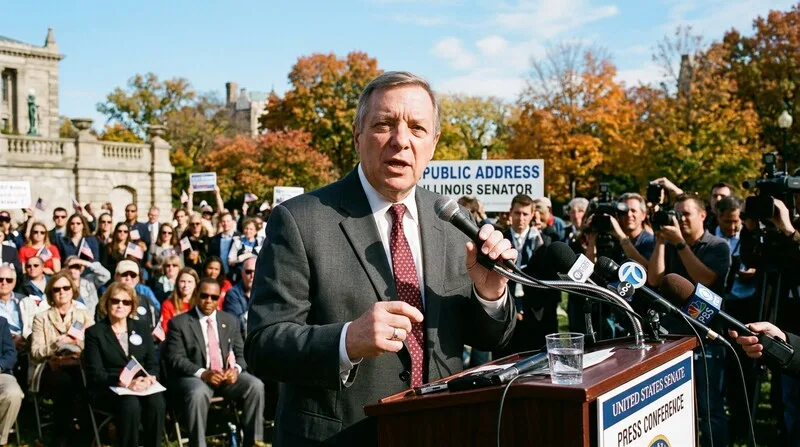
- Jeff Merkley (D) seeks re-election in a state Harris carried by 14.3 points in 2024 (55.3%–41.0%) — Oregon is rated Safe Democratic. Biden won Oregon by 16 points in 2020.
- Oregon has not elected a Republican senator since Gordon Smith's defeat in 2008 — Smith last won re-election in 2002 before Merkley unseated him; the state has been solidly Democratic at the Senate level for over two decades.
- Portland metro's massive liberal base offsets rural Oregon's strong Republican lean — the Portland-Salem-Eugene corridor determines statewide outcomes.
- Oregon's unique vote-by-mail system (since 1998) typically advantages Democrats through high turnout — the state has among the highest voter participation rates nationally.
Oregon is rated Safe Democratic. Merkley has won three consecutive terms with growing margins as Oregon's population growth concentrates in Democratic-leaning Portland and its suburbs. No serious Republican recruitment effort is expected. Full Senate overview →
Current Polling Snapshot
Placeholder polling estimate, early 2026. No major polls released. Figures reflect Oregon's structural Democratic lean. Merkley won 2020 with 57.2%.

Jeff Merkley — Incumbent Profile
Jeff Merkley has represented Oregon in the United States Senate since 2009, when he defeated Republican incumbent Gordon Smith in a competitive 2008 race that was one of the last genuine battleground Senate contests in Oregon's modern political history. A graduate of Stanford University and Princeton's Woodrow Wilson School, Merkley served as Speaker of the Oregon House of Representatives before his Senate run, bringing executive legislative experience to a chamber that often rewards pragmatic dealmakers.
In practice, Merkley has governed as one of the chamber's most consistently progressive voices. He was the sole senator to endorse Bernie Sanders in the 2016 Democratic presidential primary, a signal of his ideological positioning relative to his caucus. He has been among the most vocal advocates for filibuster reform, arguing that the 60-vote threshold has become an anti-democratic obstruction tool that prevents majority governance. He has served on the Senate Foreign Relations Committee and Banking Committee, and has focused domestically on housing affordability, environmental protection, and labor rights in a state where those issues command broad public support.
Oregon's Political Landscape
Oregon presents a study in geographic political polarization. The Willamette Valley, which runs from Portland south through Salem to Eugene, contains roughly two-thirds of the state's population and votes overwhelmingly Democratic. Portland itself is one of the most left-leaning major cities in the country. The state's rural eastern counties and parts of the southern coast vote heavily Republican, but the population imbalance makes statewide Republican victories essentially impossible without a catastrophic Democratic collapse in the cities and suburbs.
Harris carried Oregon by 14.3 points in 2024 (55.3%–41.0%), a modest narrowing from Biden's 16-point margin in 2020. Merkley's 2020 re-election with 57.2% (+17.6 pts) demonstrates the durable advantage that comes from incumbency in a blue-leaning state. The state's political energy in 2026 will be focused far more on its competitive congressional districts than on the Senate race.
Merkley's National Policy Role
While Oregon itself is not a battleground, Merkley's Senate tenure has had outsized national influence through his advocacy on procedural reform. His long-running campaign to end or significantly weaken the legislative filibuster has made him a central figure in Senate governance debates. If Democrats were to regain the majority, Merkley would be a leading voice for whether and how to change Senate rules — decisions that would shape what a Democratic majority could actually accomplish.
His committee assignments have also made him relevant in foreign policy and financial regulatory debates beyond his state's immediate interests. His advocacy for aggressive climate policy aligns with Oregon's significant renewable energy sector and the state's broad environmentalist electorate. In a safe seat, Merkley has the political freedom to take ideological positions that senators in competitive states cannot afford — making him a useful bellwether for the Democratic Party's progressive wing.
Historical Results — Oregon Senate (Class 2)
Gordon Smith (R) held this seat 1997–2009. Merkley’s 2008 win by just 3.3 points was the last genuinely competitive Oregon Senate race. Oregon has since shifted 15+ points bluer at the Senate level.
Video: Merkley’s 22-Hour Senate Filibuster (2025)
KGW News (Portland) — Senator Merkley concludes his 22-hour Senate floor protest in October 2025, a defining moment in his career as the Senate’s leading filibuster reform advocate. Source: KGW News.
Key Facts — Oregon Senate 2026
2026 Senate Race Context & National Outlook
The 2026 midterm elections are taking place in an environment shaped by significant economic uncertainty. Trump's Liberation Day tariffs triggered a consumer confidence collapse and PCE inflation surged to 4.5% in Q1 2026. The Trump approval rating stands at 38.1% approve / 59.2% disapprove — among the lowest for any first-year president since modern polling began. The Generic Ballot shows Democrats with a consistent +6.0 advantage, a historically predictive indicator of significant House seat gains.
In the Senate, 33 Class 2 seats are up in 2026. Republicans must defend seats in Georgia, Iowa, North Carolina, Alaska, and Texas, while Democrats defend Nevada, New Hampshire, Michigan, Minnesota, and Virginia. Key battleground races that will determine Senate control include Georgia (Jon Ossoff, D), Iowa (open seat, Ernst retires), Nevada (Jacky Rosen, D), and Alaska (Lisa Murkowski, R). The full Senate map is at the Senate 2026 overview.
Issue-level polling context: The top issues driving 2026 are the economy and tariffs, healthcare, immigration, and Social Security. See the Battleground Tracker for the latest state-level polling and the Trump Policy Tracker for executive action context.
Frequently Asked Questions
Who is running for Senate in Oregon in 2026?
Senator Jeff Merkley (D) is seeking his fourth term in 2026. Merkley, first elected in 2008, is a leading progressive voice in the Senate. No major Republican challenger has entered the race as of early 2026.
What is Jeff Merkley known for in the Senate?
Jeff Merkley is known as one of the Senate's most consistent progressive voices. He was the only senator to endorse Bernie Sanders in the 2016 Democratic primary, has been a vocal advocate for ending the filibuster, and has championed environmental legislation, housing affordability, and workers' rights throughout his tenure.
Why is Oregon rated Safe Democratic in 2026?
Oregon voted for Kamala Harris by 14.3 points in 2024 (55.3%–41.0%). The state has not elected a Republican US Senator since 2002 and has shifted steadily leftward with growth in the Portland metropolitan area. Merkley's incumbency and Oregon's structural Democratic lean make this race non-competitive.
How did Jeff Merkley first win his Senate seat?
Jeff Merkley won his first Senate election in 2008, defeating Republican incumbent Gordon Smith by 3.3 percentage points in a Democratic wave year. He was subsequently re-elected in 2014 and 2020 by wider margins as Oregon's Democratic lean strengthened.