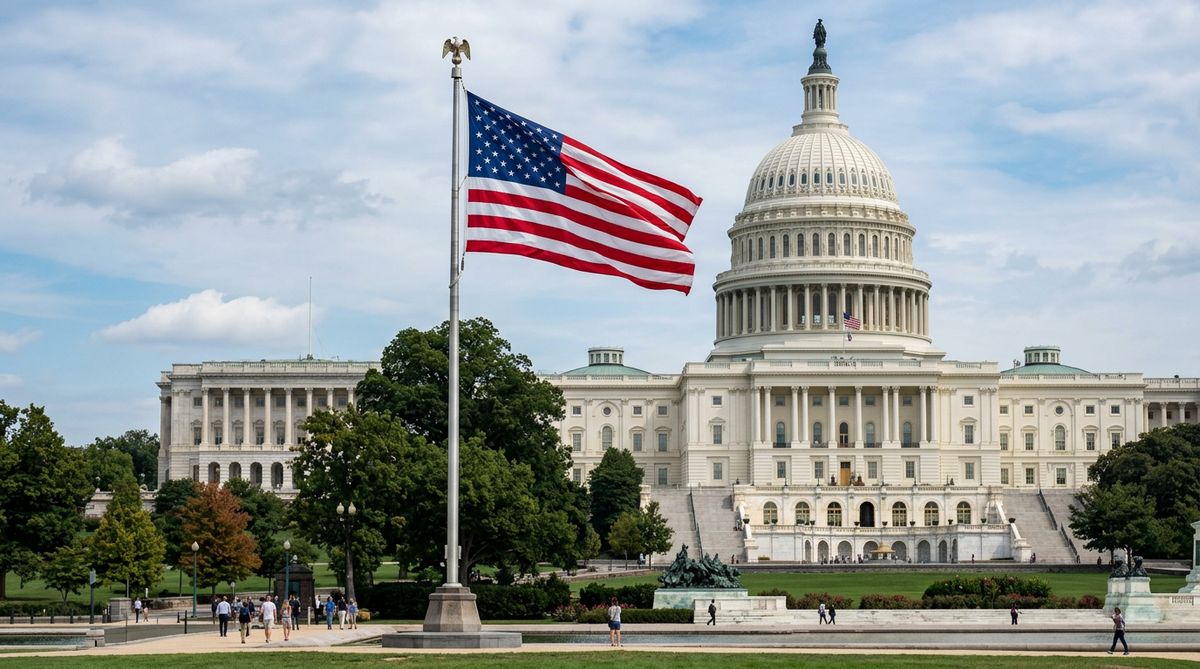
The Budget Process: How It's Supposed to Work
The formal budget process begins in February when the president submits a budget request to Congress. This document is a statement of the administration's priorities — it is not binding and Congress is free to ignore it. The budget request triggers committee work in both chambers: the Budget Committees set overall spending and revenue targets, and the Appropriations Committees divide those totals among 12 subcommittees, each responsible for one of the 12 annual appropriations bills.
The 12 appropriations bills cover: Agriculture; Commerce, Justice, Science; Defense; Energy and Water; Financial Services; Homeland Security; Interior and Environment; Labor, Health and Human Services, Education; Legislative Branch; Military Construction and Veterans Affairs; State and Foreign Operations; and Transportation and HUD. Each bill must pass both the House and Senate and be signed by the president before October 1, the start of the federal fiscal year.
In practice, Congress has not passed all 12 bills by October 1 in most recent years. The last time all appropriations bills were signed on time was fiscal year 1997. The breakdown of regular order has normalized the use of continuing resolutions and massive year-end omnibus packages that bundle all 12 bills together.
Continuing Resolutions: The Stopgap Reality
When the government is not funded at the start of a fiscal year, Congress passes a continuing resolution (CR) to keep government open temporarily at prior-year funding levels. CRs are intended as short-term bridges to full appropriations, but they have become a permanent feature of budgeting.
CRs have several practical consequences. They typically fund agencies at the same rate as the prior year, preventing new programs from launching and agencies from adjusting spending patterns. They create planning uncertainty: agencies do not know how long CR funding will last or what their final-year budget will be. Contractors and grant recipients may delay hiring or projects under CR uncertainty.
A CR can also be used strategically. Short-term CRs set up recurring deadlines that can be used to extract legislative concessions — either by members who threaten to block the CR unless demands are met, or by the president who can threaten a veto. The government has shut down multiple times when CR negotiations collapsed.
Government Shutdowns: What Happens and Who Gets Blamed
What Shuts Down
Non-essential federal employees are furloughed. National parks and monuments close. Processing of passports, loans, permits, and grant applications slows or stops. The IRS suspends some taxpayer services. Federal contractors stop work on many projects. Essential workers — military, air traffic controllers, Border Patrol, TSA, emergency services — continue working without pay. Back pay is typically approved after the shutdown ends, but that provides no relief for workers who cannot cover immediate bills.
Political Blame
Shutdowns are rarely resolved by one side simply capitulating. Public opinion data consistently shows that the party perceived as causing the shutdown suffers more in polling. Republicans bore more blame for the 2018-2019 35-day shutdown (the longest in history) over Trump's border wall funding demands. The party in power typically owns more blame because voters expect the majority to govern. However, shutdowns over single contentious issues can sometimes break in favor of the party using them as leverage if public opinion supports their underlying demand.
Discretionary vs. Mandatory Spending
The federal budget divides into two major categories that operate under fundamentally different rules:
Discretionary spending (approximately $1.4 trillion, or about 20% of total spending) must be appropriated each year through the 12 bills described above. It covers defense (roughly half of all discretionary spending), education, transportation, scientific research, foreign aid, and most federal agency operations. This is the only portion of the budget that Congress negotiates annually.
Mandatory spending (approximately $4 trillion, or roughly 60% of total spending) is governed by pre-existing law and flows automatically based on eligibility criteria rather than annual appropriations. Social Security, Medicare, Medicaid, and income support programs like SNAP and unemployment insurance are the main components. Interest on the national debt (now exceeding $1 trillion) is also mandatory. To reduce mandatory spending, Congress must change the underlying laws — which is politically difficult because these programs have large, politically active beneficiary populations.
2026 Context: The Republican Reconciliation Bill
Republicans in the 119th Congress (2025-2027) are pursuing a major reconciliation package alongside regular appropriations. The reconciliation bill aims to extend the 2017 Tax Cuts and Jobs Act provisions that expire at the end of 2025, add new tax provisions, increase defense and border security spending, and offset some costs with cuts to Medicaid, SNAP, and other programs.
Because reconciliation can pass the Senate with 51 votes (bypassing the 60-vote filibuster threshold), Republicans are attempting to use it to advance their fiscal agenda with their Senate majority. Speaker Johnson's thin House majority makes passage of both regular appropriations and reconciliation politically precarious: conservative members may demand deeper cuts that moderate members will not support, and vice versa.
The combination of regular appropriations debates and reconciliation makes 2025-2026 one of the most consequential fiscal years in recent memory. The outcome will shape federal spending levels, tax rates, and deficit trajectories for years to come.
Frequently Asked Questions
How long do government shutdowns typically last?
Shutdowns vary widely in length. Many last only a few days or a weekend. The 2018-2019 shutdown lasted 35 days, the longest in US history, triggered by disagreement over border wall funding. The 2013 shutdown lasted 16 days over the Affordable Care Act. Shorter shutdowns of 2-3 days have occurred multiple times. The political and economic costs tend to accumulate over time, which eventually creates enough pressure on both sides to negotiate a resolution.
What is an omnibus spending bill?
An omnibus bill packages multiple appropriations bills — sometimes all 12 — into a single piece of legislation. Omnibus bills are typically produced in end-of-year negotiations when Congress has failed to pass individual bills throughout the year. They are often thousands of pages long, give members limited time to review details, and pass under time pressure because the alternative is a shutdown. Critics argue omnibus bills reduce transparency and accountability by burying provisions in legislation few members have fully read. Supporters note they are often the only practical way to fund the government and avoid extended shutdowns.
Does the president have line-item veto power?
No. The Supreme Court struck down the Line Item Veto Act in Clinton v. City of New York (1998), ruling it violated the Constitution's presentment clause, which requires the president to sign or veto bills in their entirety. The president must sign or veto each spending bill as a whole. This means that specific spending provisions the president opposes cannot be removed without vetoing the entire bill — which would shut down the relevant government operations. Some presidents use signing statements to signal their intent not to enforce specific provisions, though the legal status of these statements is contested.