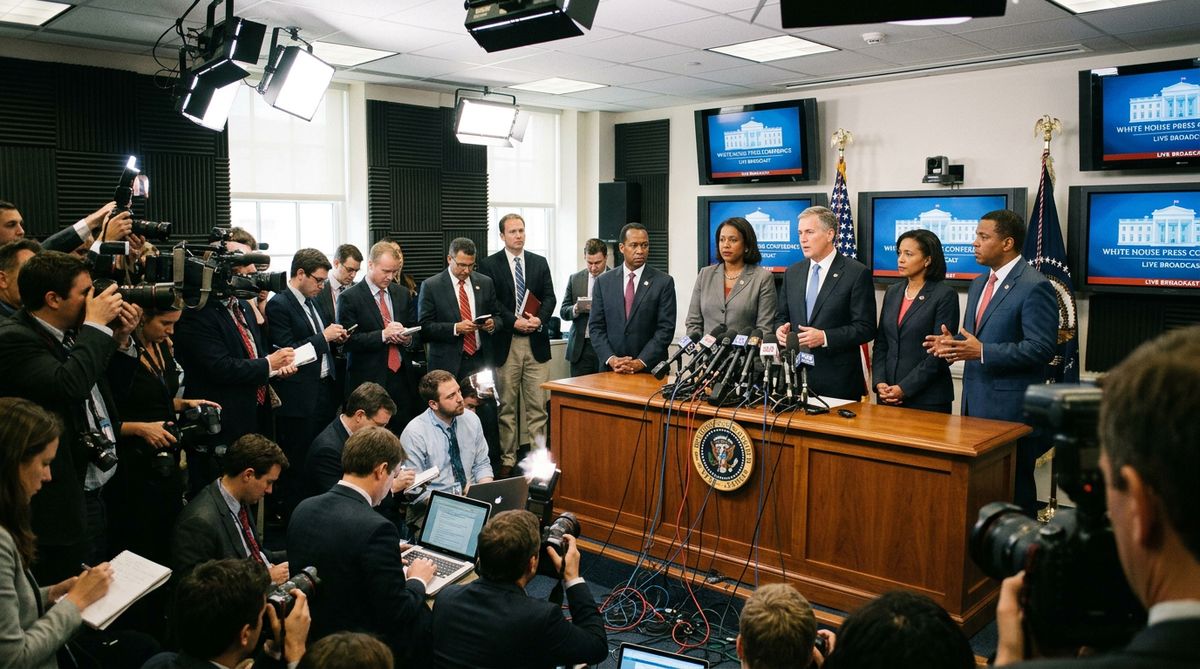
What Is the Presidency? Powers, Limits, and the Executive Branch
Article II of the Constitution created the executive branch and the office of President. Here is a plain-English guide to what presidential powerx-width:640px;margin:0;"> Article II of the Constitution created the executive branch and the office of President. Here is a plain-English guide to what presidential powers actually are, where they come from, and what constrains them.
The Constitutional Foundation
Article II of the Constitution vests “executive power” in a single President of the United States. This language is deliberately broad — the Founders debated extensively whether to have a single executive or a committee, ultimately choosing a unitary executive for speed and accountability. The President serves a four-year term, chosen through the Electoral College, and must be a natural-born citizen at least 35 years old who has lived in the US for at least 14 years.
The 22nd Amendment, ratified in 1951 following Franklin Roosevelt’s four terms, limits presidents to two full terms (or 10 years maximum if a president served more than two years of a predecessor’s term). Before that, the two-term tradition established by George Washington was convention rather than law.
The Constitution gives the President core duties: to “take Care that the Laws be faithfully executed,” to serve as Commander-in-Chief, to make treaties (with Senate approval), and to nominate federal officers and judges (with Senate confirmation).
Core Presidential Powers
Commander-in-Chief: The President directs all US military forces. This authority is sweeping in operational terms — the president can order troops deployed, direct military strategy, and authorize strikes without waiting for Congress. However, Congress alone has the power to declare war, and the 1973 War Powers Resolution requires notification within 48 hours of committing forces and limits unauthorized deployments to 60 days plus 30 days for withdrawal.
Executive orders: The President can issue legally binding directives to federal agencies and departments without an act of Congress. These have the force of law within the executive branch. They cannot override existing federal law or the Constitution, and they can be challenged in court. Any subsequent president can revoke them with a new order.
Veto power: The President can refuse to sign any bill passed by Congress. A vetoed bill returns to Congress, where it can be overridden only by a two-thirds majority vote in both chambers — a high bar that is rarely met. Presidents can also use a “pocket veto” by not signing a bill within 10 days when Congress is adjourned.
Pardon power: Article II grants the President the power to grant pardons for federal crimes. This power is nearly absolute — it cannot be overridden by Congress or reviewed by the courts. It covers only federal crimes, not state offenses. Notably, the pardon power cannot be used in cases of impeachment.
Presidential Powers: Enumerated vs. Implied
| Power | Source | Key Limit |
|---|---|---|
| Commander-in-Chief | Article II, Sec. 2 | War Powers Resolution (1973) |
| Veto | Article I, Sec. 7 | Two-thirds override by Congress |
| Pardon | Article II, Sec. 2 | Federal crimes only; not impeachment |
| Executive orders | Implied (Article II, Sec. 1 & 3) | Cannot override statute; reviewable by courts |
| Treaty-making | Article II, Sec. 2 | Requires two-thirds Senate approval |
| Appointments | Article II, Sec. 2 | Senate confirmation for principal officers |
Checks on Presidential Power
Congress
Controls the federal budget and can override vetoes. Can impeach and remove the president. Senate must confirm cabinet members, ambassadors, and federal judges. Can pass laws that override executive orders or restrict presidential discretion.
Federal Courts
Can strike down executive orders as unconstitutional or as exceeding statutory authority. Federal judges are appointed for life, insulating them from presidential pressure. The Supreme Court has ruled against presidents of both parties on executive power claims.
Frequently Asked Questions
What does Commander-in-Chief mean?
The Commander-in-Chief clause makes the President the supreme commander of all US Armed Forces. This gives direct authority over military operations and deployments. However, Congress holds the power to declare war, and the War Powers Resolution limits unauthorized deployments to 60 days. Presidents have disputed the Resolution’s constitutionality while largely complying with its notification requirements.
Can a president be removed before the term ends?
Yes, through impeachment: the House impeaches by simple majority; the Senate convicts and removes by two-thirds majority. Three presidents have been impeached (Johnson, Clinton, Trump twice) but none was removed. The 25th Amendment Section 4 also allows the Vice President and Cabinet to transfer power if the president is incapacitated, though this mechanism has never been invoked.
What limits exist on executive orders?
Executive orders cannot override acts of Congress or the Constitution. They can be struck down by federal courts. Any new president can revoke a predecessor’s executive orders immediately. Because of this fragility, major policy changes made only by executive order — rather than by legislation — are at risk of reversal with each change in administration.



We use cookies for analytics and functionality. Learn more