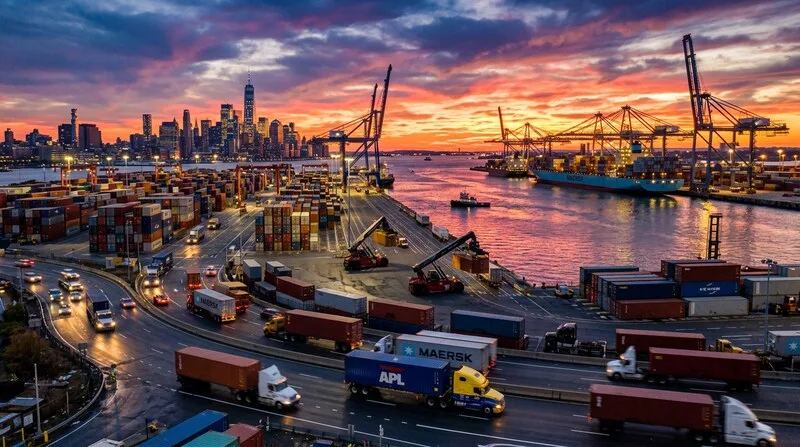
- The S&P 500 dropped 15% post-Liberation Day (April 2025), erasing ~$5 trillion in market capitalization — the largest tariff-driven market drop in modern US history
- Goldman Sachs raised recession probability to 45%; JPMorgan briefly placed odds above 60% before partial tariff pauses stabilized sentiment
- 68% of voters are concerned about a recession in the next 12 months — including 45% of Republican-leaning voters in manufacturing states worried the tariffs will cost jobs
- 72% of independents say the economy is on the wrong track — the swing voter verdict that historically predicts midterm seat losses for the president's party
- Consumer sentiment (U. of Michigan) fell from 74.0 in January 2025 to 57.9 by March 2026 — the lowest reading since the post-COVID inflation spike that drove 2022 Democratic losses
The Economic Shock and Its Political Fallout
The April 2025 "Liberation Day" tariff announcement — imposing across-the-board duties of 10% on most imports and targeted rates of 25-145% on Chinese goods — triggered the largest single-day stock market drop since the COVID-19 crash of March 2020. The S&P 500 fell 9.5% in a single session, with losses compounding over subsequent weeks to reach a peak drawdown of approximately 15%. For ordinary Americans watching their 401(k) balances shrink, the political message was immediate and visceral.
Goldman Sachs, JPMorgan, and the Federal Reserve Bank of New York all raised their recession probability estimates significantly through Q1 2026. Goldman's model reached 45%, while JPMorgan briefly placed odds above 60% before partial tariff pauses stabilized sentiment. Consumer confidence surveys — a leading indicator of spending and thus economic activity — showed steep declines. The University of Michigan's Consumer Sentiment Index fell from 74.0 in January 2025 to 57.9 by March 2026, the lowest reading since the post-COVID inflation spike.
For Republicans holding competitive House and Senate seats, the timing is politically perilous. Midterm elections are historically referenda on the sitting president's performance, and presidential economic approval is the single strongest predictor of seat losses. When voters feel economically anxious heading into an election, the president's party typically bears the cost — regardless of whether macroeconomic data actually confirm a recession.

Swing-State Voter Sentiment: Where It Hurts Most
The political damage from tariffs is unevenly distributed across the electoral map, and the geography is particularly inconvenient for Republicans. Manufacturing-heavy swing states — Pennsylvania, Michigan, Wisconsin, and Ohio — are precisely the states that will decide House and Senate control in 2026. These states import billions in intermediate goods subject to the new tariffs, from auto parts sourced in Ontario to specialty steel from South Korea.
Pennsylvania polling from February-March 2026 shows Trump\'s approval approval rating at just 38% statewide, down from 51% at his January 2025 inauguration. Among the critical "soft Republican" suburban voters in the Philadelphia collar counties — Bucks, Chester, Delaware, Montgomery — the drop has been even steeper, with economic disapproval reaching 61%. These voters supported Trump's agenda on immigration and energy but expected economic competence in return.
Agricultural communities present a different but equally painful dynamic. Soybean farmers in Iowa, corn growers in Indiana, and pork producers across the Midwest face retaliatory tariffs from China, the EU, and Canada on their exports. The 2018-2019 tariff impact cost American agriculture an estimated $27 billion in lost exports; early projections for the current escalation suggest damages could exceed that figure. Republican senators from farm states — many of whom privately opposed the tariffs — face a base that is more economically stressed than politically rebellious, but the distinction may matter less by November 2026.
Tariff Impact & Voter Sentiment by State
| State | Trump Econ. Approval | Change Since Jan 2025 | Recession Concern | Key Exposed Sector |
|---|---|---|---|---|
| Pennsylvania | 38% | -13 pts | 71% | Steel, Chemicals |
| Michigan | 36% | -15 pts | 74% | Auto Parts, Assembly |
| Wisconsin | 40% | -11 pts | 68% | Dairy, Manufacturing |
| Iowa | 42% | -9 pts | 66% | Soybeans, Pork Exports |
| Arizona | 41% | -10 pts | 69% | Semiconductors, Retail |
| Georgia | 39% | -12 pts | 70% | Logistics, Ports, Poultry |
Sources: State-level polls compiled March 2026; Goldman Sachs economic projections; USDA trade data.
The 2026 Electoral Calculus
Historical analysis of midterm elections shows a strong correlation between presidential economic approval and House seat losses. When a president's economic approval falls below 45%, his party tends to lose an average of 28 House seats — more than enough to flip the slim 4-seat Republican majority Democrats need to overcome. The current trajectory of Trump's economic approval suggests that ceiling could be crossed well before November 2026.
Republicans in D+5 or D+0 to R+5 districts are watching the economic numbers most closely. Representatives like Don Bacon (NE-02), Gabe Evans (CO-08), and Brian Fitzpatrick (PA-01) represent districts where college-educated voters who abandoned Trump on cultural grounds are now being joined by working-class voters worried about retirement accounts and layoffs. The coalition of economic anxiety is broader and harder to message around than any single cultural issue.
Democrats, for their part, face a messaging challenge: how to hold Republicans accountable for tariff-driven economic pain without appearing to root for a recession. The party's early 2026 strategy focuses on kitchen-table specifics — the price of imported goods, factory closures, 401(k) losses — rather than abstract macroeconomic arguments. Whether that messaging resonates will be tested in the special elections and party registration data coming out of the first half of 2026.
Voter economic anxiety driven by tariff uncertainty is the single biggest structural threat to Republican House and Senate majorities in 2026. With Trump's economic approval below 40% in Michigan and Pennsylvania — and 72% of independents saying the economy is on the wrong track — the conditions for a significant midterm wave are building. Whether a formal recession materializes before Election Day may be less important than whether voters feel one is coming.