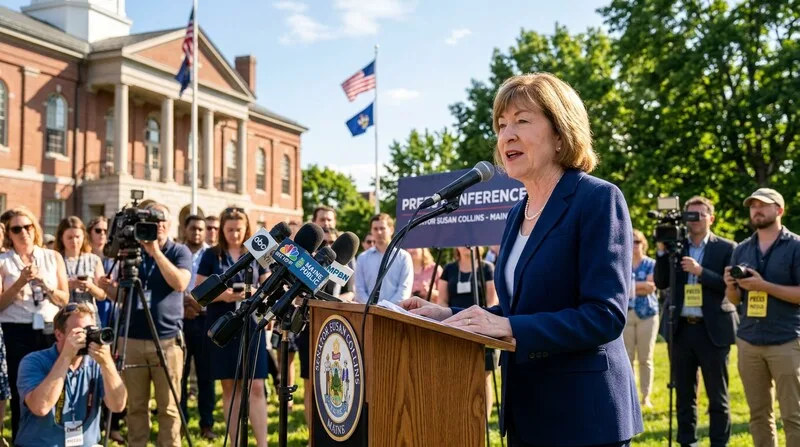
- Susan Collins (R-ME) won re-election to Maine's Senate seat in 2020 by 8.6 points — defying polls that showed her trailing Democrat Sara Gideon in one of the cycle's most watched races, becoming the most expensive Senate race in Maine history.
- Maine is D+6 at the presidential level — Biden won the state by 9 points while Collins won re-election, making her one of the most successful Republican ticket-splitters in the Senate with a 28-year career representing a blue-leaning state.
- Collins is one of the most centrist Republicans in the Senate — she voted to convict Trump in both impeachment trials and has broken with party leadership on healthcare, environmental, and election security issues, while still caucusing with Republicans.
- She chairs the Senate Appropriations Committee and is one of the Senate's most effective members at directing federal funding to Maine — a state that benefits substantially from defense contracts, healthcare research, and infrastructure funding that she helps secure.

Biography
Susan Margaret Collins was born on December 7, 1952, in Caribou, Maine, into a family with deep roots in Maine public life. Her father was a five-term mayor of Caribou and her mother served on the city council. She graduated from St. Lawrence University in 1975 and spent much of her early career in Washington as a congressional staffer, serving on the staff of Sen. William Cohen for twelve years. She also served as the Maine Commissioner of Professional and Financial Regulation under Governor John McKernan.
Collins was first elected to the Senate in 1996, defeating Democratic incumbent Joseph Brennan in a year that favored Republicans nationally. She has since won re-election in 2002, 2008, 2014, and 2020 — always in a state that trends Democratic at the presidential level. Her 2020 victory was particularly striking: she won by 8.6 percentage points while Joe Biden carried Maine by approximately 9 points, making her one of the most remarkable split-ticket performers in modern Senate history.
Collins has chaired or served as ranking member on several major Senate committees, including the Appropriations Committee, the Special Committee on Aging, and the Homeland Security and Governmental Affairs Committee. Her longevity on Appropriations has made her a powerful advocate for Maine federal funding — a practical brand of constituent service that transcends partisan politics in the state.
At age 71, she is the longest-serving female senator in American history, surpassing the record previously held by Barbara Mikulski of Maryland. Her tenure spans six presidents and represents a continuity of moderate Republicanism increasingly rare in the modern GOP.
Collins vs. Her Party: Key Votes Where She Broke Ranks
Susan Collins' brand is built on a record of departures from the Republican majority on high-profile votes. These are not random — they form a consistent pattern of protecting Maine-specific priorities (healthcare, bipartisan infrastructure), constitutional concerns (impeachment), and moderate social positions. Each break carries political cost; collectively, they explain why she wins D+7 Maine by double digits.
| Vote | Year | Collins Vote | GOP Majority | Outcome & Significance |
|---|---|---|---|---|
| ACA repeal ("skinny repeal") | 2017 | No | Yes (mostly) | Bill failed 49-51; Collins, Murkowski, McCain the deciding No votes |
| Brett Kavanaugh confirmation | 2018 | Yes | Yes | Confirmed 50-48; Collins' floor speech seen as decisive; drew intense Democratic backlash in Maine |
| First Trump impeachment (conviction) | 2020 | No | No | Acquitted; Collins said Trump had "learned his lesson" — widely mocked after Jan. 6 |
| Second Trump impeachment (conviction) | 2021 | Yes | No | One of 7 Republicans to vote guilty; 57-43 short of 67 needed |
| Infrastructure Investment & Jobs Act | 2021 | Yes | No (most) | Passed 69-30; Collins co-led bipartisan negotiating group |
| Bipartisan Safer Communities Act | 2022 | Yes | No (most) | First major federal gun legislation in 30 years; Collins co-sponsored |
| Electoral Count Reform Act | 2022 | Yes | Split | Passed 68-29; Collins chief Senate author; reformed ambiguous 1887 law |
Key Policy Positions & Votes
Healthcare
Collins was one of three Republicans whose votes defeated the 2017 ACA repeal effort, a decision that defined her moderate brand during the Trump era. She has consistently opposed full Medicaid rollbacks and supported the Children's Health Insurance Program reauthorization. Her healthcare position remains one of her clearest departures from the national GOP.
Bipartisan Governance
Collins co-led the bipartisan group that negotiated the 2021 Infrastructure Investment and Jobs Act, securing her vote for one of Biden's signature achievements. She also co-sponsored the Bipartisan Safer Communities Act on gun polling in 2022 and the Electoral Count Reform Act. These high-profile bipartisan efforts are central to her Senate identity and Maine brand.
Trump & Accountability
Collins voted to convict Donald Trump in his second impeachment trial following the January 6, 2021 Capitol attack, one of seven Senate Republicans to do so. She has criticized aspects of Trump's conduct while generally supporting Republican legislative priorities. Her Kavanaugh confirmation vote in 2018 drew significant backlash from Maine Democrats and national liberal donors.
2026 Senate Race
Maine has a D+7 presidential lean, making it structurally challenging for any Republican. Yet Collins has consistently defied that structural disadvantage through extraordinary crossover appeal. Her 2020 performance — winning by 8.6 points while Biden carried the state by 9 — demonstrated a roughly 17-point gap between her vote share and the presidential vote. No senator in either party matches that level of personal brand strength relative to their state's partisan baseline.
Her 2026 path depends on maintaining that crossover coalition: moderate and independent Maine voters who split their tickets, rural voters who trust her constituent service record, and college-educated voters in Portland and Bangor who may vote Republican for Collins but Democratic at the presidential level. The Appropriations Committee chairmanship she has held gives her tangible federal funding wins to campaign on.
The key risk factors are a strong, well-funded Democratic challenger and a nationalized election environment that makes ticket-splitting harder. Rep. Jared Golden, a moderate Democrat who himself votes across party lines, has been mentioned as a potential candidate whose profile could compete in the crossover space Collins has traditionally owned. As of early 2026, no major Democratic challenger has announced, leaving Collins as a clear favorite but not invulnerable.
Frequently Asked Questions
Who is Susan Collins?
Susan Collins is Maine's senior senator, first elected in 1996 and the longest-serving female senator in American history. She has built a reputation as one of the most prominent moderate Republicans in the Senate and has repeatedly won re-election in a state that votes Democratic for president. She faces re-election in November 2026.
Is Susan Collins vulnerable in 2026?
Collins faces a competitive environment structurally — Maine leans D+7 at the presidential level — but her exceptional crossover appeal makes her a strong favorite. She won by 8.6 points in 2020 while Biden carried Maine by 9 points, one of the most remarkable split-ticket performances in modern Senate history. A strong Democratic challenger could make it competitive.
What is Susan Collins known for?
Collins is known for her moderate, independent brand — opposing the 2017 ACA repeal, supporting the bipartisan infrastructure law, co-sponsoring gun polling legislation, and voting to convict Trump in his second impeachment. Her Appropriations Committee work securing federal funding for Maine is also central to her political identity.