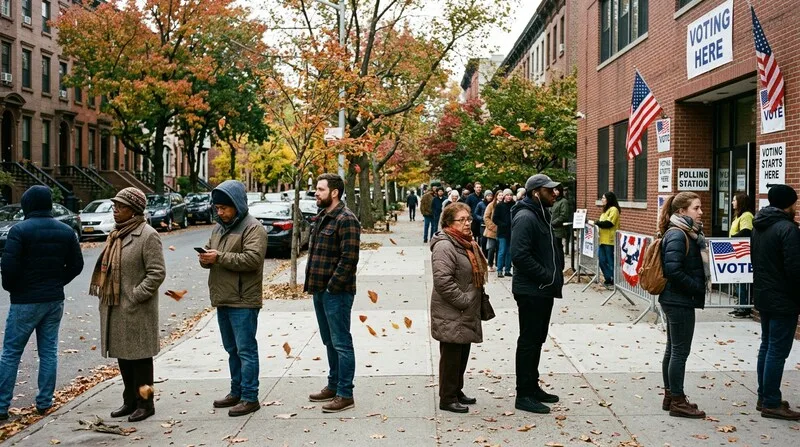
- Black turnout: 66% (2020) → 55% (2022) → below 2020 in 2024 — the 11-point presidential-to-midterm drop is the core Democratic math challenge in key states
- Trump received ~15% of Black male vote in 2024, up from ~8% in 2020 — most pronounced among non-college young Black men; driven by economic anxiety and cultural messaging
- Three critical states: Georgia (Ossoff needs 90%+ Black vote + high turnout), Michigan (Slotkin won by 1.9pts — Wayne County essential), Pennsylvania (Philadelphia margin defines every statewide race)
- Warnock 2022 runoff is the model: Black church networks + iconic candidate + enormous org investment → elevated midterm turnout; replicating it requires the same scale of resources
The Turnout Baseline: 2020 vs. 2022 vs. 2024
Black voters turnout reached a modern high of approximately 66% in the 2020 presidential election, driven by intense mobilization against Trump, enthusiasm for the first Black woman on a major party presidential ticket, and record early voting infrastructure investment by national Democrats and Black-led organizing groups. The energy was unmistakable: the Black Voters Matter Fund, Color of Change, and dozens of local and national organizations ran coordinated campaigns that substantially increased Black voter registration and turnout in Georgia, Michigan, Wisconsin, Pennsylvania, and Arizona.
By 2022, with Biden in the White House and the acute anti-Trump mobilization factor removed, Black turnout fell to approximately 55% nationally. This represented a return toward historical midterm baselines, but the drop was steeper than Democrats needed in several competitive Senate and governor's races. Georgia proved to be the exception: Raphael Warnock's runoff victory in December 2022 demonstrated that Black voters mobilization could be sustained in a specific high-stakes race with an iconic candidate who had strong local roots. The Warnock case is the model Democrats point to as evidence that Black turnout can be elevated in non-presidential cycles — but the organizational investment required was enormous, and Warnock is a uniquely compelling figure in Georgia's Black church and community networks.
In 2024, the picture complicated further. National Black voters turnout remained below 2020 levels. More significantly, exit poll data showed the share of Black voters voting Republican — particularly Black men — reached levels not seen since the 1960s by some measures. Trump's 15% of the Black male vote nationally, and his substantially higher share among Black men under 45 without college degrees, reflected a genuine and multifactorial shift in the coalition that Democrats could not dismiss as noise.

Black Voter Share and Turnout: 2020 vs. 2022 vs. 2024 by State
| State | Black Share of Electorate | 2020 Turnout (est.) | 2022 Turnout (est.) | 2024 D Black Vote Share | Strategic Importance |
|---|---|---|---|---|---|
| Georgia | 29% | 68% | 62% | 91% | Ossoff re-election; Stacey Abrams org |
| Michigan | 14% | 65% | 52% | 88% | Wayne County anchor for Slotkin |
| Pennsylvania | 11% | 64% | 53% | 89% | Philadelphia margins for Senate race |
| North Carolina | 22% | 63% | 51% | 90% | Tillis vulnerability; D flip target |
| Wisconsin | 6% | 60% | 49% | 90% | Milwaukee County for Johnson challenger |
| Arizona | 5% | 58% | 46% | 85% | Smaller but critical in close races |
Turnout figures are estimates from Census CPS surveys and state-level analysis. Black share of electorate figures reflect likely voter composition in competitive cycles. 2024 Democratic Black vote share from national exit polls; state-level exit poll samples have larger margins of error. Georgia's 2022 turnout remained elevated relative to other states due to the Warnock runoff mobilization.
Three Strategic Challenges for Democrats
The Gen Z Black Male Question
The demographic showing the largest swing toward Trump in 2024 was young Black men — those between roughly 18 and 35 without four-year college degrees. Podcast appearances, social media influencer endorsements, and anti-establishment messaging connected with a generation of Black men who feel economically left behind and culturally alienated from what they perceive as a Democratic Party preoccupied with identity politics rather than economic opportunity. Democrats cannot simply dismiss this shift as a media narrative; it showed up in enough geographic clusters — Philadelphia, Detroit, Milwaukee, Atlanta — to affect real margins. Reversing it requires authentic economic messaging and visibility in Black male media ecosystems, not top-down campaign advertising. The challenge is that neither of those things can be faked or accelerated in a single cycle.
Medicaid and Social Security as Mobilizing Issues
Medicaid covers approximately 22% of Black Americans, a substantially higher rate than the general population, because Black households are overrepresented among lower-income Americans who qualify under current eligibility thresholds. Republican budget proposals to cut Medicaid by hundreds of billions of dollars are, in demographic terms, proposals that disproportionately affect the Black community. Democrats' strategic bet for 2026 is that making Medicaid cuts concrete and personal — "your family's coverage" rather than an abstract budget line — can mobilize Black voters who did not turn out in 2022. The same logic applies to Social Security: Black Americans rely on Social Security at higher-than-average rates as a proportion of retirement income. Both issues provide material for an economic mobilization argument that does not depend on identity politics framing.
Black-Led Organizing Infrastructure
Georgia demonstrated in 2020 and 2022 that Black-led organizing infrastructure — Stacey Abrams' New Georgia Project, the Black Voters Matter Fund, and dozens of local organizations — can produce Black turnout rates in a non-presidential cycle that approach presidential-year levels. This infrastructure exists in Georgia more robustly than anywhere else, which is part of why Georgia's 2022 Black turnout exceeded that of other states. Building comparable infrastructure in Michigan, Pennsylvania, and North Carolina is a multi-year investment that Democrats began in 2023 and are expanding. The question is whether the investment is sufficient by November 2026, and whether the anti-Trump policy environment — Medicaid cuts, DOGE, tariff-driven economic anxiety — provides the motivating urgency that the Warnock runoff had in Georgia.
Georgia: The Ossoff Imperative
Jon Ossoff won his Georgia Senate seat in January 2021 with 50.6% of the vote in a runoff that was notable for extraordinarily high Black voters turnout in Fulton, DeKalb, Cobb, and Gwinnett counties. His path to re-election in 2026 runs through the same geography. Georgia has moved from a D+0 lean to approximately R+3 since 2020, driven by continued population growth in exurban Republican areas and modest Republican gains among suburban Hispanics and working-class Black men. To win statewide in that environment, Ossoff needs near-unanimous support from Georgia's Black voters, who make up approximately 29% of the electorate, and he needs them to turn out at rates approaching 2020 or the 2022 runoff — not 2022 general election levels.
Ossoff has maintained a high local profile since his 2021 win, investing heavily in constituent services, holding high-visibility oversight hearings that generate local media coverage, and maintaining relationships with Black church networks and community organizations throughout Atlanta and south Georgia. His campaign for re-election is expected to begin full operation in mid-2025 with an explicit Black voters mobilization strategy as its organizational foundation. The Republican nominee will almost certainly run aggressive advertising in Atlanta's Black media attempting to replicate Trump's 2024 gains with Black men — a strategy that could depress Ossoff's share if not countered effectively.