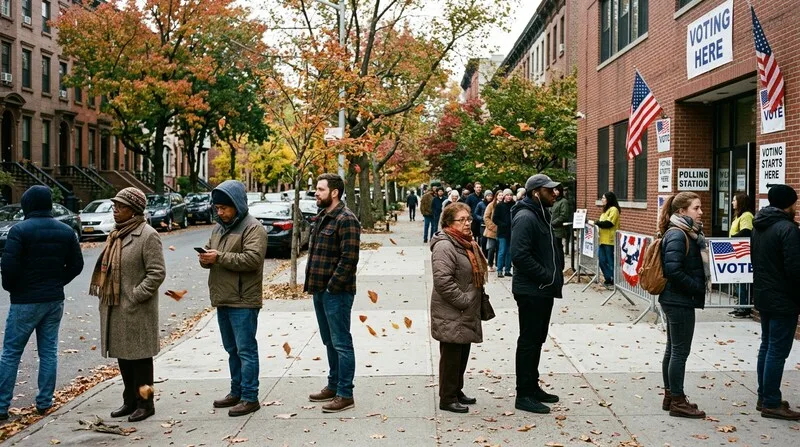
Whether Democrats win or lose the House and Senate in 2026 will depend almost entirely on turnout — specifically whether the party can replicate the extraordinary 2018 wave mobilization or whether 2026 resembles the more modest 2022 cycle. The difference between those two cycles was roughly 6 million Democratic votes and 32 House seats.
- Voter file scores (0-100 scale) are built from voting history — the single highest-predictive variable — plus age, registration date, neighborhood partisan lean, and consumer data; high-propensity (70+) voters need minimal mobilization investment, while low-propensity (below 40) voters receive intensive field attention
- 2018 wave benchmark: 49M Democratic votes, +41 House seats, D+8.6pt national — nearly every 40-60 propensity voter turned out; 2022 was more selective, driven by Dobbs-energized suburban voters while other low-propensity groups underperformed
- 2026 models project +4-7% Democratic turnout above 2022 baselines in the top 50 competitive House districts, driven by DOGE opposition, economic anxiety, and Medicaid defense
- Democratic models have historically underestimated Republican rural turnout — a systematic bias the party has actively tried to correct in its modeling methodology since 2020
How Turnout Models Are Built
Democratic voter file models maintained by the DCCC, DSCC, and affiliated data firms score every registered voter in the United States on a predicted likelihood to vote — typically on a 0-100 scale. The score integrates voting history (the single highest-predictive variable), age, registration date, neighborhood partisan lean, and consumer data correlates. A voter who participated in the last four elections has a high propensity score; a recently registered 22-year-old has a low one. Campaign resource allocation flows from these scores: high-propensity voters need minimal mobilization investment, while low-propensity voters — the "unreliable but Democratic" universe — are where ground operations focus their time and money.
The central modeling challenge in 2026, as in every midterm, is estimating what will move voters in the 40-60 propensity range. In 2018, virtually the entire 40-60 range turned out, producing the wave. In 2022, it was more selective: the Dobbs decision drove college-educated suburban voters above historical expectations while other lower-propensity groups underperformed. DOGE, economy as an issue, and Medicaid threats are the 2026 equivalents — and current models show them registering strongly in those middle-band voters in suburban congressional districts.

2018 vs. 2022 vs. 2026 Projections
| Cycle | D House Vote (M) | D Margin | Net D Seats | Key Turnout Driver |
|---|---|---|---|---|
| 2014 | 35.6M | -5.7pt | -13 | Low enthusiasm, no major event |
| 2018 | 50.9M | +8.6pt | +41 | Anti-Trump first term, ACA |
| 2022 | 44.8M | +2.8pt | -9 | Dobbs — suburban women lifted |
| 2026 (projected) | 47-52M (est.) | +4 to +7pt (est.) | +5 to +20 (range) | DOGE, Medicaid, cost of living |
Where 2026 Mobilization Is Focused
Democratic field organizations are deploying resources based on three priority universes in 2026. First, low-propensity Black voters in Atlanta, Philadelphia, Detroit, Milwaukee, and Charlotte — the same communities where 2024 turnout dropped relative to 2020 and where Senate races are on the line. Second, younger voters (18-35) in suburban congressional districts, particularly in California, New York, and Pennsylvania, where DOGE cuts to student loan programs and federal agencies have generated measurable anger. Third, college-educated suburban voters who drove the 2022 Dobbs-era overperformance and who, according to multiple state-level polls, are showing high interest in 2026 at levels comparable to 2018.
The model risk is the same as every cycle: Democratic models have historically underestimated Republican rural turnout. The systematic error has been partially corrected after 2020, but Republican MAGA infrastructure — particularly in rural Pennsylvania, Wisconsin, Michigan, and North Carolina — has been strengthened since 2022. Even in a Democratic wave scenario, Republican rural bank accounts of votes in those states may keep multiple Senate races closer than generic ballot numbers suggest. The 2026 outcome will likely be determined by which side's models are more accurate in the 8-12 most competitive Senate and 20-30 most swing districts.
The Early Vote and Mail Ballot Factor
One underappreciated dimension of the 2026 turnout equation is early vote and mail ballot infrastructure. Democratic campaigns have invested heavily in early vote programs since 2020, and states like Georgia, Pennsylvania, and Michigan have expanded vote-by-mail access in ways that permanently changed turnout models. Early Democratic voters are particularly high-propensity in Democratic models — when a voter requests a mail ballot and returns it, that is a confirmed vote that can be removed from the mobilization universe and resources redirected to lower-propensity voters. Republican legal challenges to mail ballot expansion have rolled back some access in certain states, but the structural shift toward early voting has been durable enough that it now represents 40-50% of all ballots cast in competitive Senate states.
The implication for 2026 models is that the final-week turnout surge that historically characterized high-enthusiasm Democratic cycles is somewhat less predictive than it once was. A significant portion of the Democratic vote will already be banked by late October, giving campaigns clearer visibility into their position before Election Day. If Democratic early vote registrations and returns are running 15-20% above 2022 levels by late October — a threshold that would be consistent with the current enthusiasm indicators — the 2018 scenario becomes the more likely reference point for final outcomes.
Current Q1 2026 indicators — small-dollar donation volume, volunteer sign-up rates, and special election performance — all track closer to the 2017-2018 pre-wave pattern than to the more modest 2021-2022 pattern. If those leading indicators are correct, Democrats are on track for a turnout environment that gives them a realistic path to House control. But models are not destiny: Republican rural turnout infrastructure has improved since 2018, and the geographic sorting of the electorate means Democrats need to translate enthusiasm into votes in specific competitive districts, not just nationally. Watch the September generic ballot numbers: a sustained D+6 or better is historically consistent with a wave; D+3 to D+5 produces a close but competitive environment.