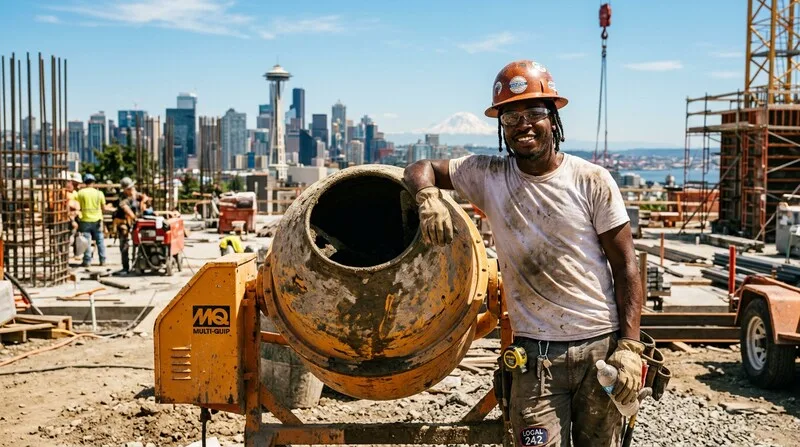
- Union households gave Democrats just 55% of their vote in 2024, down from 64% in 2020 — the lowest level of union Democratic support recorded in modern exit polling history.
- With 14 million union members and roughly 26 million union households total, even a 9-point swing toward Republicans represents a major shift in Rust Belt electoral math.
- The AFL-CIO spent $100 million on the 2024 cycle — yet the realignment of white male union workers continued, particularly in manufacturing-heavy districts in Michigan, Pennsylvania, and Wisconsin.
- Reagan won 44% of union households in 1984 — Trump's 2024 share approaches or exceeds that historic high, marking the completion of a 40-year political realignment.
- The split is largely demographic: Black and Latino union members remain strongly Democratic; white male union members without college degrees drive the rightward shift toward Republican economic nationalism.
The Long Decline: Union Political Alignment Since 1972
Union households supported Democrats at 70%+ through the 1970s and 1980s in presidential elections. The decline began gradually in the 1980s with the Reagan realignment (Reagan won 44% of union households in 1984) and has been episodic since — some Democratic candidates (Obama in 2008) partially reversed the trend while others (Clinton in 2016) accelerated it. The 2024 result of 55% marks the lowest level of union worker shift Democratic support in exit polling history. This matters disproportionately in Great Lakes battleground states (Michigan, Wisconsin, Pennsylvania) where union membership remains concentrated and the presidential margins are decided by small voter movement.
Union Household Vote by Sector — 2020 vs. 2024
Trump's UAW and Manufacturing Strategy
Trump's outreach to autoworkers was strategic and sustained. His core message combined several elements: that his 2018 steel and aluminum tariffs saved manufacturing jobs, that Biden's EV transition mandates would eliminate UAW jobs (a specific and credible fear given the different labor requirements for EV vs. ICE vehicle production), and a broader populist frame that Democratic elites had abandoned working people. The UAW's endorsement of Harris after a hard-fought negotiation with Biden over EV credits was seen as a union leadership decision that did not fully reflect the rank-and-file's political disposition. Exit data from Michigan showed Trump winning a significant share of union worker shift voters in counties with heavy automotive employment.
SEIU's Defensive Strength in Purple States
While manufacturing union members shifted toward Republicans, SEIU's healthcare and home care workers remained among the most reliably Democratic labor blocs. SEIU's 2 million members are concentrated in exactly the states where Democratic candidates most need ground support: California, New York, Illinois, and competitive states like Pennsylvania, Michigan, Nevada, and Arizona. SEIU's political program — 2 million conversations in the 2024 cycle — is credited by Democratic strategists with preventing even larger losses among working-class voters. In Nevada, the culinary union (UNITE HERE, SEIU-adjacent) is widely regarded as essential infrastructure for any competitive Democratic race.
2026 Labor Strategy: Messaging and Mobilization
Democratic strategists and labor unions are developing 2026 messaging strategies that directly address the 2024 defection. The core challenge: manufacturing workers who shifted toward Trump were responding to concrete policy concerns about trade and EV mandates, not abstract cultural messaging. A recapture strategy requires tangible policy responses (specific legislation protecting manufacturing jobs, trade policy that doesn't threaten existing union contracts) rather than identity-based appeals. The AFL-CIO's political department has commissioned extensive polling showing that "Build Back Better"-style economic arguments resonate more with manufacturing workers than immigration restriction or law enforcement messaging — but connecting those arguments to specific Democratic candidates remains the organizational challenge.

Frequently Asked Questions
How many Americans belong to unions and what sectors have the most members?
According to 2024 Bureau of Labor Statistics data, approximately 14 million workers (10.5% of employed workers) belong to unions. The largest sectors by union membership are government/public sector workers (approximately 6 million), manufacturing and trades (approximately 3.5 million), healthcare and social assistance (approximately 1.5 million), and transportation and utilities (approximately 1.2 million). Union membership has declined from approximately 35% of the workforce in the 1950s to current levels due to deindustrialization, right-to-work laws in 27 states, and aggressive anti-union employer strategies.
Does union membership still predict Democratic voting in 2026?
Union membership remains a significant but weakening Democratic predictor. The gap between union and non-union workers of similar demographics has shrunk from approximately 20 points in the 1990s to approximately 10-12 points in 2024. Union households still vote Democratic at higher rates than demographically comparable non-union workers, but the "union premium" for Democrats has declined substantially. In competitive Senate and House races in Pennsylvania, Michigan, and Wisconsin, candidates who can run close to 55-58% among union households while holding the professional suburban vote have a viable path to victory.
What is the political significance of the recent Amazon, Apple, and Starbucks unionization efforts?
The wave of organizing at Amazon warehouses, Apple stores, and Starbucks locations (2021-2023) represents a new front in the labor movement among service and logistics workers who are predominantly young, racially diverse, and heavily urban. These workers are demographically quite different from the aging white manufacturing union members who have been shifting Republican. If these organizing efforts succeed and build durable unions, they could expand the union electorate in a direction that is more naturally Democratic — younger, more diverse, more urban. However, these organizing efforts have faced significant employer resistance and their long-term stability is uncertain.