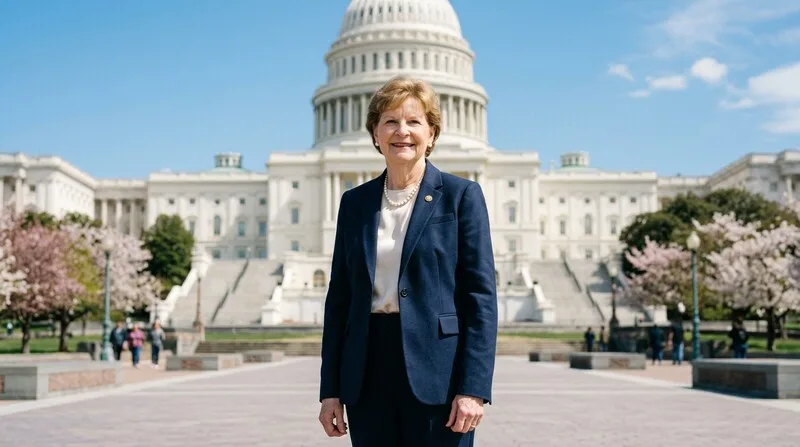
- Jeanne Shaheen (D-NH) is a three-term New Hampshire senator who announced her retirement in 2024 after serving since 2009 — the first woman elected both governor and senator from the same state.
- She was Governor of New Hampshire (1997-2003) before winning her Senate seat, giving her one of the most complete political resumes of any current senator — executive and legislative experience in a key swing state.
- New Hampshire is a genuine battleground — Shaheen won her 2020 re-election by just 3.7 points in a state with a strong libertarian streak and the largest proportion of independent voters of any state.
- Shaheen's retirement opened an open Senate race in 2024 that Democrat Maggie Goodlander won by 1.2 points over Republican Kelly Ayotte — one of the closest Senate races of the 2024 cycle.
Biography
Cynthia Jeanne Shaheen was born on January 28, 1947, in Saint Charles, Missouri, but spent most of her adult life in New Hampshire. She graduated from Shippensburg University of Pennsylvania in 1969 with a degree in English, and earned a master’s degree in political science from the University of Mississippi in 1973. She moved to New Hampshire and became involved in Democratic politics, working on Gary Hart’s 1984 presidential campaign and Jimmy Carter’s 1980 campaign, among others. She was elected to the New Hampshire State Senate in 1990 and served until running for governor.
Shaheen was elected Governor of New Hampshire in 1996, 1998, and 2000, serving three terms — the maximum allowed under state law. Her governorship was notable for economy polling during the technology boom of the late 1990s, education reform, and the creation of the state’s first-ever kindergarten program. She ran for Senate in 2002 but lost to Republican John Sununu by 4 points. She ran for Senate again in 2008, defeating incumbent Sununu 52-45 — one of the Democratic pickups that gave the party its 60-seat supermajority. She won reelection in 2014 and 2020 by comfortable margins.
Her announcement that she will not seek a fourth Senate term in 2026 was not unexpected given her age — she will be 79 during the campaign — and her decision to leave on her own terms rather than risk losing or serving in diminished capacity. Her Senate career is distinguished primarily by longevity, pragmatism, and foreign policy work, rather than major landmark legislation.
Policy Record
Foreign Policy & Armed Services
Shaheen served on both the Foreign Relations Committee and the Armed Services Committee, an unusual dual assignment that gave her a comprehensive platform on national security issues. She was a consistent supporter of NATO and transatlantic alliances, advocated for Ukraine aid, and opposed Russian aggression in Ukraine. She supported the Iran nuclear deal (JCPOA) and advocated for diplomatic engagement. Her foreign policy record is internationalist and moderately hawkish, distinguishing her from the more isolationist or progressive wings of the Democratic caucus.
Energy & Environment
New Hampshire’s geography and economy have shaped Shaheen’s energy positions. She supported the Inflation Reduction Act’s clean energy investments and has advocated for energy efficiency, renewable energy development, and addressing climate polling. However, she has been more moderate than many Senate Democrats on energy transition timelines, reflecting New England’s reliance on existing power sources and the economic constraints of rural New Hampshire. She has consistently supported the Low Income Home Energy Assistance Program (LIHEAP), critical to New Hampshire winters.
Healthcare & Small Business
Shaheen voted for the Affordable Care Act and has consistently supported its protections, including coverage for pre-existing conditions. She has been an advocate for rural healthcare polling — particularly relevant in New Hampshire where rural hospitals and community health centers serve significant populations far from urban centers. Her small business advocacy reflects New Hampshire’s economy, which is dominated by small and medium enterprises. She served on the Small Business Committee and has worked on SBA loan access, procurement opportunities, and regulatory relief for small businesses.
The Open Seat: New Hampshire 2026
New Hampshire’s open Senate majority in 2026 is one of the highest-profile open contests in the cycle. New Hampshire is genuinely competitive: it has voted Democratic in every presidential election since 2000, but its large independent voters population and libertarian-leaning political culture make statewide results unpredictable. The First Primary in the Nation gives the state outsized political attention every four years; the 2026 Senate race gives it high midterm relevance.
Potential Democratic candidates for the seat include Governor Chris Sununu’s successor (Governor-elect Kelly Ayotte, a Republican, won in 2024, complicating the D picture), former Senator Kelly Ayotte now governor, and various Democratic figures. Potential Republican candidates include various state-level figures. The race is rated Toss-up to Lean Democratic in early 2026 ratings, making it one of the genuine two-way swing opportunities in the Senate majority.
| Metric | Value |
|---|---|
| 2024 Presidential (NH) | D+6 (Harris 52%, Trump 46%) |
| 2024 Governor | R (Kelly Ayotte won) |
| 2022 Senate (Hassan re-elect) | D+2.3 (Hassan 54%, Bolduc 44%) |
| 2026 Rating | Toss-up to Lean D |
| Primary type | NH: open primary (independents vote in either party) |